Stock Market for Beginners: How Indian Markets Actually Work
Stock market for beginners in India explained clearly. Learn how NSE and BSE work, key terms, how to open an account, and common mistakes to avoid.
If you've opened a trading app, watched a familiar company's price flicker, and wondered what happens when you tap Buy, you're already asking the right question. The stock market for beginners is less about guessing prices and more about understanding a marketplace, where ownership, risk, costs, and behaviour all matter.
For most first-time Indian investors, the hard part isn't finding a stock. It's learning how the market works well enough to avoid turning a simple start into an expensive mistake.
Table of Contents
- What Happens When You Buy Your First Share
- How Indian Stock Exchanges and Indices Work
- Investing Versus Trading and the Costs Involved
- Opening a Demat and Trading Account in India
- Index Funds Versus Single Stocks for Small Portfolios
- Common Beginner Mistakes and How to Avoid Them
- Your First 90 Days in the Indian Stock Market
What Happens When You Buy Your First Share
You're on a phone, maybe in a crowded train or after dinner, and you search for a well-known Indian company. The app shows a live price, you tap Buy, and within moments the order is sent out of sight. What looks like a tiny screen action is a market transaction, and it starts with an order reaching another participant who's willing to sell.
A share is partial ownership in a publicly traded company, not a coupon, not a ticket, and not a promise from the app maker. The price changes because buyers and sellers keep adjusting their offers, and the market settles where supply and demand meet, not where the company itself wants it to be TD on how stock prices move.
Practical rule: if you understand that a share is ownership, you'll stop treating every price tick like a mystery and start reading it like a market conversation.
That's why the price can shift many times during the day. New buyers arrive, some sellers become more urgent, and both sides react to news, sentiment, and expectations. The company's business matters, of course, but the price on your screen is still set by market participants trading with each other.
For a beginner, the mental model should be simple. You aren't sending money into a black box. You're entering a marketplace where someone else is willing to take the opposite side of your trade, and the match happens through an exchange.
This is for informational and educational purposes only and not investment advice. Consult a SEBI-registered adviser before investing.
How Indian Stock Exchanges and Indices Work
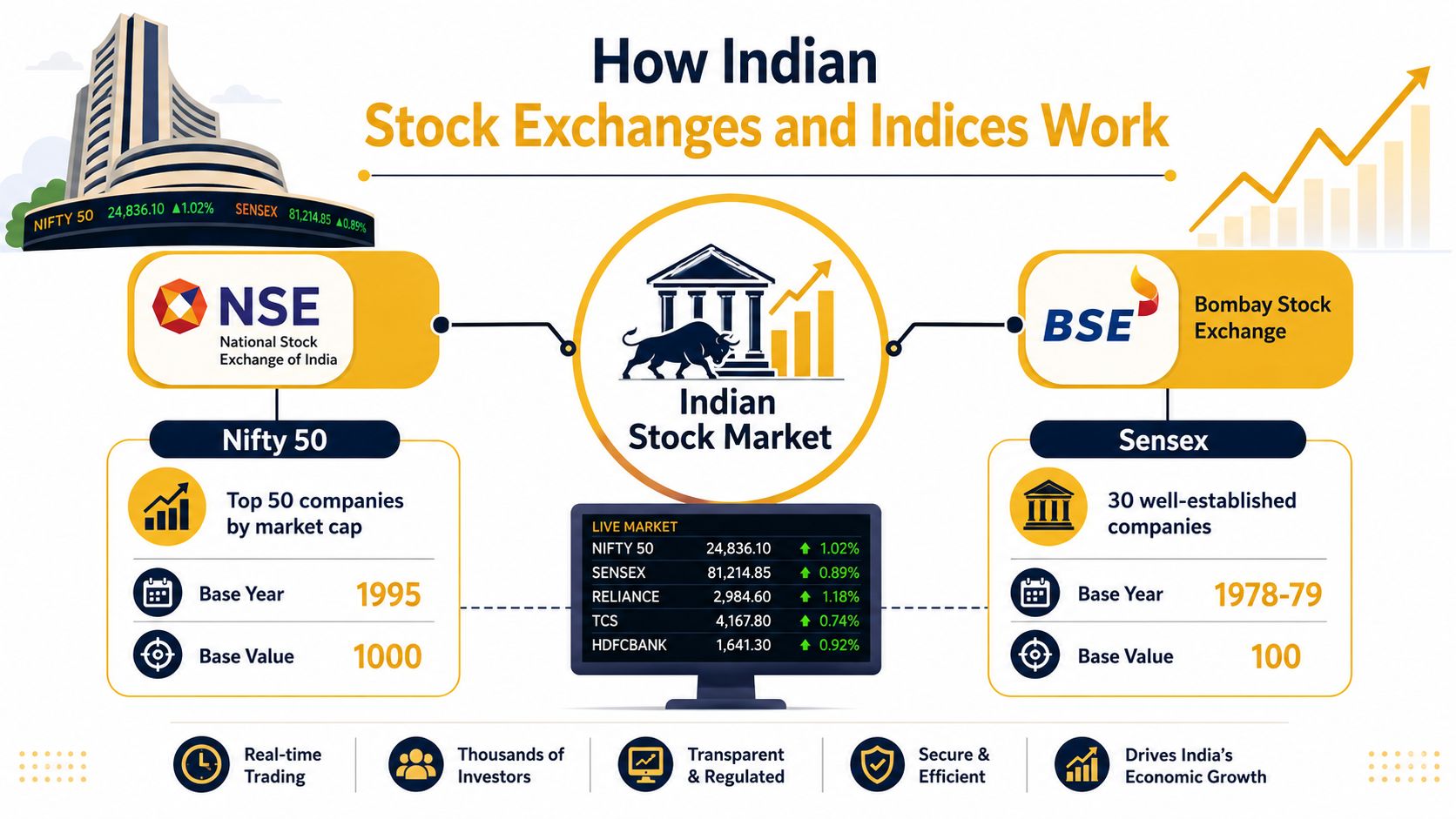
India's listed equity market runs through two recognised exchanges, the NSE and the BSE, and that matters because a normal market purchase is made from another investor on an exchange, not directly from the company. There's also a separate primary market for new issues such as IPOs, where companies raise fresh capital for the first time Investopedia on primary and secondary markets.
Why the exchange structure matters
The Bombay Stock Exchange is the older venue, dating back to 1875, while the National Stock Exchange was incorporated in 1992 and began operations in 1994. The NSE's benchmark NIFTY 50 was launched in 1996 Britannica on Indian stock market basics. That history matters because many beginners first learn the market through indices, not through one stock at a time.
An index is a summary number that tracks a basket of stocks. It helps you see whether large parts of the market are moving together or not. The NIFTY 50 gives a diversified snapshot of large Indian companies across sectors, which is why it's often the first reference point on a live market panel.
Quick read: exchanges are the marketplaces, and indices are the scoreboards.
That simple distinction helps when you're scanning an app and seeing NSE, BSE, NIFTY 50, and SENSEX in the same place. The exchanges are where trading happens. The indices are how you understand the broad movement.
For a live view of how the major benchmarks are presented, Bharatstox's NIFTY 50 live analysis is a useful example of how market data gets turned into readable context.
Investing Versus Trading and the Costs Involved
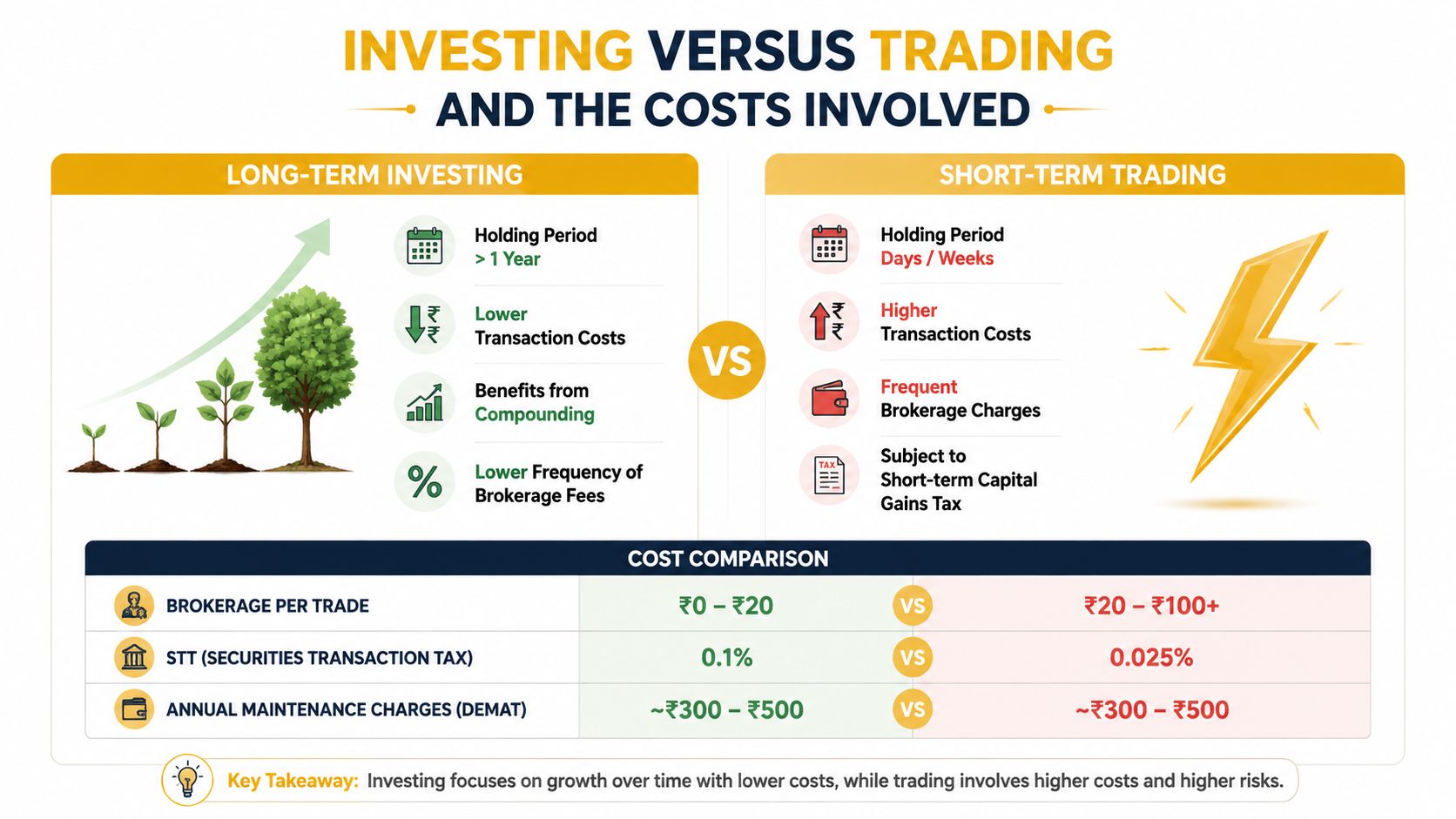
A beginner opening a brokerage app in India often treats investing and trading as the same activity. They are different habits. Investing usually means holding a share for the long term and letting the business compound, while trading means trying to profit from shorter price moves. For a plain-English overview of how the market is discussed, see Fool on stock market basics.
The hidden cost of being active
For Indian investors, the cost difference becomes visible quickly in a small portfolio. Every trade can carry brokerage, Securities Transaction Tax, exchange charges, stamp duty, and GST. None of these charges feels dramatic on its own, but together they can take a noticeable slice out of a modest account, especially if you keep buying and selling in small amounts.
That is why frequent activity works like friction. A bicycle can keep moving, but if the chain is constantly rubbing, more effort goes into motion and less into speed. In the market, each extra trade adds another layer of cost before any profit is made.
The bigger issue is behavioural drift. Trading rewards speed, constant checking, and second-guessing. Investing asks for patience, a clear thesis, and an exit plan decided before the order is placed.
A simple test helps here. If you cannot explain your exit before entering, you are reacting to price movement instead of following a plan.
That distinction matters because many beginners slide from plain equity investing into F&O speculation without noticing it. SEBI has repeatedly warned retail investors about losses in derivative trading, which is why the line between saving and speculating deserves attention from day one. For a look at how active short-term calls are framed, Bharatstox's intraday trading calls page is a useful example of the short-term trading mindset that can pull new investors away from a steadier approach.
Opening a Demat and Trading Account in India
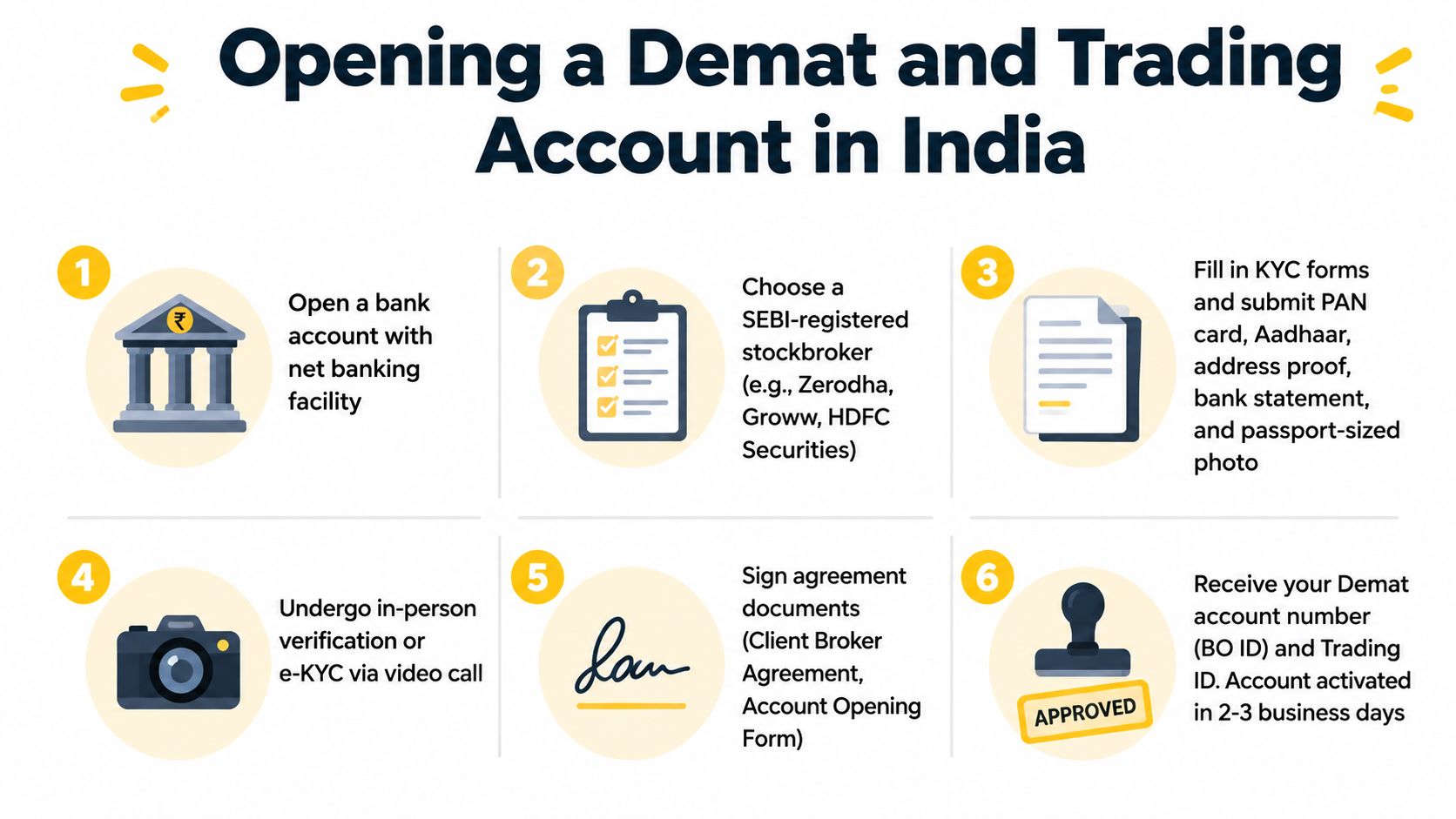
A first buy order in India usually begins with three linked pieces, a bank account, a trading account, and a demat account. The demat account stores shares in electronic form, while the trading account is what you use to place the order. For a plain overview of how brokerage accounts and trade planning fit into this setup, see Fool on brokerage accounts and trade planning.
What the paperwork usually looks like
Most account-opening journeys in India begin with KYC. Keep your PAN card, Aadhaar, bank statement, and a cancelled cheque ready, because brokers and depository participants use them to verify identity and banking details. The process may also include in-person verification or e-KYC by video call, depending on the broker's workflow.
The account is generally linked through depository infrastructure, with the two major depositories in India being CDSL and NSDL. You are not handing shares to a physical vault or a paper file. Ownership sits in electronic form, and settlement happens through that system.
Brokers in India usually fall into two broad types. Discount brokers tend to focus on low-cost execution and basic platform access, while full-service brokers often add research, advisory-style support, and broader service layers. The choice affects convenience and support, but it does not remove the need to understand the order you are placing.
Beginners often miss the sequence. A bank account with net banking, KYC documents, signed agreements, and then the account IDs usually make up the path from first interest to first order. That order matters because each step depends on the one before it, much like wiring a new switchboard before electricity can flow through the house.
For readers who want a closer look at how a company's shares are described on the market side, the what a listed company page shows can help make the jump from account setup to actual market information feel less abstract.
Bharatstox operates as a media publisher and market-information platform, not as a broker or investment manager. For readers trying to follow NSE and BSE activity in one place, its live panels and attributed market coverage can be one of several tools to use while learning how the market is displayed.
Index Funds Versus Single Stocks for Small Portfolios
If you are starting with a small amount, the key question is often not which stock looks exciting. It is how to begin without letting brokerage, taxes, and avoidable mistakes eat into a tiny portfolio. That is why the comparison between a Nifty 50 index fund or ETF and single-stock picking matters so much for new investors.
A broad index fund spreads your money across many large companies at once. One weak company does not dominate the outcome, which is helpful when every rupee in the account has to work hard. Single stocks work differently. They ask you to judge one business at a time, accept company-specific risk from day one, and stay patient even when prices move around for reasons that have little to do with the underlying business.
For a first-time investor, cost friction is easy to underestimate. A small portfolio can lose a meaningful share of its edge to brokerage, bid-ask spreads, and repeated orders, especially if the habit becomes buying and selling often. Index funds and ETFs usually keep the process simpler, because one purchase gives you exposure to a wide basket instead of forcing you to build that basket stock by stock.
India's beginner base is large and active. NSE reported an average of 10.8 million retail clients across cash, F&O, and commodities in March 2025 NSE retail client figure and Nifty return context. That scale matters because opening an account is easy, while building steady habits is much harder.
Useful lens: a small starting amount does not need more action. It needs fewer avoidable mistakes.
Long-term context matters too. For Indian beginners, one commonly cited reference point is the Nifty 50's long-run return profile, often described as about 12–14% CAGR over periods of 15+ years, with real returns of roughly 6–8% after inflation NSE retail client figure and Nifty return context. The exact outcome will always vary, but the basic lesson is clear. A broad market route can be a better fit than trying to identify the next winner before you have the tools to judge businesses properly.
Index fund versus single stock picking for beginners
| Factor | Nifty 50 Index Fund or ETF | Single Stock Picking |
|---|---|---|
| Diversification | Built in across large companies | Depends on how many stocks you choose |
| Research effort | Lower | Higher |
| Behavioural risk | Lower temptation to chase every headline | Higher temptation to overtrade and react quickly |
| Suitability for a small start | Often simpler | Can become inefficient if costs and mistakes pile up |
| Learning curve | Easier first step | Steeper because each company needs separate study |
A practical India-specific point often missed in beginner guides is the drift from investing into speculation. A small account can become a training ground for curiosity, then slide into repeated trades, then into F&O because fast movement looks exciting. That shift is where many beginners lose the discipline that made the account open in the first place. If you want to understand how the market describes businesses and why that matters before you buy a share, the plain-language guide to what is impact company is a useful follow-up.
For many first-time investors, the simplest portfolio is the one that asks for fewer decisions. A broad index fund gives you market exposure without forcing you to bet early on a single company, and that is often a better fit when the account is still small.
Common Beginner Mistakes and How to Avoid Them
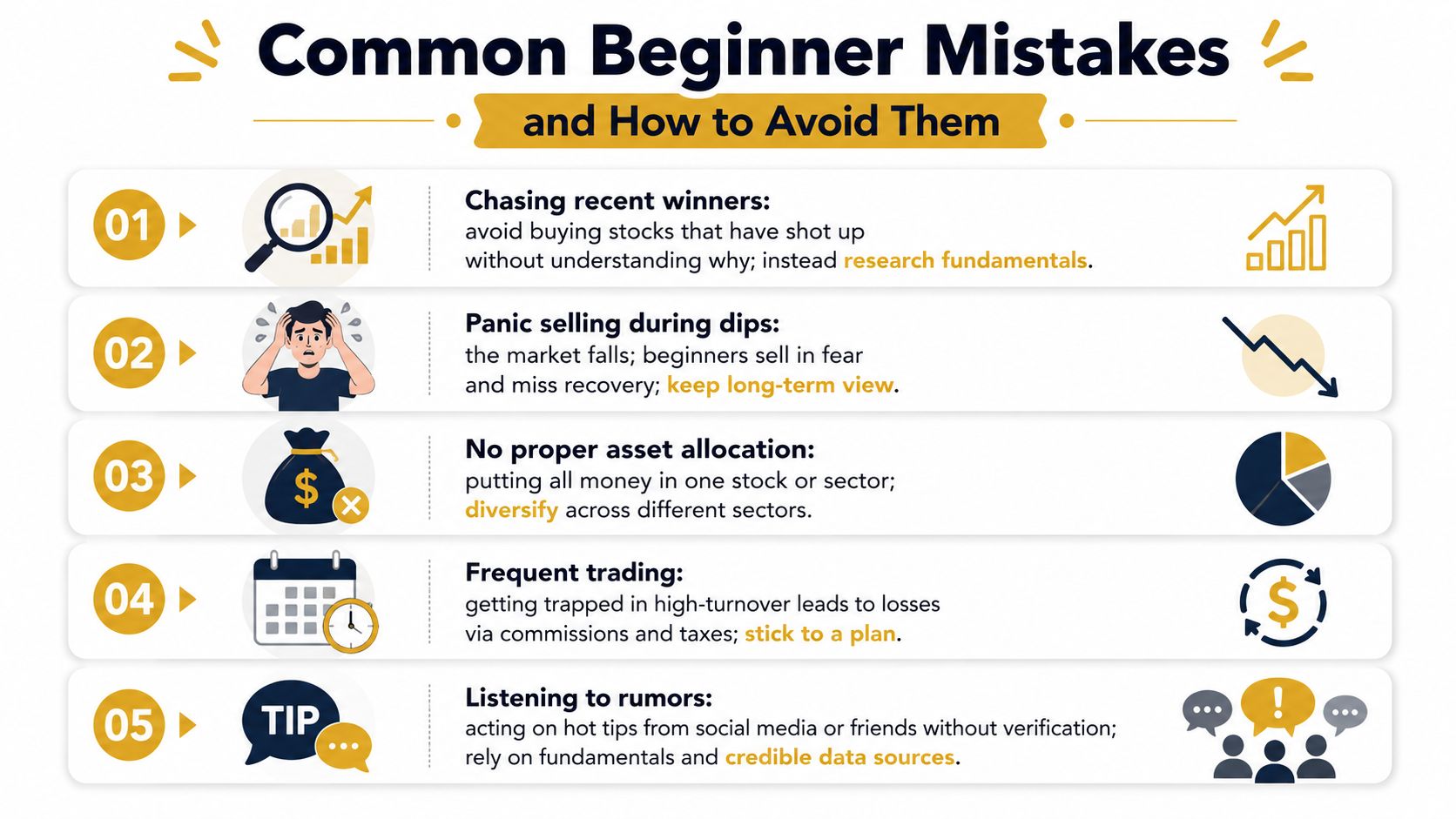
Most beginner mistakes are not knowledge failures. They're behaviour traps that feel sensible in the moment. A stock has already gone up, so it looks “proven”. A dip appears on the screen, so it feels urgent to sell. That's how people confuse motion with insight.
The traps that show up first
Chasing recent winners is a classic one. A stock that moved sharply yesterday can feel safer than one that's been quiet, but price alone doesn't tell you whether the business is still worth owning. A better habit is to ask what changed, and whether the move came with genuine business improvement or just market excitement.
Checking your portfolio too often is another trap. Every glance turns a long-term position into a daily emotional test, and that often leads to overreaction. If you're investing, you don't need to watch every tick like a trader.
Ignoring position sizing creates a different kind of damage. One large bet on one stock or one sector can dominate the account and make recovery harder if things go wrong. Diversification spreads risk, but only if you use it.
A fourth mistake is drifting into derivatives and F&O because it looks faster. Beginners often enter that space with little understanding of margin, expiry, or downside. The result is usually more noise, more stress, and more unnecessary turnover.
A simple trend filter is easier than a crowded chart
Technical analysis doesn't need a pile of indicators to feel legitimate. Beginner-friendly chart reading usually works better when you focus on trend on higher timeframes, support and resistance, volume, and at most one or two momentum tools like 14-period RSI or MACD beginner technical analysis guide. A breakout without stronger volume is a common false-signal risk.
A straightforward trend filter is the relationship between the 50-day and 200-day moving averages. When price stays above both and the 50-day slope turns up, traders treat that as a sign of strengthening trend, and a 50-day cross above the 200-day is often called a golden cross moving average guide for beginners. That doesn't make a trade good on its own, but it gives you a measurable structure instead of a hunch.
Your First 90 Days in the Indian Stock Market
The cleanest start is not a chase for fast returns. It's a learning routine that slowly turns unfamiliar screens into familiar behaviour. A beginner who learns the account setup, watches the market, and keeps risk small is usually in a better place than one who tries to do everything at once.
Bharatstox's NSE BSE live market coverage is a practical place to see how live benchmark movement is presented in an Indian context. Use that kind of panel for observation first, not as a signal to rush.
A low-pressure first-quarter plan
- Week 1, paperwork first: finish KYC, open the linked accounts, and make sure you can see holdings and contract notes clearly.
- Weeks 2 to 4, watch before acting: follow NIFTY 50, SENSEX, and BANKNIFTY movement on live panels, and note how prices behave around news and opening hours.
- Month 2, one small real action: use a modest, deliberate first investment, preferably in a broad-market route if your goal is to learn the mechanics without overcomplication.
- Month 3, build reading discipline: go through one corporate filing or earnings summary each week so balance-sheet language starts to feel normal.
The goal isn't to become fast. It's to become less confused.
That's the main difference between a hopeful beginner and a durable one. The first wants certainty right away. The second learns the structure, watches the costs, and lets experience build before taking bigger steps.
If you want more plain-English explainers on Indian markets, live benchmark coverage, and SEBI-aware market journalism, visit Bharatstox. You'll find India-specific market context, beginner-friendly guides, and live NSE and BSE coverage that can help you read the market with more confidence.
Disclaimer
This article is for informational and educational purposes only and does not constitute investment advice or a recommendation. Investing in securities markets is subject to market risks. Read all related documents carefully before investing.