How to Read Annual Report India: A Practical Guide
Learn how to read annual report India with this step-by-step guide. Navigate MD&A, financials, auditor remarks, and SEBI disclosures confidently.
You've opened an Indian company's annual report on your phone, scrolled past the chairman's message, and reached a wall of tables. The useful question isn't whether you can read every page. It's whether you can verify the company's story against the auditor's report, consolidated financial statements, notes, and later exchange filings.
Learning how to read an annual report in India means treating the document as a starting point for verification, not as a polished brochure. The process below helps you identify the right filing, find the numbers that matter, and recognise when the narrative doesn't match the evidence.
Table of Contents
- Why Indian Annual Reports Are More Than Just a PDF
- Locating and Verifying the Official Annual Report
- Reading the Financial Statements for Real Signals
- Decoding Auditor Remarks and Notes to Accounts
- Cross-Checking Claims Against Subsequent Filings
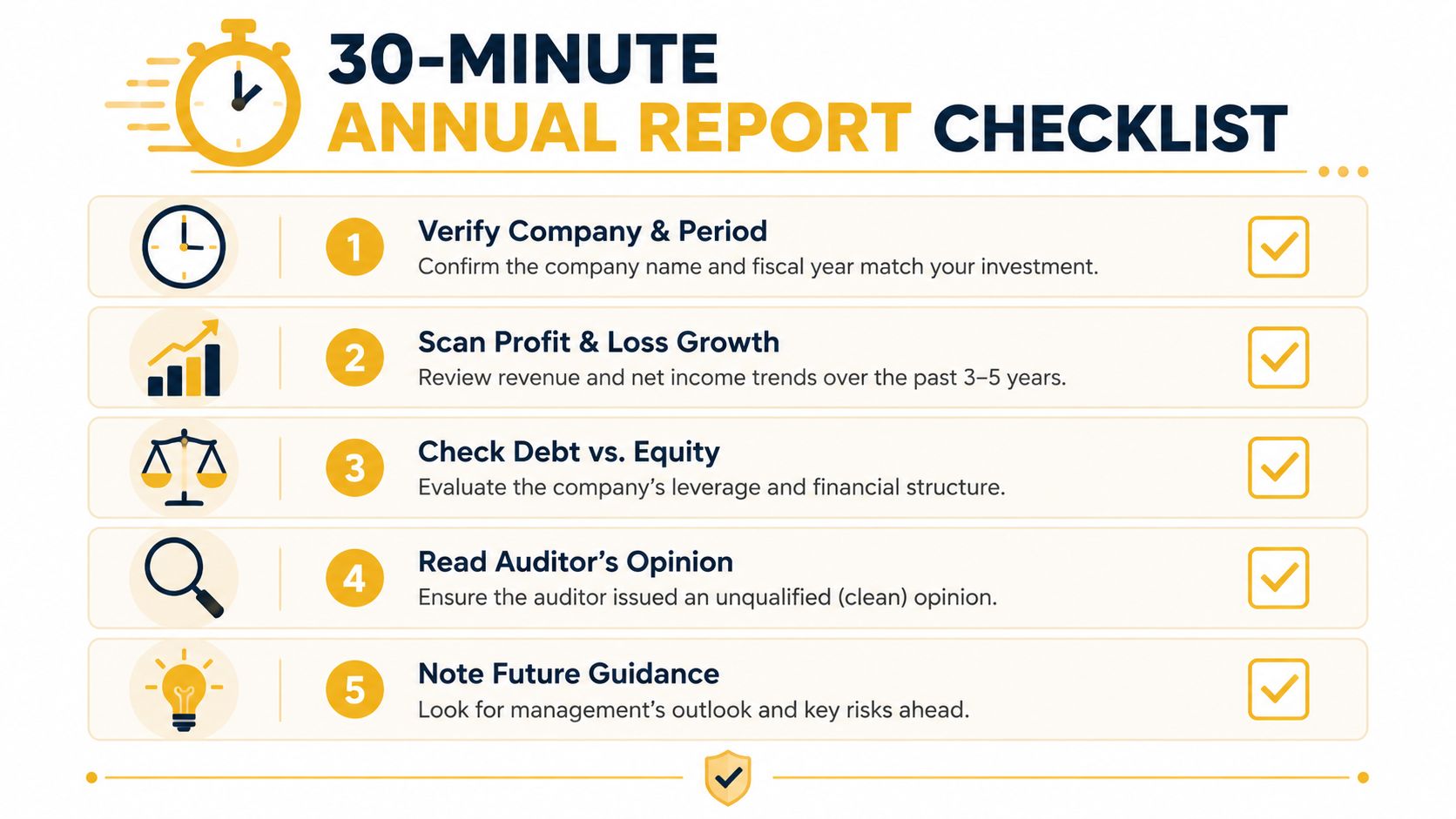
- Your 30-Minute Annual Report Checklist
Why Indian Annual Reports Are More Than Just a PDF
A company's annual report sits inside a regulated disclosure chain. For Indian companies, that chain can include audited financial statements, the Board's Report, auditors' report, corporate governance disclosures, and post-AGM filings. Listed companies typically bundle audited standalone and consolidated statements, the Board's Report and auditors' report in one package under the corporate-filing framework described by SEBI's corporate filings guidance.
That makes the document more important than a presentation deck. It also means the AGM date, publication date, and filing date deserve attention before you study earnings. Under Section 137 of the Companies Act, 2013, annual accounts in Form AOC-4 must be filed within 30 days of the AGM, while the annual return in Form MGT-7 or MGT-7A is due within 60 days of the AGM. For FY 2025-26, published compliance calendars often translate those rules into practical dates around 29 October 2026 for AOC-4 and 28 November 2026 for MGT-7, depending on the AGM date. These filing timelines are summarised in this India-focused ROC compliance guide.
For listed companies, Regulation 34 of the SEBI LODR framework requires submission of the annual report to the stock exchange within 21 working days of AGM approval and adoption, as explained in the text of Regulation 34. A report filed after the AGM, or a report that doesn't reflect the latest approved accounts, needs closer checking.
Start with the sections that carry evidence
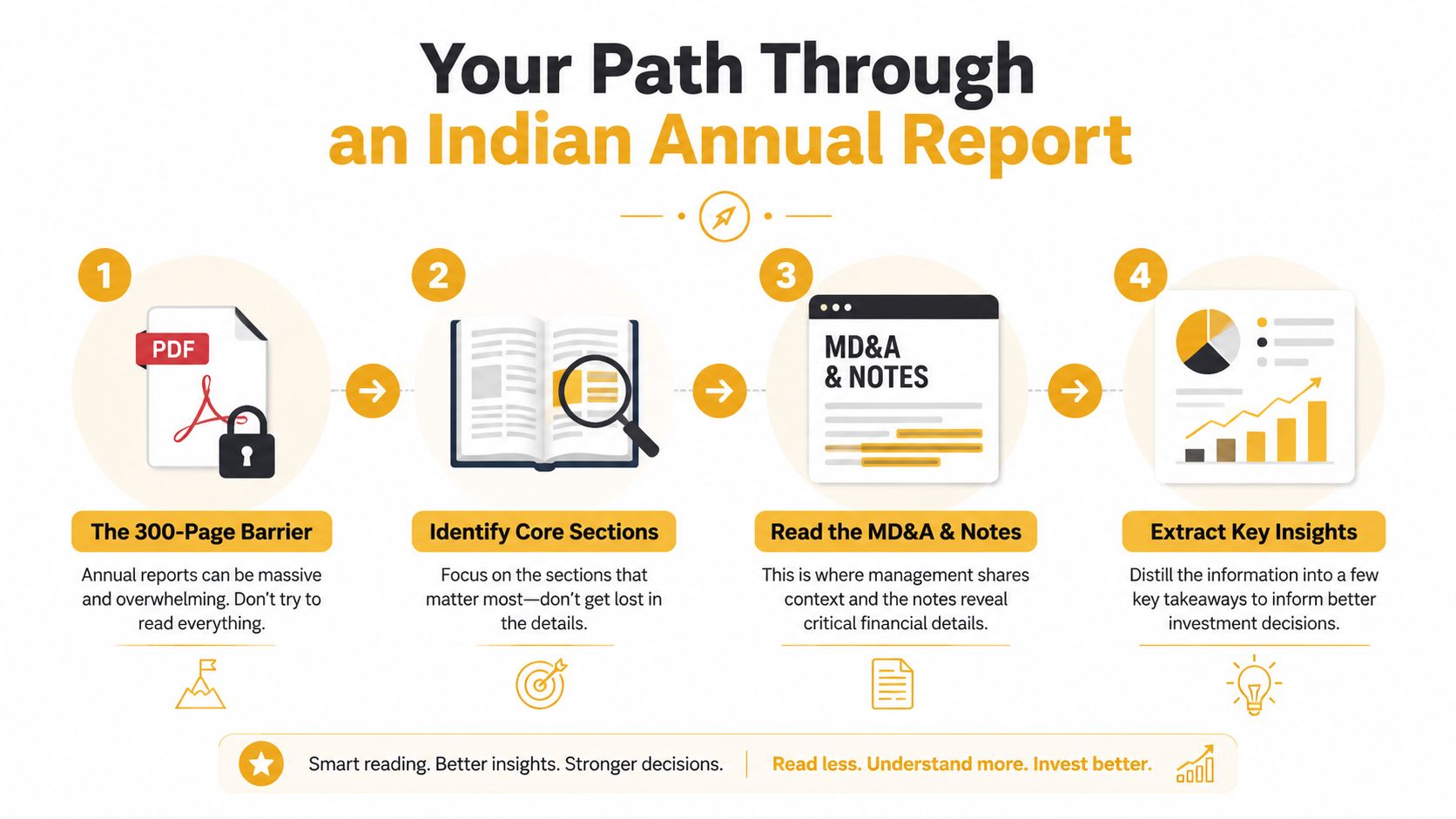
A practical reading order is:
- Auditor's report, to identify qualifications or reservations early.
- Consolidated financial statements, to see the group's overall position.
- Management Discussion and Analysis, or MD&A, to understand the company's explanation of performance.
- Cash flow statement and balance sheet, to test whether reported profit has financial support.
- Notes to accounts, where accounting policies, segments, related parties and contingent liabilities are explained.
- Corporate governance and sustainability disclosures, including BRSR where applicable.
The chairman's message and highlights can provide context, but they shouldn't control your interpretation. A company may describe strong growth in its opening pages while the notes show rising receivables, exceptional items or cash-flow pressure.
Practical rule: Read the highlights for orientation, not for proof.
A useful research platform may help you compare filings and market information, but the underlying documents still matter. Bharatstox's equity research platform guide is relevant for understanding how research tools can fit around, rather than replace, primary filings.
Locating and Verifying the Official Annual Report
Before reading a single number, confirm that you've downloaded the correct document for the correct company and financial year. Search results often surface reposted PDFs, investor presentations or older reports, and a familiar company logo doesn't prove that the file is current.
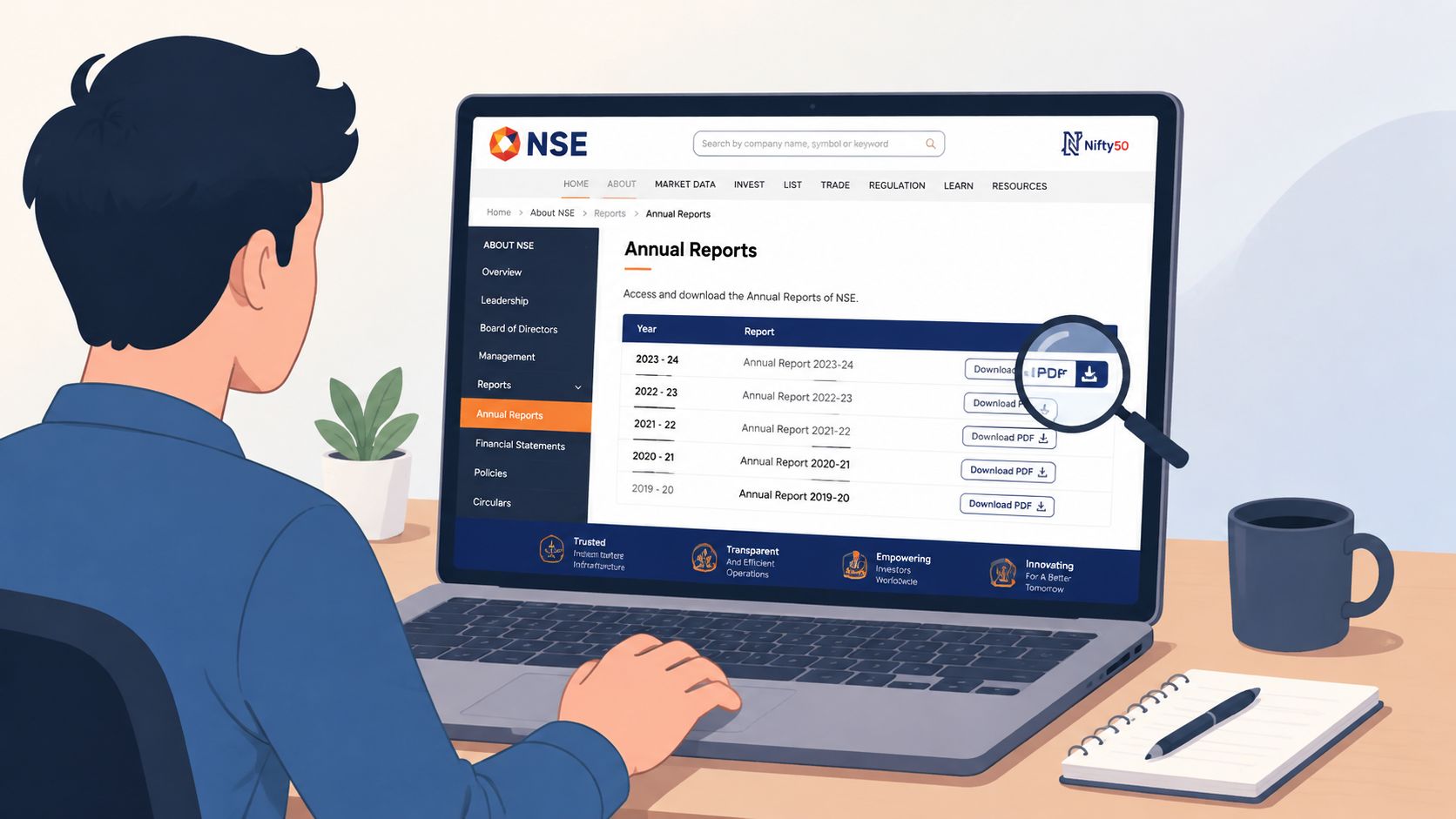
For a listed Indian company, begin with the company's page on the NSE or BSE website. On NSE, use the company section and open the corporate-filings area, then select annual reports. BSE provides a comparable route through its company filings and annual-report records. The NSE annual reports archive provides official company documents and filing timestamps.
Check the document identity
Look at the first pages and the file details. Confirm:
- Company name and legal identity, especially where a group has subsidiaries or a similarly named entity.
- Financial year, including whether the report covers the latest completed period.
- Standalone or consolidated status, because these are not interchangeable.
- AGM date, approval date and exchange submission date.
- Auditor's signing date, which helps establish when the accounts were finalised.
The filing date is useful metadata, not decoration. A report submitted within the Regulation 34 timeline is easier to place in context. A delayed filing doesn't automatically prove wrongdoing, but it gives you a specific governance question to investigate.
Match the report with the ROC trail
Indian annual accounts are filed through Form AOC-4 after the AGM, while the annual return is filed through Form MGT-7 or MGT-7A. Compare the annual report with the relevant ROC filing dates to check whether the accounts were filed on time and whether the report reflects the most recently approved numbers.
For FY 2025-26, practical compliance calendars commonly show around 29 October 2026 for AOC-4 and 28 November 2026 for MGT-7, subject to the AGM date. Those dates aren't a substitute for checking the company's actual AGM and filing records.
A company's investor-relations page can still be useful, but exchange-hosted documents provide a stronger provenance trail. If a company website contains a different version, compare the file date, page count, financial year and any revised disclosures instead of assuming the newer-looking PDF is the authoritative one.
Bharatstox also surfaces NSE and BSE corporate announcements, which can help readers follow filings in plain language while retaining the exchange document as the primary reference.
Reading the Financial Statements for Real Signals
The financial statements become easier to interpret when you stop reading them as isolated pages. Start with the MD&A, then move to consolidated profit and loss, balance sheet and cash flow. This order lets you compare management's explanation with the numbers that support or challenge it.
Consolidated statements usually provide the more complete view for a listed group because they include the company and its subsidiaries together. Standalone figures can still matter, especially where the parent and subsidiaries have different businesses, but relying only on standalone results may hide debt, losses or cash movements elsewhere in the group.
Read the unit line before reading the amount. Indian reports may present figures in lakh or crore, and one lakh means one hundred thousand while one crore means ten million, as illustrated by SEBI's annual-report presentation conventions. A ₹500 figure in crore is not comparable with ₹500 shown in lakh.
Use change filters, then investigate the note
A practical benchmark is to flag any line item that changes by more than 15% year on year, then open the corresponding note. A change of that size isn't automatically negative. It's a prompt to ask what caused it.
For example, inspect the note if receivables, inventory, debt, goodwill or exceptional items move sharply. Then compare the explanation with revenue growth, cash generation and the company's stated business conditions.
| Metric | What it reveals | Red flag signal |
|---|---|---|
| Revenue | Scale and reported business growth | Revenue rises while collections weaken |
| EBITDA margin | Operating profitability before interest, tax, depreciation and amortisation | Margin expands without a clear operating reason |
| PAT | Profit after tax | Profit depends heavily on exceptional items |
| Operating cash flow | Cash generated by core operations | Persistent gap between cash flow and net profit |
| Net debt | Borrowing after available cash | Debt rises while operating performance weakens |
| Receivable days | Speed of customer collections | Receivables grow faster than revenue |
| ROCE | Return generated on capital employed | Returns decline despite reported profit growth |
The most useful single comparison is operating cash flow versus net profit. If profit repeatedly rises but operating cash flow remains weak, investigate revenue recognition, unpaid customer balances and working-capital requirements. A temporary gap can have a reasonable explanation, but a persistent gap deserves attention.
A five-to-seven-metric trend table across at least five annual reports can reveal changes a single year conceals. Keep the table simple and update it when a new report arrives. For readers who want a separate screening workflow, this guide to using Screener can complement, but not replace, annual-report reading.
For a broader technical perspective on warning signs, Lighthouse Consultants' financial-statement fraud detection resource offers useful context on why inconsistencies across statements and notes deserve investigation.
Decoding Auditor Remarks and Notes to Accounts
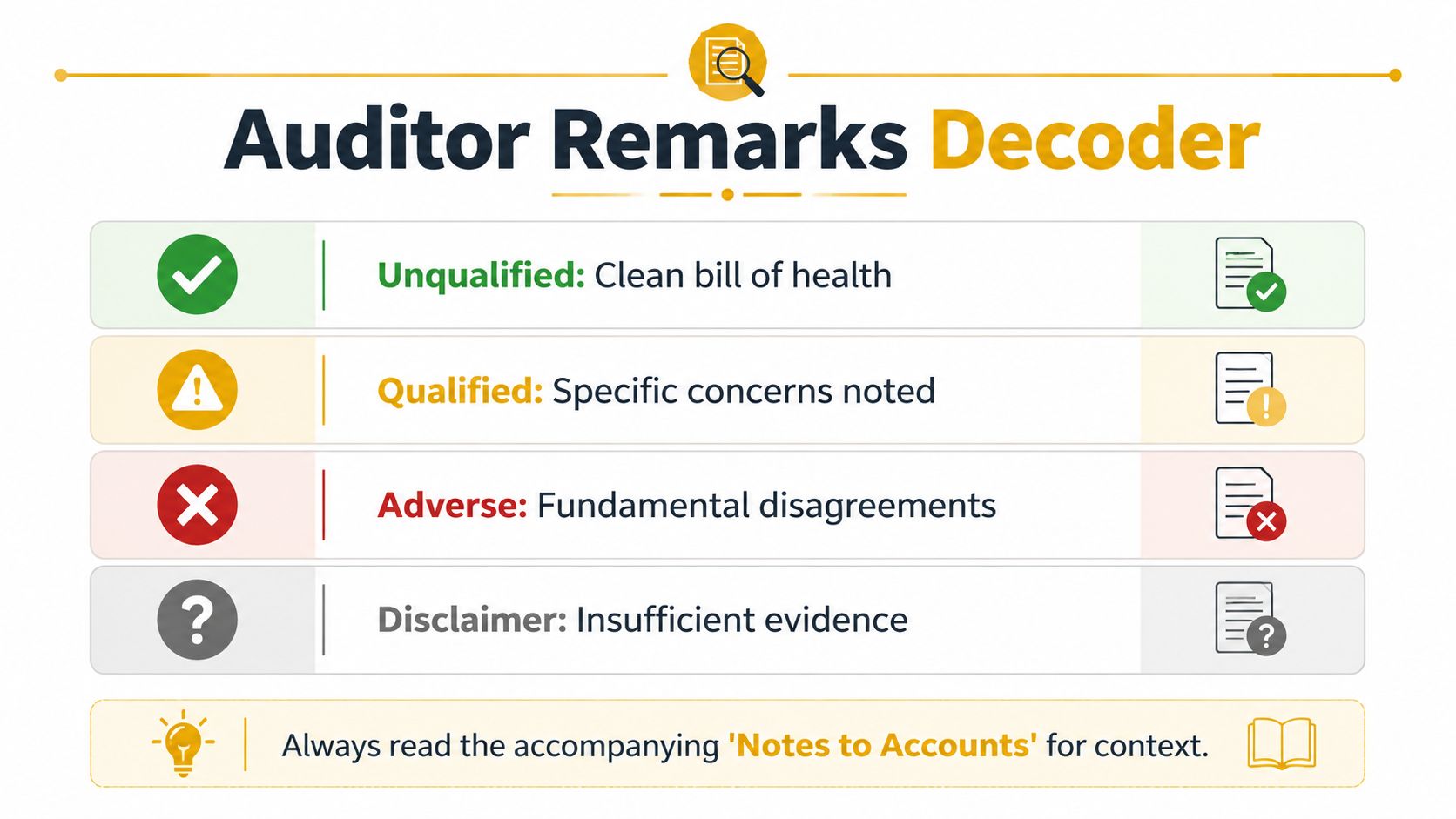
The auditor's report should be one of your first stops because it tells you whether the financial statements received a clean opinion. An unqualified opinion means the auditor found the statements fairly presented within the applicable reporting framework. A qualified opinion identifies a specific concern or limitation. An adverse opinion indicates fundamental disagreement with the financial statements, while a disclaimer means the auditor couldn't obtain enough evidence to form an opinion.
A qualified, adverse or disclaimer opinion doesn't tell you the full conclusion by itself. It tells you where to slow down, identify the affected figures and understand the auditor's reasons. The same applies to an emphasis-of-matter paragraph. It draws attention to an important matter already disclosed in the statements, and it may require context without automatically meaning the accounts are misstated.
Read the notes as explanations, not footnotes
The notes to accounts often contain the detail that changes your understanding of the headline numbers. Schedule III-style disclosures extend beyond the profit and loss account and balance sheet to include cash flow information and detailed notes, including accounting policies, segment details and contingent liabilities. The State Bank of India annual-report materials illustrate the role these disclosures play in presenting the underlying accounts.
Search the notes for:
- Accounting policies, especially revenue recognition, depreciation, impairment and consolidation.
- Segment information, to see which businesses generate sales and profit.
- Contingent liabilities, which may become obligations if a dispute or event goes against the company.
- Related-party transactions, including dealings with promoters, subsidiaries or connected entities.
- Promoter pledging and shareholding changes, which can affect governance and financial risk.
- Charges registered or satisfied with the Registrar of Companies, indicating secured borrowing and changes in security arrangements.
Schedule III also requires companies to explain the numerator and denominator used for disclosed ratios. If a ratio changes by more than 25% versus the previous year, the company must provide additional explanation, according to Schedule III information from the Income Tax Department.
The note is where a headline becomes testable. Match each important management claim with the accounting detail underneath it.
A management statement about improving efficiency, for instance, should be examined alongside margins, employee costs, receivables and operating cash flow. If the auditor highlights a matter connected to a subsidiary, legal claim or valuation, trace that issue through the relevant note rather than stopping at the opinion page.
The accompanying video provides another visual explanation of auditor remarks:
Cross-Checking Claims Against Subsequent Filings
An annual report is a yearly snapshot. Its usefulness increases when you compare it with what the company disclosed afterwards.
Start with the next quarterly results and exchange announcements. If the annual report says capacity, demand or margins are improving, check whether later filings support that direction. If management changes its language after year-end, identify what changed and whether the company explained the shift.
This is an event-driven reading habit. You don't wait for the next annual report to revisit the story. You watch subsequent filings for auditor developments, acquisitions, capital raising, board changes, promoter pledging, related-party transactions and other events that may alter the interpretation of the annual accounts.
Include governance and sustainability disclosures
BRSR, or the Business Responsibility and Sustainability Report, adds another layer for companies required to provide it. Retail readers often skip these pages because they appear separate from profit and loss, but they can contain information about environmental exposure, employee practices, social commitments and governance processes.
Read BRSR alongside the risk section and later announcements. A stated sustainability commitment should be compared with measurable disclosures and subsequent updates, rather than accepted solely because it appears in a formal report.
SEBI's Investor Survey 2025 found that about 21.3 crore households held at least one securities product, as reported in the survey's main report. That level of participation makes practical verification important, particularly for first-time investors who may encounter social-media tips or finfluencer commentary without a dependable audit trail.
Use exchange filings to verify:
- Promoter pledging and changes in shareholding, against the annual report.
- Related-party disclosures, against later transactions and announcements.
- Cash-flow trends, against quarterly results.
- Board or auditor changes, against governance claims.
- BRSR statements, against subsequent sustainability or compliance updates.
A company's annual report should become one node in this record, not the entire record. Bharatstox's guide to corporate action events can help readers understand why later exchange disclosures may change the context of an older report.
Your 30-Minute Annual Report Checklist
You can build a repeatable first-pass review without reading every page. Open the official exchange filing on your phone and work through these checkpoints in order.
- Verify company and period. Confirm the legal entity, financial year, AGM date and exchange filing date. If the document identity is unclear, stop and locate the official version.
- Read the auditor's opinion. Look for an unqualified opinion, qualifications, adverse language, disclaimers or emphasis-of-matter paragraphs. Any exception requires a closer reading of the related note.
- Scan consolidated profit and loss. Check revenue, EBITDA margin and PAT, then flag material year-on-year movements. Use the 15% change filter as a prompt for investigation, not as an automatic verdict.
- Compare cash with profit. Place operating cash flow beside net profit. A persistent gap means you should examine receivables, inventory, revenue recognition and working capital.
- Check balance-sheet risk. Review net debt, receivable days, contingent liabilities, related-party transactions, promoter pledging and shareholding changes.
- Read the notes behind unusual movements. Open the relevant note for debt, goodwill, exceptional items, segment results or any ratio that changes by more than 25%, where additional explanation is required.
- Cross-check the latest quarterly filing. Compare the annual report's MD&A claims with later results, announcements, BRSR disclosures and governance updates.
The aim isn't to produce certainty in half an hour. It's to decide which parts of the report deserve deeper verification and which claims lack immediate support.
This is for informational and educational purposes only and not investment advice. Consult a SEBI-registered adviser before investing.
Bharatstox brings together market journalism, NSE and BSE corporate filings, and plain-language explanations that can help you follow an annual report beyond the day it is published. Visit Bharatstox to track filings, read market education, and build a more disciplined verification workflow.
Disclaimer
This article is for informational and educational purposes only and does not constitute investment advice or a recommendation. Investing in securities markets is subject to market risks. Read all related documents carefully before investing.