Corporate Action Events: Your Guide for NSE & BSE Stocks
Understand corporate action events like dividends, splits, and buybacks. Learn how they impact your NSE/BSE shares and how to track them easily.

Corporate action events are official announcements by a publicly listed company that bring a material change to its shares, directly affecting shareholders and the stock's market value. In a single year, Asia-Pacific accounted for 62,000 corporate events, and dividend payments and income distributions were the most common type worldwide, which is why even one alert on a stock you own deserves attention.
You buy a stock on a normal trading day, then your app flashes a notice about a bonus issue, dividend, or split. That notice can change how many shares you hold, what cash you receive, or when you're eligible for a benefit, so the details matter as much as the headline. For a retail Indian investor watching NSE and BSE names, this is one of those market mechanics that looks small until it lands in your portfolio.
Table of Contents
- What Are Corporate Actions and Why They Matter
- The Main Types of Corporate Actions Explained
- Understanding Corporate Action Timelines
- How Corporate Actions Impact Your Portfolio Value
- Tracking Corporate Actions with Bharatstox
- FAQ on Corporate Action Events
What Are Corporate Actions and Why They Matter
A corporate action is an official event from a listed company that changes shareholder entitlements, and often the market price adjusts around it. If you own an Indian stock, these are the moments when the company is no longer just reporting numbers, it is changing the structure of what you hold.
That could be a dividend, a bonus issue, a split, a buyback, or a rights issue. The headline may look routine, but the effect is practical, it can change share count, cash flow, or eligibility for a benefit. For Indian investors, that's why exchange filings and company announcements aren't background noise, they're portfolio events.
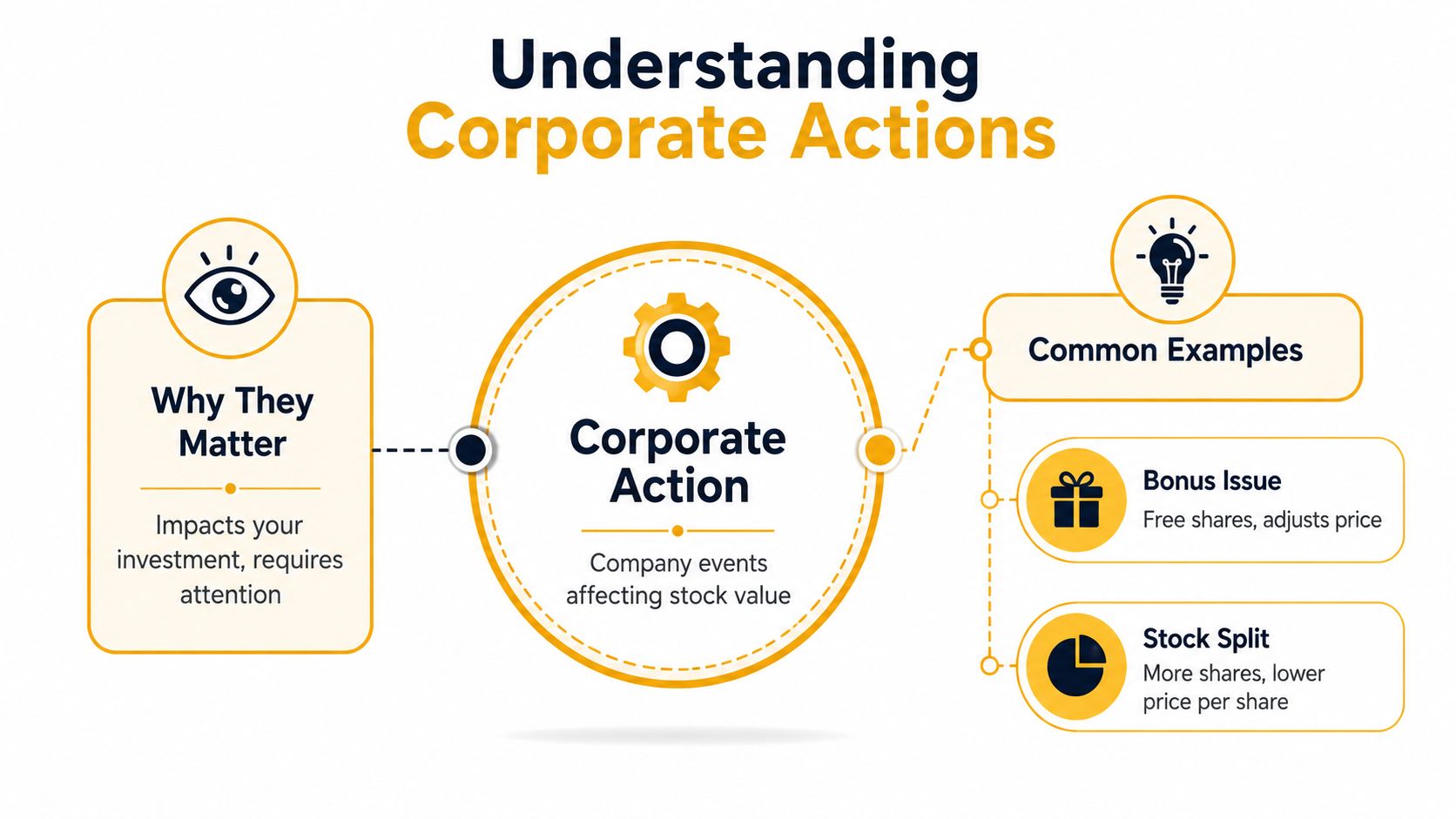
A useful way to think about it is this, a corporate action is like a venue update on the guest list for your holdings. If you're on the list, your entitlement changes in a defined way, and if you miss the timing, you may miss the benefit. That's why a reliable feed matters, especially in a market where 62,000 corporate events appeared in Asia-Pacific in one year and dividends were the most common event globally, according to Oxera's corporate action processing study.
Practical rule: don't treat a corporate action as a notice to read later. Treat it like a settlement-related update that can affect your position on a specific date.
For a beginner-friendly market overview, Bharatstox also keeps a plain-English explainer on stock market basics for Indian readers, which helps put these events in context.
The Main Types of Corporate Actions Explained
Corporate actions don't all work the same way. Some happen automatically, some give you a choice, and some require you to act before a deadline, which is why the classification matters as much as the event name.
The HMRC shares manual groups them into mandatory, mandatory with options, and voluntary events, which is a clean way to judge whether you need to do anything at all (HMRC stamp taxes shares manual). That framework is especially useful for Indian retail investors who see a flurry of exchange notices and wonder which ones need a response.
Dividends
A dividend is a cash distribution from the company to eligible shareholders. Companies use dividends to return part of their profits to investors, and for many retail investors it's the most familiar corporate action because the money shows up directly in the account.
Dividends can be straightforward, but the detail still matters. Some are mandatory in the sense that eligible holders receive them automatically, while others can be structured as mandatory with options, where the shareholder may choose cash or stock, depending on the terms. That's why the announcement language matters more than the label alone.
Stock Splits
A stock split increases the number of shares and reduces the price per share proportionally. Companies usually do this to make the stock look more accessible, though the underlying business doesn't magically change because the share count changed.
For the shareholder, the main impact is cosmetic at first glance, but operationally important. You hold more shares, each priced lower, and the market and back office have to adjust the position cleanly. This is typically a mandatory action, so you don't need to submit an instruction.
Bonus Issues
A bonus issue gives existing shareholders extra shares without asking them to pay more. Investors often see this as “free shares”, but the economic reality is that the company is distributing value in share form rather than cash form.
The share count rises, the per-share price adjusts, and the total value usually reflects the same underlying ownership slice after the market re-prices the stock. That makes a bonus issue useful to understand in conjunction with the ex-date, not just the announcement.
Buybacks
A buyback is when the company offers to repurchase its own shares. Companies may do this to return capital, adjust capital structure, or support capital efficiency, but the effect on the shareholder depends on whether they tender shares and on the offer terms.
This is more often a voluntary event because shareholders may need to decide whether to participate. In plain terms, if you miss the process or ignore the deadlines, you may remain a holder and not take part in the offer.
Rights Issues
A rights issue gives existing shareholders the right to buy additional shares, usually at terms set by the issuer. Companies use rights issues to raise capital while giving current shareholders a chance to maintain their ownership percentage.
This is a classic voluntary action because you generally need to choose whether to subscribe. If you do nothing, your economic position can change because dilution may affect your percentage ownership.
| Event Type | Investor Action Required? | Typical Impact on Holdings |
|---|---|---|
| Dividend | Sometimes no, sometimes yes | Cash or stock benefit, depending on the structure |
| Stock Split | No | More shares, lower price per share |
| Bonus Issue | No | Extra shares issued, price adjusts |
| Buyback | Often yes | Opportunity to tender shares |
| Rights Issue | Yes | Choice to subscribe or let entitlement lapse |
For exchange-facing announcement updates, Bharatstox also has a dedicated NSE corporate announcements page that helps readers scan filing language more quickly.
Understanding Corporate Action Timelines
The timeline is where many new investors get tripped up. A company can announce an event today, but the market uses specific dates to decide who qualifies, when the price adjusts, and when benefits are delivered.
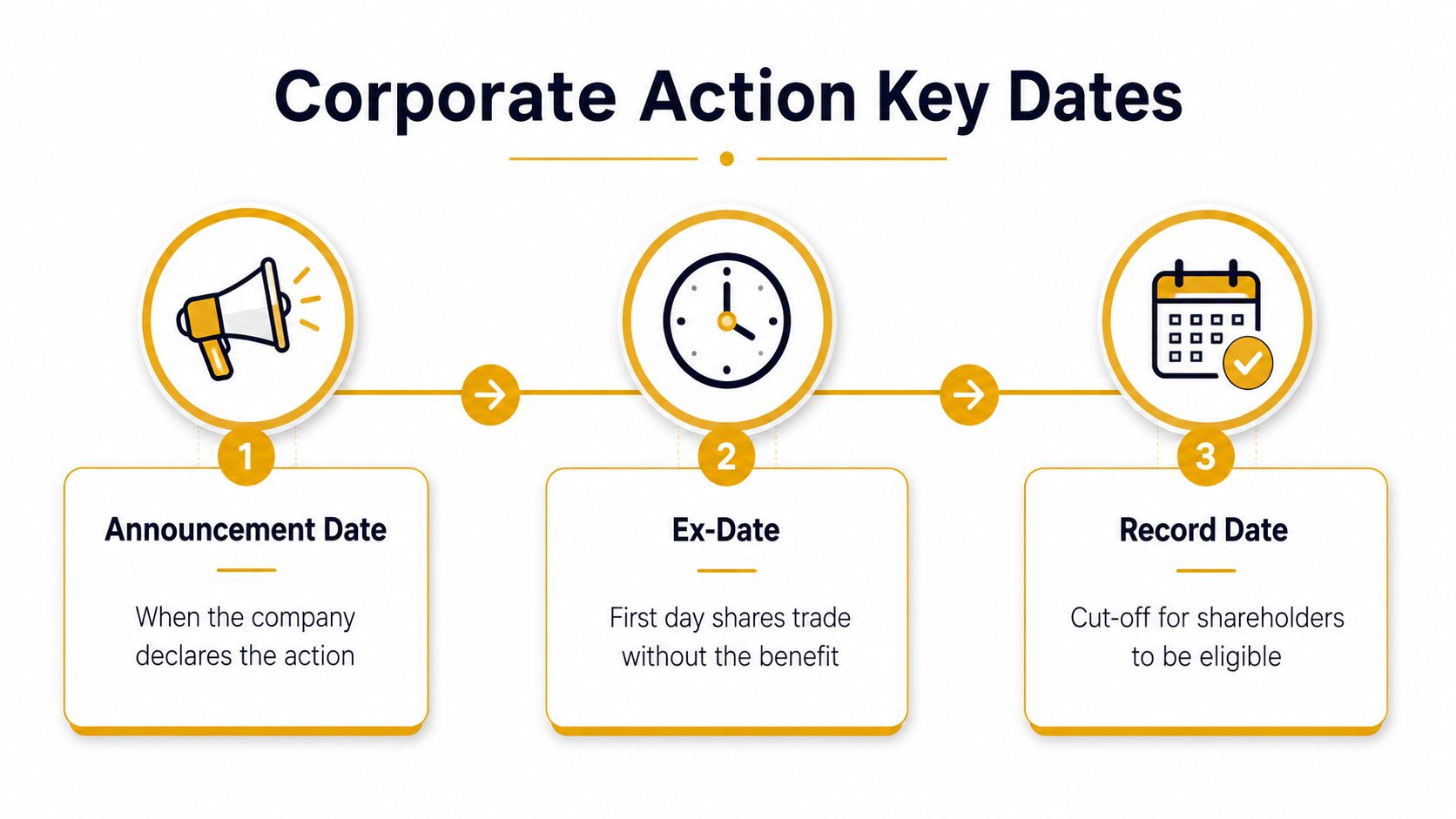
Imagine a guest list. The announcement date is when the host sends the invite, the record date is the final headcount, and the ex-date is the day the benefit stops attaching to a buyer. If you buy after the ex-date, you're too late for that event's entitlement, even if the company announced it earlier.
The market treats the ex-date as the adjustment point. Nasdaq's equity index manual says index securities are adjusted for corporate actions prior to market open on the effective date, ex-date, ex-dividend date, or ex-distribution date, which is why the price shift belongs to the ex-date, not the announcement day (Nasdaq corporate actions and events manual).
Investor shortcut: announcement tells you what happened, ex-date tells you whether you still qualify, and payment date tells you when the benefit arrives.
For Indian traders and investors, that distinction is highly important because exchange announcements often arrive before the actual entitlement cut-off. If you're trying to align a trade, the ex-date is the date that matters most for eligibility, while the record date confirms the eligible list. The record date is the company's final snapshot, but the market starts separating eligible and ineligible buyers on the ex-date.
How Corporate Actions Impact Your Portfolio Value
A corporate action can change what you own, but it does not automatically create extra wealth. The market usually adjusts the price to reflect the value being distributed, so a bonus issue or split can feel like a gain without being free money.
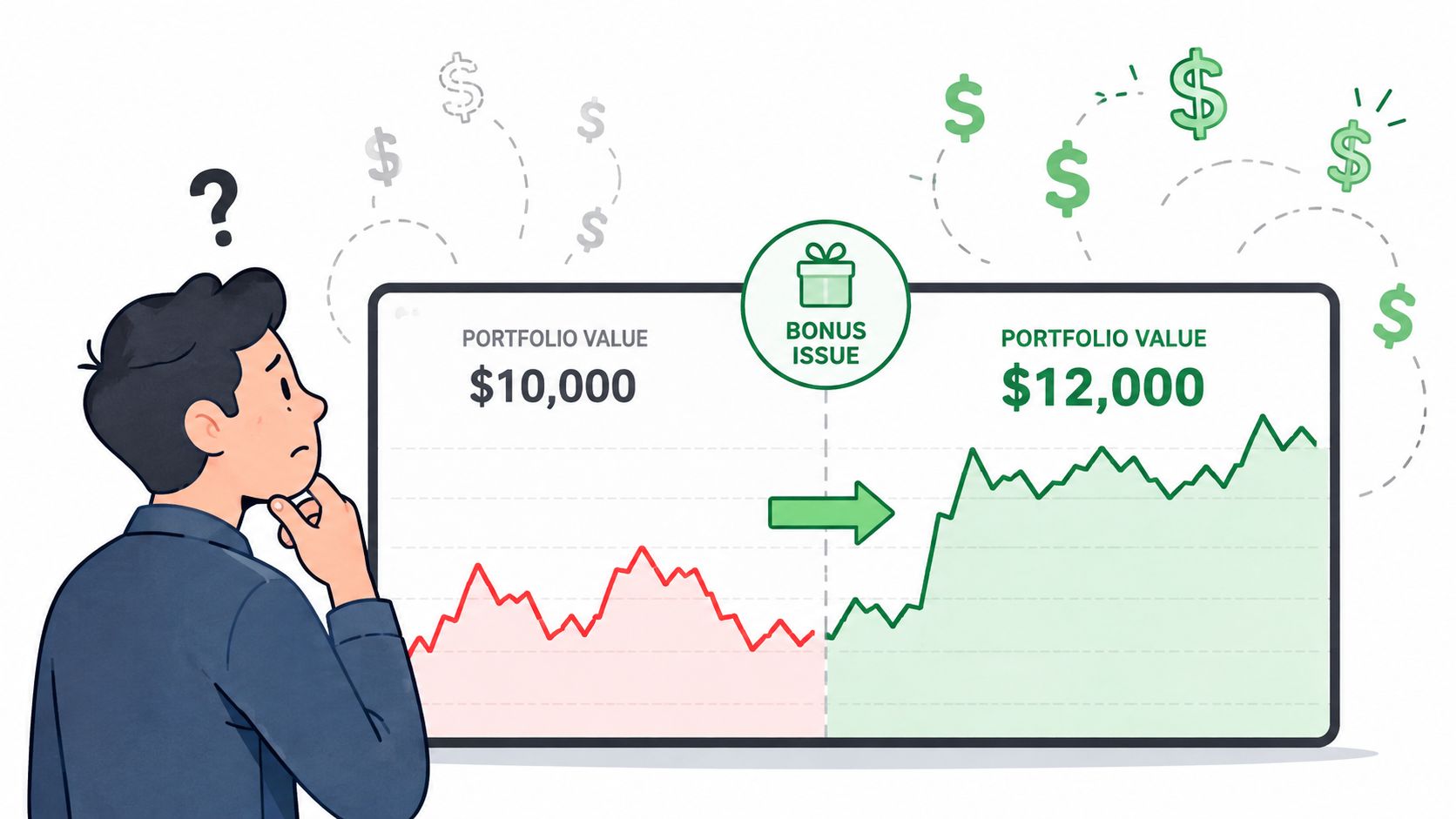
The key question is what happens after the action, not just when it is announced. Upvest's corporate actions guide groups events by how they affect share count, cash received, or rights, and that is the right way to judge whether the outcome is favorable after dilution and taxes (Upvest corporate actions guide). A company can look generous on paper and still leave the shareholder with a different economic result than the headline suggests.
A simple example helps. If a stock split doubles the number of shares, the price usually adjusts so the total holding value stays broadly the same. A bonus issue works in a similar way, because the investor receives more shares, while the market price per share often moves lower to reflect the larger share base.
That is why operational accuracy matters. Corporate actions are one of the more complex parts of securities processing, and fragmented data can create entitlement mismatches or manual repairs, according to S&P Global Market Intelligence. In a retail account, that can show up as the wrong quantity, a delayed credit, or a missed entitlement.
The practical takeaway is simple. Watch the timing, check the event type, and confirm whether the action is automatic or elective. For retail investors following NSE and BSE stocks, that means reading the exchange filing carefully and matching it to the ex-date and record date before assuming the holding value has really changed.
For a clearer view of company notices and their market context, Bharatstox also publishes Indian stock market news, which can help you connect corporate actions with wider sector or index moves.
This is for informational and educational purposes only and not investment advice. Consult a SEBI-registered adviser before investing.
Tracking Corporate Actions with Bharatstox
The hard part for many retail investors isn't understanding the concept, it's finding the filing quickly and reading it without getting lost in legal language. Exchange notices can be precise, but they're not always written for someone checking a phone between work calls or during a commute.
That's where a mobile-first news and data feed matters. Bharatstox surfaces NSE and BSE announcements in plain language, so a reader can spot the corporate-action terms, see the key dates, and understand whether the event is mandatory or requires an action. It's one way to reduce the gap between the exchange filing and the question in your head, “Do I need to do anything?”
A clear announcement feed also helps because time matters. If the event is close to ex-date, a slow reading of a dense filing can leave too little room to react, especially for voluntary actions that need a response before the deadline.
Bharatstox's live market coverage for NSE and BSE sits alongside these announcements, which helps readers connect the filing with the market reaction in one place. That combination matters because the same corporate action can affect price, liquidity, and holding structure, and the sooner you see it, the easier it is to read the timeline correctly.
FAQ on Corporate Action Events
A stock can look simple on the screen and still raise practical questions once a corporate action appears in the filing. A dividend, a rights issue, a buyback, or a bonus issue can all change what an investor receives, what they need to do, and how the holding is reflected later in the account.
Do corporate actions affect taxes in India?
They can, depending on the event and how the benefit is structured. A cash dividend is treated differently from a buyback or a rights issue, so the tax treatment can change from case to case, and investors should check the latest Indian tax rules before acting. If the event involves cash, extra shares, or an offer to tender shares, the filing should be read carefully so the tax angle is not missed.
What happens if I miss a voluntary corporate action deadline?
Usually, the choice attached to that event is lost. For a rights issue or a buyback offer, missing the deadline can leave you outside the process even if you were otherwise eligible. The ex-date and the response window matter because they act like the cutoff line at a counter, once it passes, the option is gone.
Where should I verify the official details?
Start with the company's exchange filing on NSE or BSE, then read the eligibility language, key dates, and action terms closely. If the notice is dense, a curated market-news platform can help you identify the main fields faster, but the exchange filing remains the primary source.
Corporate actions can also create post-trade complexity, because the same event has to be reflected correctly across records, entitlements, and settlement systems. As noted by S&P Global Market Intelligence, that complexity makes clear and timely information important for retail investors too. The practical habit is simple, check the official notice, confirm the dates, then follow the event through a reliable market feed.
If you want a cleaner way to follow NSE and BSE corporate action events, visit Bharatstox for exchange filings, plain-English market coverage, and live updates that help you read the timeline without guesswork. It gives Indian retail investors the key dates, the event type, and the market context in one place.
Disclaimer
This article is for informational and educational purposes only and does not constitute investment advice or a recommendation. Investing in securities markets is subject to market risks. Read all related documents carefully before investing.