Indian Stock Market News: How to Read, Filter, and Trust It
Learn how Indian stock market news is produced, what moves NSE and BSE, and how to filter reliable coverage with clear, factual reporting standards.

Indian stock market news often tells you what the Nifty 50 and Sensex did, but not where the genuine action is. If you only read the headline index move, you can miss sector rotation, stock-specific momentum, and the difference between a broad selloff and a narrow tape.
Table of Contents
- Why Headline Index Moves Miss the Real Story
- How India's Market Infrastructure Shaped Modern News Coverage
- Reading Bylines and Timestamps in Market Reporting
- Connecting Macro Variables to Sector-Level Market Action
- Spotting Sector Rotation Beyond the Benchmark
- Evaluating News Sources for Accountability and Transparency
- Using Trading Session Timelines to Verify Market News
Why Headline Index Moves Miss the Real Story
Indian stock market news often tells you what the Nifty 50 and Sensex did, but it rarely shows where the strongest momentum is building. Readers who stop at the benchmark headline miss the clusters of activity that have recently drawn attention in aerospace, auto ancillaries, precision engineering, defence, textiles, and specialised manufacturing. The index can look quiet while those pockets stay busy.
Index coverage is a filter, not the whole market
That matters because the index is a shortlist, not a map of the entire market. When the media leads with Nifty or Sensex direction, it gives readers a quick pulse, but it can also hide the fact that non-index stocks are where the strongest monthly moves are showing up. For a retail reader, that shift changes the question from “Is the market up or down?” to “Which part of the market is moving?”
Practical rule: if the benchmark looks flat, don't assume the tape is dead. Check which sectors are leading, because rotation often starts before it reaches the headline.
A live benchmark page still helps, but it works best as a starting point. Bharatstox's live benchmark coverage keeps index context visible while pointing readers toward the broader market picture, as shown in its Nifty 50 live analysis.
What readers should look for instead
The better habit is to read the market in layers. First, note whether Nifty and Sensex are up, down, or stuck. Then ask which sectors are outperforming, which stocks are getting attention, and whether the move is broad or concentrated. That simple shift helps readers separate index beta, meaning the market's overall direction, from stock-specific momentum.
For Bharatstox's audience, this is especially useful because the platform already surfaces attributed calls and filings. The value is not limited to seeing that something moved. It also lies in understanding why it moved and whether the move belongs to a larger theme or just one busy session.
If your feed only gives you headline numbers, you are reading a summary of the market. The skill is learning to spot what the summary leaves out and why that matters for the next decision.
How India's Market Infrastructure Shaped Modern News Coverage
Modern market journalism in India took shape as the market itself became faster, more transparent, and more centralised. In the early 1990s, the National Stock Exchange was established in 1992, began trading in 1994, and introduced India's first fully automated screen-based electronic trading system. The Nifty 50 then launched on 22 Apr 1996, giving investors a broad benchmark for the first time, while the Bombay Stock Exchange rolled out BOLT on 14 Mar 1995. Those milestones shifted trading away from fragmented manual dealing and toward a national, technology-led structure that changed how news is gathered, timed, and read. Readers who want the basics first can use this stock market for beginners guide as a starting point before they follow the faster-moving headlines. Economic Times coverage of the market's evolution

Why electronic trading changed the newsroom
Electronic trading speeded up price discovery. That mattered to brokers and exchanges, but it also forced newsrooms to work with tighter clocks and cleaner sourcing. A market story now has to answer when the move began, what data drove it, and whether the trigger was a filing, an analyst call, a global cue, or a policy headline.
The same period also created a stronger need for benchmarks. Once the Nifty 50 became a common reference point, reporters had a cleaner way to describe the market, but also a stronger temptation to use the index as shorthand for everything. That habit still shapes Indian stock market news today.
Stress events made event-driven reporting essential
Indian market history also includes sharp, measurable shocks. The BSE fell 12.77% on 28 Apr 1992 during the Harshad Mehta scam period. It dropped 15.52% on 17 May 2004, which is described as its largest single-day percentage fall in history. The COVID-19 lockdown shock in 2020 produced a 22.50% fall in Indian markets, while the 2024 general election result day saw a 6% decline. Those swings show why politics, regulation, and macro shocks stay central to market journalism. HDFC Sky's history of the Indian stock market
A beginner-friendly reading of this history is simple. The market is no longer a slow-moving local arena, it is a live information system. A story is only as useful as its timing, attribution, and context.
Newsrooms now sit between the exchange and the reader. One side sends prices and filings, the other side wants meaning. Good coverage bridges that gap without dressing up noise as insight.
Reading Bylines and Timestamps in Market Reporting
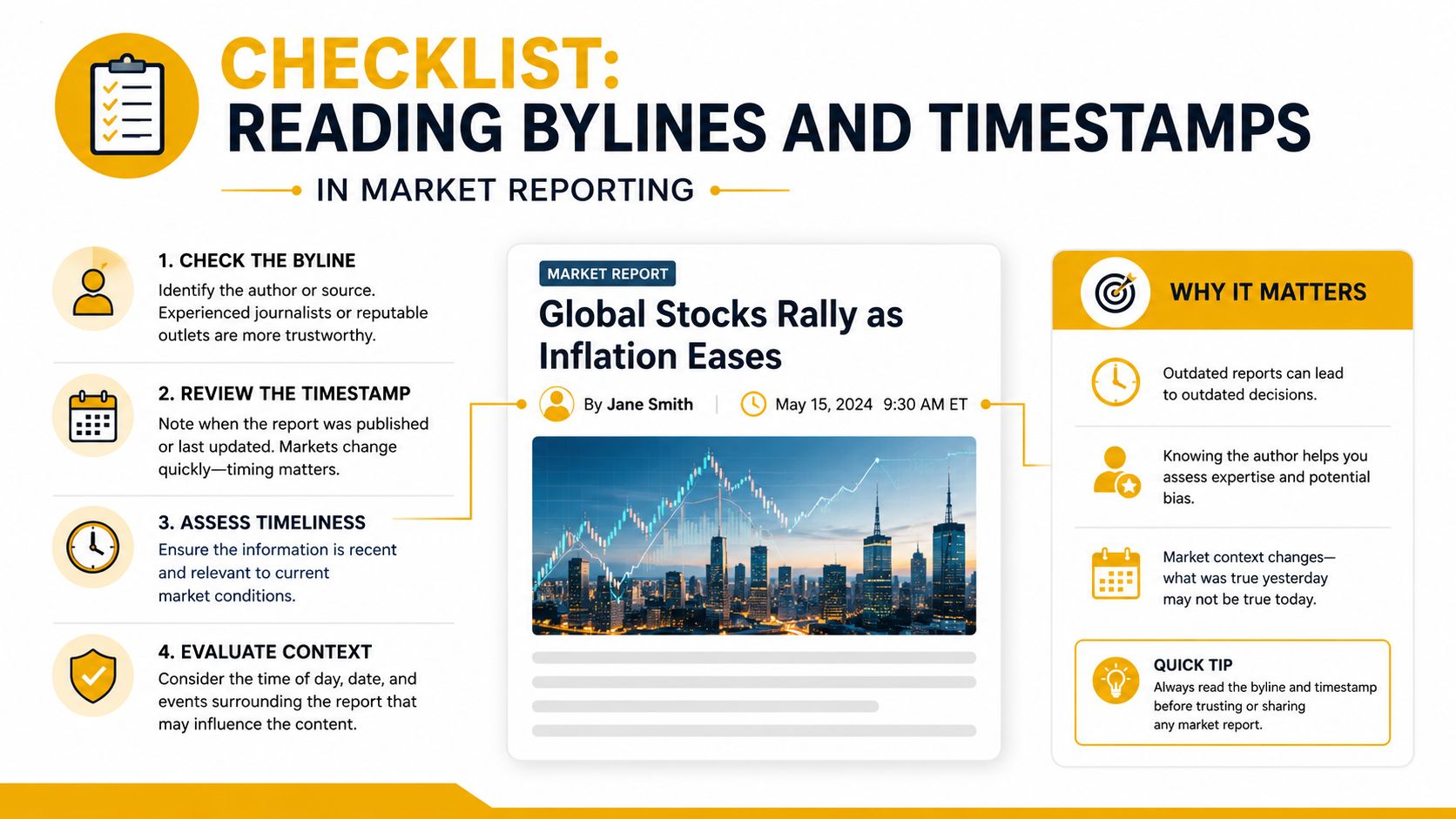
A market story is easier to trust when you can see who wrote it and when they wrote it. In Indian stock market news, the byline, timestamp, and attribution are not cosmetic details. They're the basic tools that tell you whether you're reading a reporter's account, an analyst's view, or a recycled tip.
Start with the byline
A named byline gives you accountability. If the writer is a journalist, the job is to report what happened, quote sources carefully, and separate fact from interpretation. If the item is a research call, the author should be a named analyst with a clear registration trail, not an anonymous voice passed around in a chat group.
Practical rule: if a post can't tell you who stands behind it, treat it as unverified until you can cross-check it elsewhere.
Then check the timestamp
The timestamp tells you whether the story was published before or after the move you're reading about. That sounds basic, but it's one of the most common ways retail readers get misled. A clean timestamp lets you see whether the writer captured the market in real time or explained a move after the fact.
Bharatstox's reporting standard is built around visible bylines and honest timestamps, and its corporate announcements stream is useful for readers who want to follow exchange filings in plain language. The platform's NSE corporate announcements coverage is a good example of how a filing can be surfaced quickly without burying the timing.
Attribution should never be vague
The final check is attribution. If a piece says a stock moved because of a call, the source should be named. If it refers to a regulatory or company event, the filing should be traceable. Anonymous phrases like “market sources said” or “experts believe” add little unless the publication also shows how the claim was verified.
That separation matters because journalism and research serve different purposes. News explains what happened. Research explains what an analyst thinks might happen next. Readers deserve to know which one they're looking at before they act on it.
Connecting Macro Variables to Sector-Level Market Action
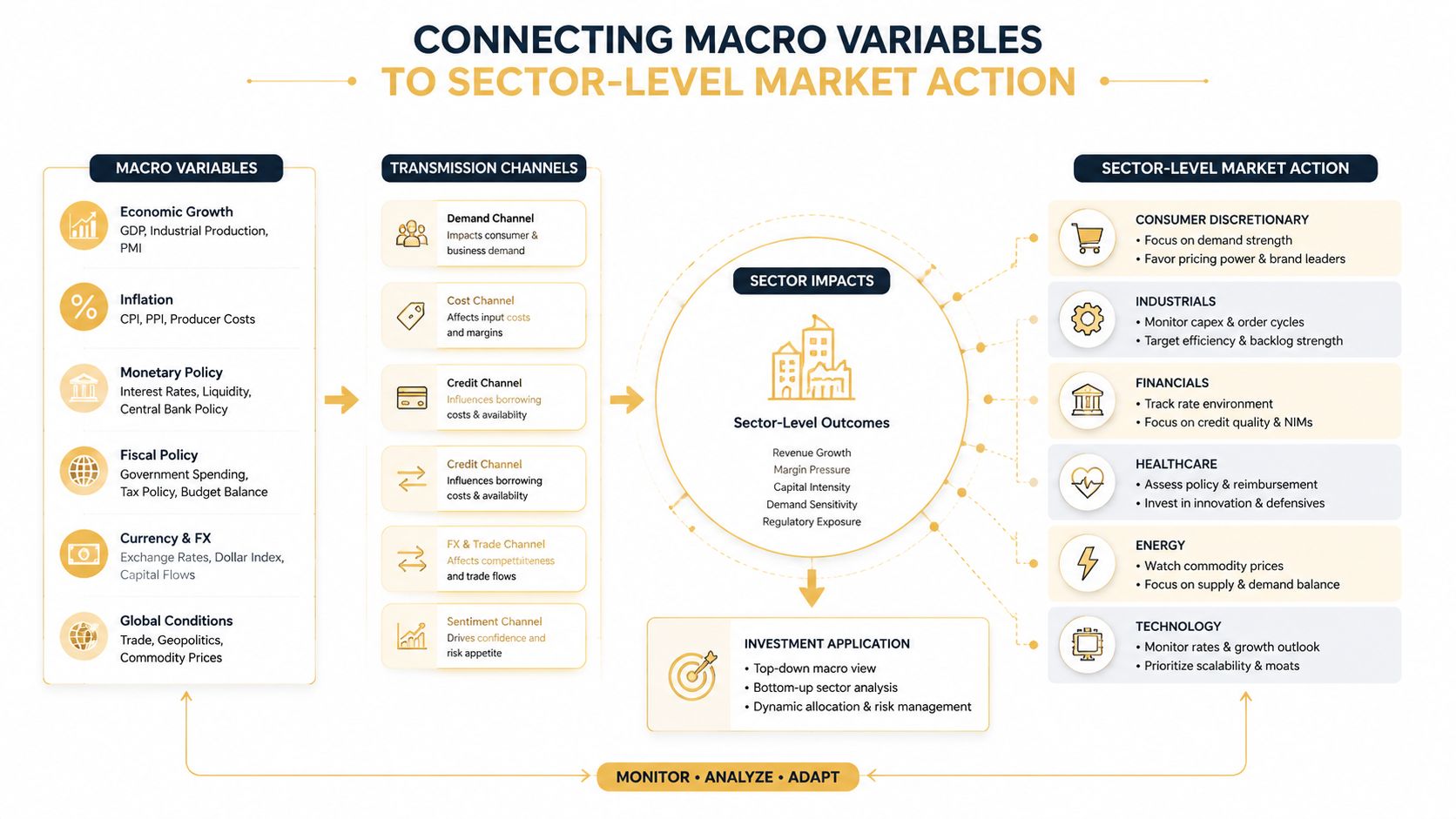
The biggest mistake in market coverage is treating macro news as if it lands evenly across every stock. It doesn't. In India, crude, currency, and foreign flows move through the market in different ways, and the impact often shows up first in sectors rather than in the headline index.
Crude and the cost line
When crude rises, it can feed inflation and margin pressure. That matters because higher input costs and higher rate expectations tend to weigh on rate-sensitive sectors such as banks and consumer names. The link isn't mechanical, but it's practical enough that traders watch oil alongside the index, not after it.
That same logic helps explain why a soft index session can still contain live pockets of strength. If a market is digesting oil or currency pressure, the pressure doesn't hit every sector equally. Some businesses absorb it better, while others feel it quickly in pricing, margins, or risk appetite.
The rupee tells a different story
Rupee coverage is another place where Indian stock market news often needs more context. BusinessLine reported the rupee at 95.28 per US dollar in early trade, with the move linked to dollar demand and rising treasury yields. Another update put the rupee at 95.17 amid geopolitical risks and lower crude prices. The Hindu BusinessLine market coverage is a reminder that currency stories work best when the driver is named, not when the move is described in broad global terms.
For readers, the point is not to reduce every market move to one cause. It's to understand the transmission channel. A weaker rupee can change how importers, exporters, and foreign-owned businesses are read by the market. A stronger rupee can shift the mood in the opposite direction.
Global assumptions can fade as fast as they arrive
Reuters reported on 01 Jul 2026 that global funds were revisiting Indian stocks as oil and rupee risks receded. That kind of story matters because it shows how much recent resilience may depend on external assumptions, not just domestic earnings. Reuters on global funds revisiting Indian stocks
Markets don't move on one variable. They reprice when several variables line up, then reverse when one of them breaks.
For a retail reader, the best habit is to ask which sector is most exposed to the macro driver in the story. That question turns a generic market headline into something you can use.
Spotting Sector Rotation Beyond the Benchmark
Sector rotation is what headline index coverage often misses. On the latest broad-market tape, NIFTY Auto rose 1.84% and NIFTY IT gained 1.42%, even while NIFTY 50 and SENSEX were lower. That's a classic sign that the market is not moving in one direction at once, and that leadership is appearing in cyclical and export-sensitive pockets. Moneycontrol's market tape
Headline indices versus sector moves
| Index or Sector | Move | Interpretation |
|---|---|---|
| NIFTY Auto | 1.84% | Cyclical strength under a weaker headline tape |
| NIFTY IT | 1.42% | Export-sensitive leadership despite index softness |
| NIFTY 50 | Lower | Benchmark weakness does not define every pocket |
| SENSEX | Lower | Large-cap pressure can coexist with selective buying |
This kind of table is more useful than a single index line because it shows breadth beneath the benchmark. If auto and IT are firm while the main indices are weaker, the market may be rotating rather than broadly unwinding. That distinction matters for readers who want to understand where attention is shifting.
Why this matters for stock-specific reading
Relative strength in autos and IT often tells you something about breadth. It can mean buyers are willing to move into sectors with their own earnings or demand narrative instead of waiting for the index to stabilise. For traders, that's a signal to pay more attention to stock-specific setups than to the benchmark alone.
The broader content gap is obvious. Most retail readers get index direction, FII flow headlines, or a top-gainers list, but not a sector map of where momentum is building. That's why a sector-rotation chart can be more actionable than a market summary that only repeats the benchmark close. Bharatstox's sector rotation chart fits that need because it frames movement by sector, not just by index.
If you're reading a soft index day, don't stop at the red headline. Ask whether the tape is distributing across the market or rotating into a different set of names.
Evaluating News Sources for Accountability and Transparency
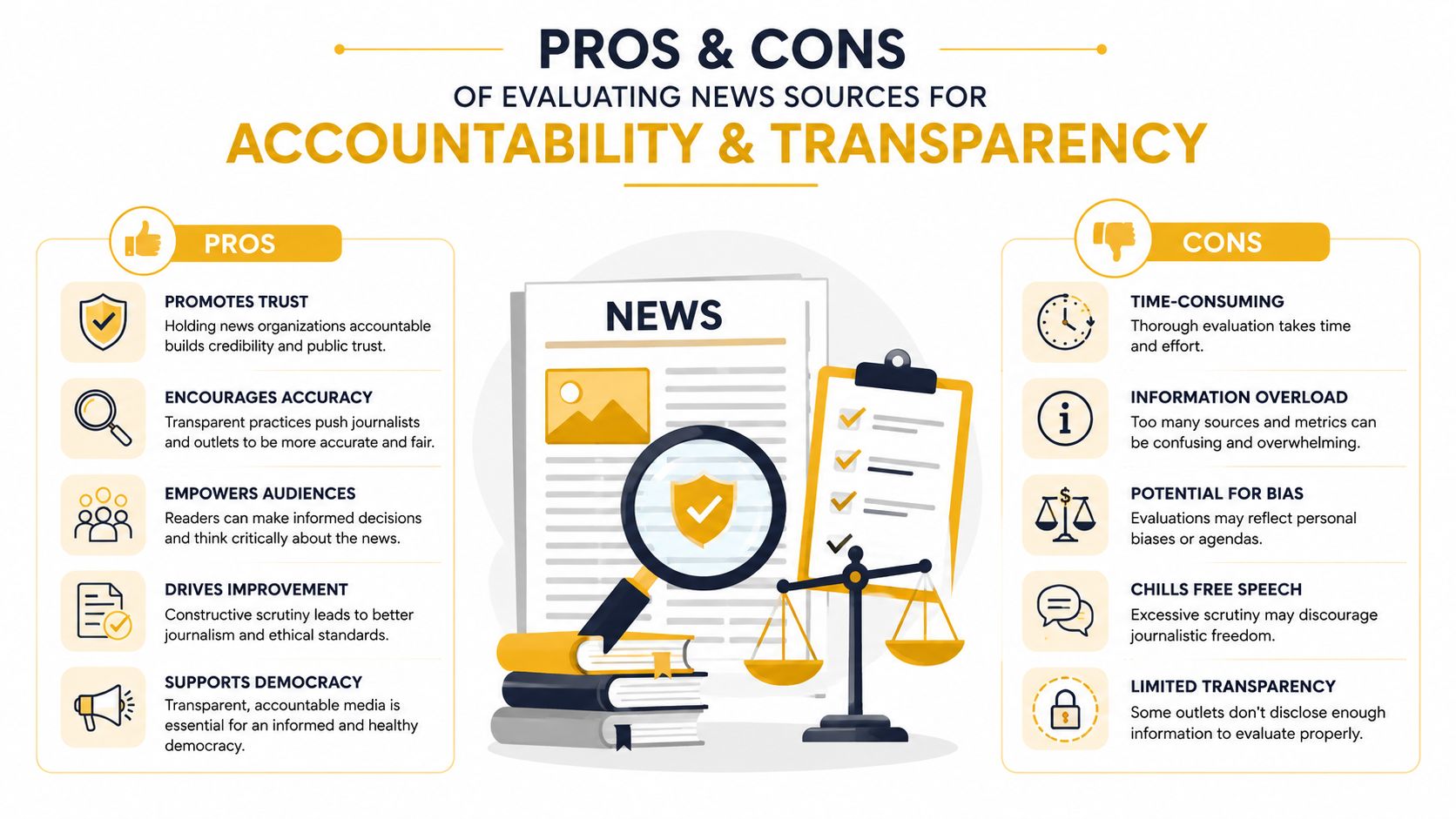
A reader needs a filter, not just more alerts. In market coverage, the most reliable sources are the ones that show who wrote the story, when it was published, what was updated, and where the underlying claim came from. Without that, Indian stock market news can slide into tip culture very quickly.
A quick accountability checklist
- Named byline with credentials: You should know whether the piece was written by a journalist or an analyst, and what role that person has.
- Visible timestamp: The publication time should be clear, and changes should be visible rather than swapped in later.
- Corrections policy: Good publishers tell you how they fix mistakes.
- Separate news and research: Reporting and trade calls should not be mixed into one undifferentiated feed.
- Named attribution for trade content: If a call is involved, the analyst should be identified, along with the registration context where relevant.
Why these checks protect retail readers
Anonymous coverage can sound confident while hiding weak sourcing. That's dangerous in a market where readers are often deciding between acting now, waiting, or learning. A source that shows its work reduces the chance that a forwarded tip gets mistaken for verified news.
This is also where Bharatstox's model is straightforward. It publishes market journalism with visible bylines and timestamps, and it separates news reporting from attributed research calls. That structure doesn't remove market risk, but it does make the paper trail easier to follow.
Practical rule: if a source won't show you the clock, the author, and the origin of the claim, it's asking for trust before earning it.
Transparency does not guarantee accuracy, but it makes accuracy easier to check. For a mobile-first reader scrolling quickly between notifications, that difference matters a lot.
Using Trading Session Timelines to Verify Market News
Indian cash equity trading opens at 9:15 AM and closes at 3:30 PM IST on weekdays, excluding market holidays. That fixed window gives readers a simple way to test whether a story was published before the move, during the move, or after the market had already priced it in. Motilal Oswal's market hours coverage
A useful way to read the day
A market morning usually starts with overnight global cues, pre-open chatter, and fresh filings. Once the session begins, price action and corporate announcements can land together, which is why the time a story first appeared matters so much. A call that goes live after the move is not the same thing as a call that appeared before the move started.
For mobile readers on low bandwidth, the simplest discipline is to open the timestamp first, then the headline, then the body. That order helps you spot whether a post is current, stale, or repackaged. It also makes it easier to compare a news item with the live market panels for Nifty 50, Sensex, bank stocks, or currency.
How to verify a story quickly
- Check the publication time first. If the move has already happened, treat the article as context, not a lead signal.
- Match the time to the session. A filing at 10:07 AM has a different meaning from one surfaced after 3:30 PM.
- Look for the first source of the claim. If the claim came from a filing, an exchange notice, or a named analyst, follow that trail.
- Separate price from explanation. A stock moving and a stock being explained are not the same event.
Bharatstox keeps timestamps non-edited so the record remains verifiable. That's useful because market reporting should preserve what was known at the time, not just what looks tidy later.
The skill is not reading every alert. It's checking whether the alert can be placed on the trading-day timeline with confidence.
If you want clearer, timestamped Indian market coverage that separates index noise from sector signal, visit Bharatstox for daily market news, live data, and attributed research calls. You'll get reporting built for retail investors who want context, not hype, and a cleaner way to follow what's moving on NSE and BSE.
Disclaimer
This article is for informational and educational purposes only and does not constitute investment advice or a recommendation. Investing in securities markets is subject to market risks. Read all related documents carefully before investing.