Equity Research India: How It Works and What Retail
Understand equity research India from SEBI registration rules to reading analyst reports. A clear, factual guide for retail investors and traders

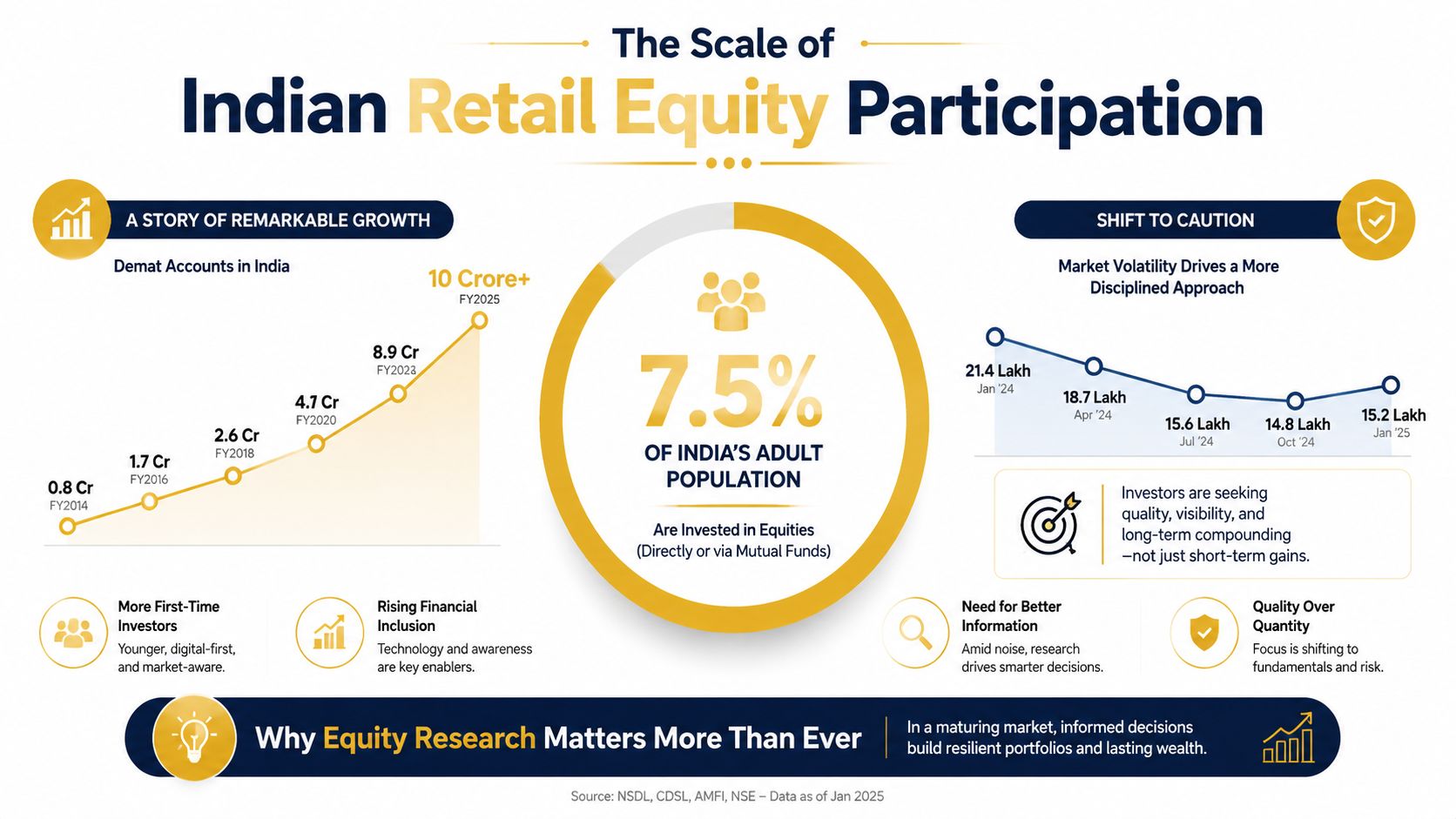
India's retail equity audience is no longer defined only by rapid account opening. NSE-linked reporting recorded ₹8,461 crore of retail equity outflows in 2025, while registered investors still reached 124 million and monthly additions slowed from 1.93 million to 1.28 million. That change makes equity research in India more important, not less: investors need to distinguish traceable, regulated analysis from anonymous tips as enthusiasm gives way to selectivity.
Equity research is the organised process of studying a company, its financial disclosures, industry conditions, risks, and valuation. In India, credible research also has a compliance dimension. Readers should know who produced a call, whether that person or firm is registered with SEBI, what interests were disclosed, and when the information was published.
Table of Contents
- Why Equity Research Matters More Than Ever for Indian Investors
- Types of Equity Research in India and How They Differ
- SEBI's Regulatory Framework for Research Analysts
- How to Read and Evaluate Equity Research Reports
- Event-Driven Research and NSE Corporate Filings
- The Cooling Retail Boom and What It Means for Research Quality
- Practical Guidance for Using Equity Research Responsibly
Why Equity Research Matters More Than Ever for Indian Investors
India's retail market has become large enough that research quality affects far more than professional fund managers. NSE said its unique registered investor base crossed 11 crore on 20 January 2025, reached 11.8 crore by 31 July 2025, and crossed 13 crore in April 2026. The same reporting noted that the exchange added about 2.1 crore new investors in FY26, while total client codes rose to 22.1 crore by March 2025 and 25.7 crore by late April 2026. These figures describe participation, not investor skill. A larger audience also means more demand for explanations that separate evidence from noise. (NSE investor-base announcement)
What equity research actually does
A research report turns scattered information into a structured argument. An analyst may examine revenue, margins, debt, cash flow, industry competition, management commentary, corporate announcements, and valuation methods. The output might discuss a company's strengths and weaknesses, but it shouldn't be treated as a promise about what the share price will do.
For a mobile investor, the useful question isn't “Is this call bullish or bearish?” It's, “What evidence supports the view, what could disprove it, and who accepts responsibility for publishing it?” A report with a named analyst, a clear date and time, cited filings, stated assumptions, and visible risks gives the reader a basis for checking the work.
Why the cooling phase changes the test
A rising investor count can create an impression that every market participant is equally engaged and that every new account will become an active buyer. The outflow data points to a more complicated picture. When additions slow and investors withdraw money from equities, readers may become more selective, more sensitive to losses, or more vulnerable to persuasive but unsupported claims.
Practical rule: Treat research as a method for improving your questions, not as a substitute for your judgement.
India's exchange-based disclosure system gives investors a substantial public information trail. The challenge is interpretation speed and credibility. Bharatstox readers following NSE and BSE names on phones need concise reporting, but concision must not remove attribution, risk context, or the distinction between journalism and regulated research.
Types of Equity Research in India and How They Differ
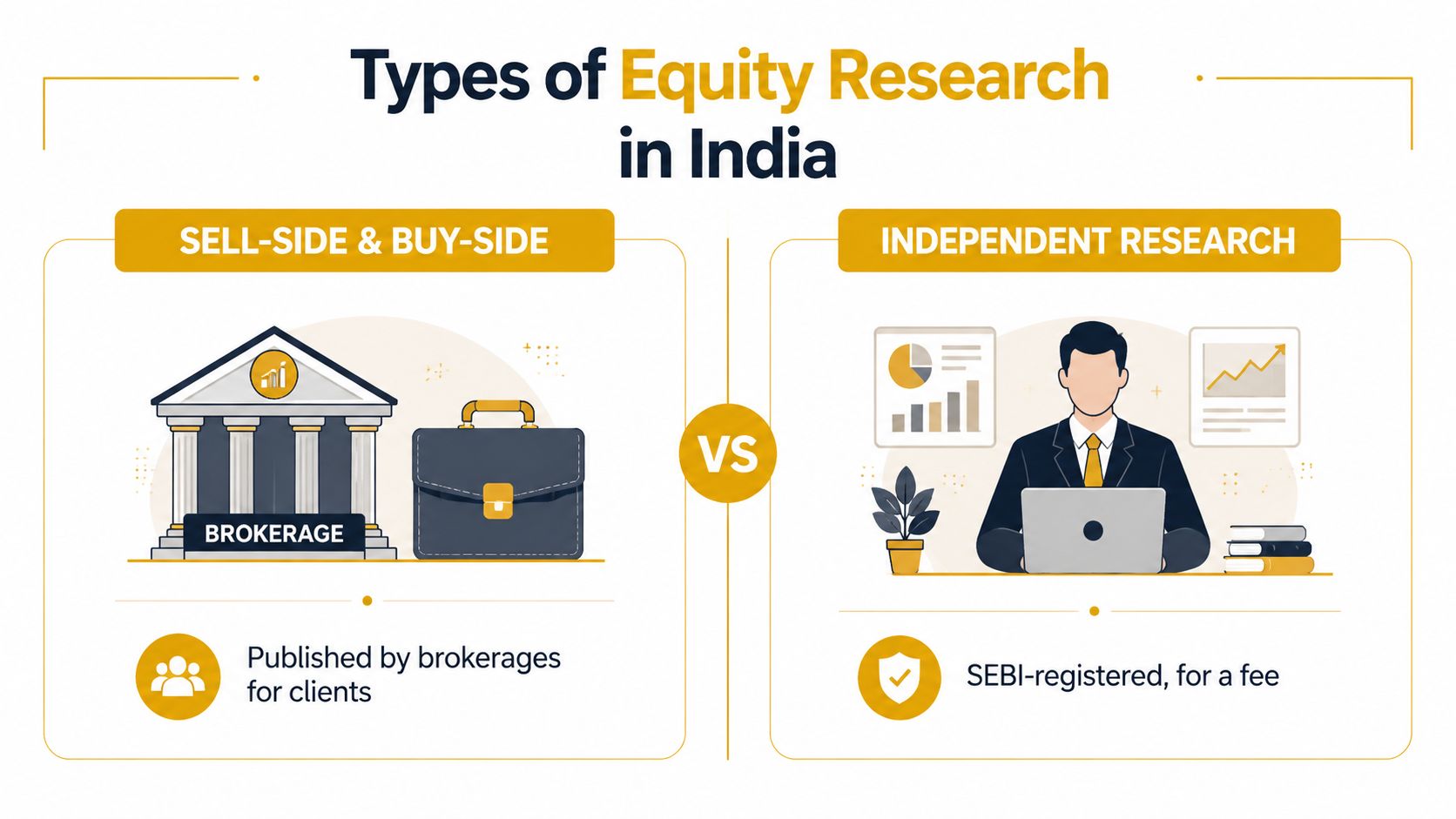
Not all equity research serves the same reader. The easiest way to understand the market is to ask three questions: who paid for the work, who receives it, and what regulatory role does the publisher claim?
Sell-side research
Sell-side research is generally produced by brokerages and investment banks for their clients. Its analysts cover companies and sectors, publish reports, and may issue views or valuation assessments within the firm's research process. The intended audience often includes institutional clients, but some reports also reach retail users through brokerage platforms and media coverage.
The analogy is a newsroom supported by a distribution network. The research team creates analysis, while the brokerage supplies access to clients and trading infrastructure. That relationship makes conflict disclosure important. Readers should check whether the report explains holdings, compensation links, and other interests.
Buy-side research
Buy-side research is created inside an asset manager, mutual fund, pension institution, or other investing organisation for internal decision-making. The team may study public filings, industry data, management commentary, and company meetings, but the work isn't necessarily published for the public.
Its purpose differs from a public report. A buy-side analyst may be helping a portfolio manager assess a question rather than issuing a distributed call. Retail investors usually see the result indirectly through public disclosures or commentary, not the full internal research process.
Independent research and attributed calls
Independent research comes from analysts or firms operating outside a traditional brokerage research department. Where a person holds themselves out as a research analyst and provides regulated research activity, SEBI registration and related requirements become central. A paid research product should identify the responsible analyst or firm, disclose the relevant registration, explain conflicts, and distinguish research from investment advice.
An attributed trade call is narrower than a full research report. It may focus on a market view, a stated horizon, and defined risk parameters. That doesn't make it automatically reliable. The reader still needs to verify the source, timing, methodology, and disclosures.
The key distinction is not whether a report appears on a website, messaging platform, or mobile application. Distribution doesn't establish credibility. Traceability and compliance do.
SEBI's Regulatory Framework for Research Analysts
SEBI's Research Analysts Regulations, 2014 created the core compliance structure for research activity in India. The regulations were notified on 1 September 2014 and came into force on 1 December 2014. They require registration, NISM-Series-XV certification, disclosures, restrictions around trading connected to recommendations, and record-keeping for public research activity. (SEBI Research Analysts Regulations, 2014)
The framework matters because a reader should be able to trace a recommendation to a person or entity with defined obligations. Disclosures can reveal whether an analyst holds the security, receives compensation connected with the company, or has another interest that could affect perceived independence. The rules don't eliminate market risk, but they create an accountability layer that anonymous forwarding channels lack.
What readers should verify
Start with the analyst's name and registration details. SEBI's public registry contains active analyst and firm records, and the BSE registered-research-analyst directory lists more than 5,000 enlistments, including early registrations such as INH000000016, INH000000024, and INH000000040. (SEBI recognised intermediaries registry)
Then check whether the material contains the required disclosures and whether the publisher clearly separates research from advisory services. A data-governance reference such as digna data governance can also help readers understand why provenance, access controls, records, and auditability matter when financial information moves through publishing systems.
For a plain-language guide to the verification process, see Bharatstox's SEBI-registered research analyst guide.
Registration fees in the current framework
SEBI's regulations were last amended on 16 December 2024. The fee schedule below comes from SEBI's regulatory material for the applicable registration framework. (SEBI amended regulations)
| Applicant type | Application fee | Registration fee |
|---|---|---|
| Individual or partnership firm | ₹5,000 | ₹10,000 |
| Body corporate or LLP | ₹50,000 | ₹5 lakh |
SEBI's July 2025 FAQ sets out a distinct fee structure for the first five years of registration. For individuals and partnership firms, it lists a ₹2,000 application fee, ₹3,000 registration fee, and ₹1,000 renewal fee. For body corporates and LLPs, it lists a ₹20,000 application fee, ₹30,000 registration fee, and ₹5,000 renewal fee. The fees are payable with the application or at renewal. (SEBI Research Analysts FAQ, July 2025)
How to Read and Evaluate Equity Research Reports
A credible report should let you reconstruct the analyst's reasoning. Start at the top, before reading the conclusion. Look for the analyst's full name, firm, SEBI registration details where applicable, publication date, publication time, and the security or sector covered.
Read the evidence before the call
A report's conclusion has less value when its assumptions are hidden. Identify the method used to assess the company. Common terms include discounted cash flow, or DCF, which estimates value from expected future cash flows, and the price-to-earnings ratio, or P/E, which compares a share price with earnings per share.
You don't need to accept the method automatically. Ask whether the assumptions are visible, whether the comparison companies are appropriate, and whether the analyst has explained what could cause the thesis to fail.
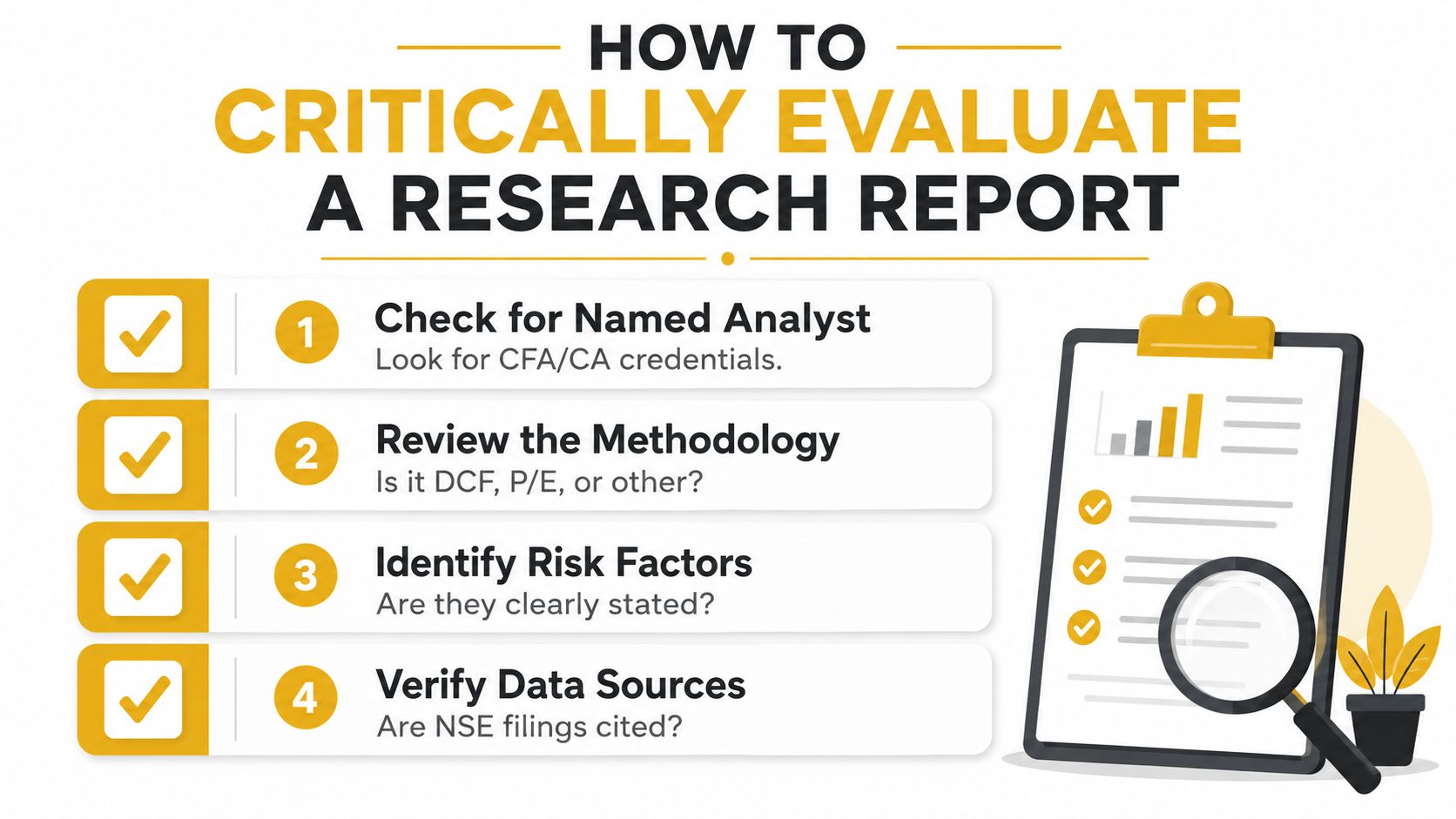
Use this practical checklist:
- Named analyst: Confirm who wrote or issued the material and whether the stated registration can be checked.
- Methodology: Identify whether the report uses DCF, P/E, financial ratios, sector comparisons, or another approach.
- Risk factors: Look for specific operational, financial, regulatory, and market risks rather than a generic disclaimer.
- Data sources: Check whether the report cites company filings, exchange announcements, annual reports, or other identifiable documents.
Bharatstox readers can pair this process with a plain-language guide to reading an annual report in India. An annual report won't answer every valuation question, but it can help you compare the analyst's claims with the company's own disclosures.
Interpret targets and time horizons carefully
A price target is an analyst's estimate based on assumptions, not a guaranteed outcome. A stop-loss is a risk-management level used by some traders, while an investment horizon describes the period over which the analyst expects the thesis to develop. These terms describe a framework. They don't remove uncertainty.
Timing also matters. NSE corporate announcements are timestamped in IST, with published examples such as 21 Aug 2026 15:30 IST and 21 Aug 2026 17:00 IST. (NSE corporate filings announcements) A report that hides when it was issued makes it harder to understand what information was available at the time.
Anonymous tips, guaranteed-return language, missing risk factors, edited timestamps, and claims that cannot be traced to a filing are warning signs. This is for informational and educational purposes only and not investment advice. Consult a SEBI-registered adviser before investing.
Event-Driven Research and NSE Corporate Filings
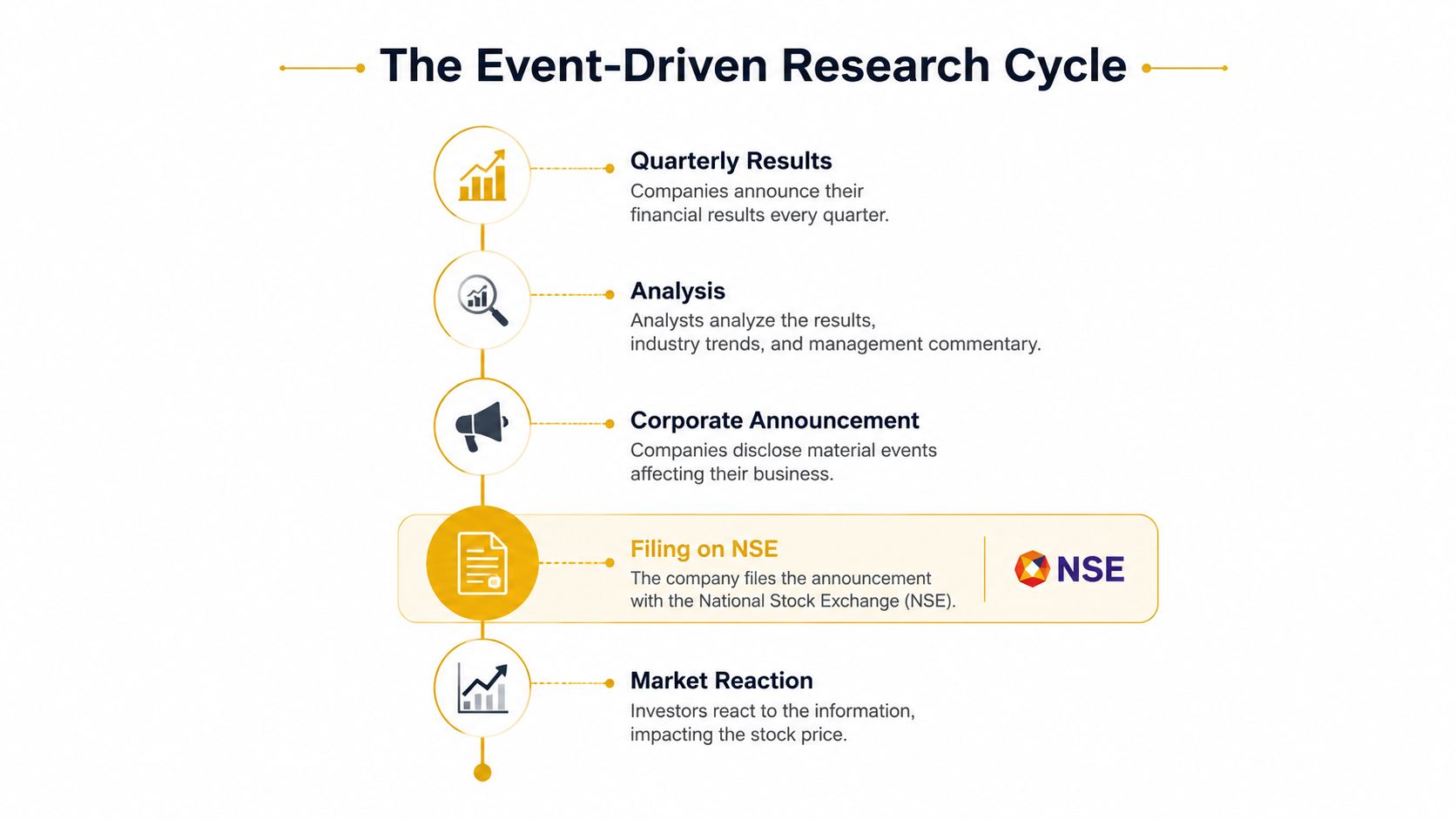
Indian equity research often follows a predictable rhythm because listed companies disclose financial information on exchange calendars. NSE states that quarterly integrated financial filings are due within 45 days of quarter-end, while the last quarter and full-year financials are due within 60 days. Related-party disclosures are published on the same day as financial results. (NSE main-board compliance calendar)
The filing-to-analysis chain
Result season begins with a company publishing financial information. Analysts then compare reported performance with prior periods, company guidance, sector conditions, and their own expectations. The company may follow with a corporate announcement, while the exchange becomes the public record through which investors receive the disclosure.
The practical issue is interpretation lag, the time between a filing appearing and a reader understanding what changed. A revenue figure alone isn't a conclusion. Investors may need to examine margins, debt, cash generation, segment performance, management commentary, and related-party information.
Research quality depends on both accuracy and timing. A correct explanation published after the market has absorbed the filing may be less useful than a clear explanation that preserves the original record.
Tools that surface and explain filings can reduce the time spent locating documents. They shouldn't replace the source document. Instead, they can help a reader identify the relevant announcement, check the timestamp, and then review the underlying filing before forming a view.
The event-driven cycle is also why a quiet trading day can change quickly. A result, board decision, fund-raising announcement, acquisition, or regulatory disclosure can alter the information set available to the market. For a practical explanation of how these announcements appear, use Bharatstox's guide to NSE corporate announcements.
The accompanying video provides another visual explanation of the research cycle:
The Cooling Retail Boom and What It Means for Research Quality
The retail participation story has two sides. India's investor base has expanded sharply, but the latest NSE-linked reporting shows that participation doesn't automatically mean continuous buying or growing conviction. Retail investors withdrew ₹8,461 crore from equities in 2025, the highest such outflows since 2019, while monthly additions slowed and the investor base still reached 124 million. (Financial Express reporting on retail outflows)
That combination challenges the simple demat-boom narrative. New accounts can continue to appear while existing participants reduce exposure, pause activity, or demand stronger evidence before acting. The market audience may be growing in total but becoming more cautious at the margin.
Why selectivity raises the standard
In an enthusiastic market, a headline can attract attention even when its evidence is thin. In a more selective market, readers are likely to ask whether earnings support the story, whether a corporate filing confirms it, and whether the analyst has disclosed a conflict.
That pressure can improve public research, but only if publishers respond with better sourcing rather than louder language. A useful report should show its work, distinguish facts from interpretation, and state what remains uncertain.
What disciplined readers should notice
Look for a clear separation between reported information and the analyst's opinion. A company's result is a fact from its filing. The explanation of why the result matters is analysis. A conclusion about possible price behaviour is an uncertain view, even when it comes from a registered analyst.
Retail readers should also watch for selective success stories. A post that highlights only favourable calls, removes old material, or obscures publication times offers an incomplete record. Cooling participation makes that record more important because investors need to judge process, not just isolated outcomes.
Credibility isn't established by the number of followers on a channel. It comes from traceable authorship, identifiable evidence, visible risk discussion, and a record that readers can audit.
Practical Guidance for Using Equity Research Responsibly
Use equity research as one input in a decision process, not as an instruction. Before relying on a report, verify the analyst or firm in SEBI's public registry, read the disclosures, and confirm that the material explains whether it is research, advisory activity, or journalism.
A simple review routine can prevent avoidable confusion:
- Record the source and time. Note the analyst's name, registration details, security covered, publication date, and IST timestamp.
- Separate fact from interpretation. Mark which statements come from an exchange filing and which represent the analyst's assessment.
- Test the assumptions. Check the valuation method, operating assumptions, financial trends, and risks.
- Look for conflicts. Review holdings, compensation relationships, and other interests disclosed in the report.
- Keep your own record. Save the original report and note later corrections rather than relying on a reshared screenshot.
The distinction between research and advice matters. A public educational article can explain a filing or describe an attributed analyst call without making a personalised recommendation. Your own financial position, time horizon, risk tolerance, and objectives still require separate consideration.
Platforms take different approaches. Bharatstox publishes attributed calls from SEBI-registered research analysts, surfaces NSE and BSE corporate filings with bylines and timestamps, and publishes market explainers. Its equity research platform guide can help readers compare the information features they need, but no platform removes the need for independent verification.
Mobile-first design also has a factual purpose. TRAI reported 1,073.44 million broadband subscribers at the end of April 2026, compared with 1,065.88 million at the end of March 2026, supporting the case for lightweight pages that make filings and research easier to read on varied connections. (TRAI broadband subscriber release)
This is for informational and educational purposes only and not investment advice. Consult a SEBI-registered adviser before investing.
Frequently asked questions
What is equity research in India?
It's structured analysis of companies, sectors, financial disclosures, risks, and valuation. Research may be produced by brokerages, internal investment teams, or independent analysts.
How can I check whether an analyst is registered?
Look for the analyst's name and registration details, then verify them against SEBI's public registry. A registration label without a traceable identity isn't enough.
Is every stock-market article research?
No. Journalism can report facts and explain events, while regulated research involves a defined analytical activity and related compliance obligations. Read the byline, disclosures, and purpose of the material.
Are trade calls guaranteed?
No. A call is an opinion based on assumptions and available information. Market outcomes remain uncertain, and responsible material should state relevant risks.
Why do timestamps matter?
They establish when the analyst or publisher issued the information and help readers compare the call with the disclosures available at that moment.
Bharatstox brings together attributed research calls, timestamped NSE and BSE filing coverage, market journalism, and educational explainers for Indian retail investors. Visit Bharatstox to follow market information with clearer source attribution and a verifiable publication record.
Disclaimer
This article is for informational and educational purposes only and does not constitute investment advice or a recommendation. Investing in securities markets is subject to market risks. Read all related documents carefully before investing.