SEBI Registered Research Analyst for 2026
Learn how a SEBI registered research analyst helps Indian investors make informed decisions with reliable stock market advice.

India's investor base grew from 27.5 million to 116.2 million since 2018-19, more than 4x, while the number of registered research analysts reached only 1,584 by June 2025. That gap is why checking whether someone is a SEBI registered research analyst matters before you act on a stock call.
A crowded market with too few registered analysts means you're more likely to meet anonymous tipsters, recycled Telegram forwards, and opinion dressed up as research. The fix is not to distrust every market view, it's to know who is accountable, who is registered, and what kind of advice falls under SEBI's rules.
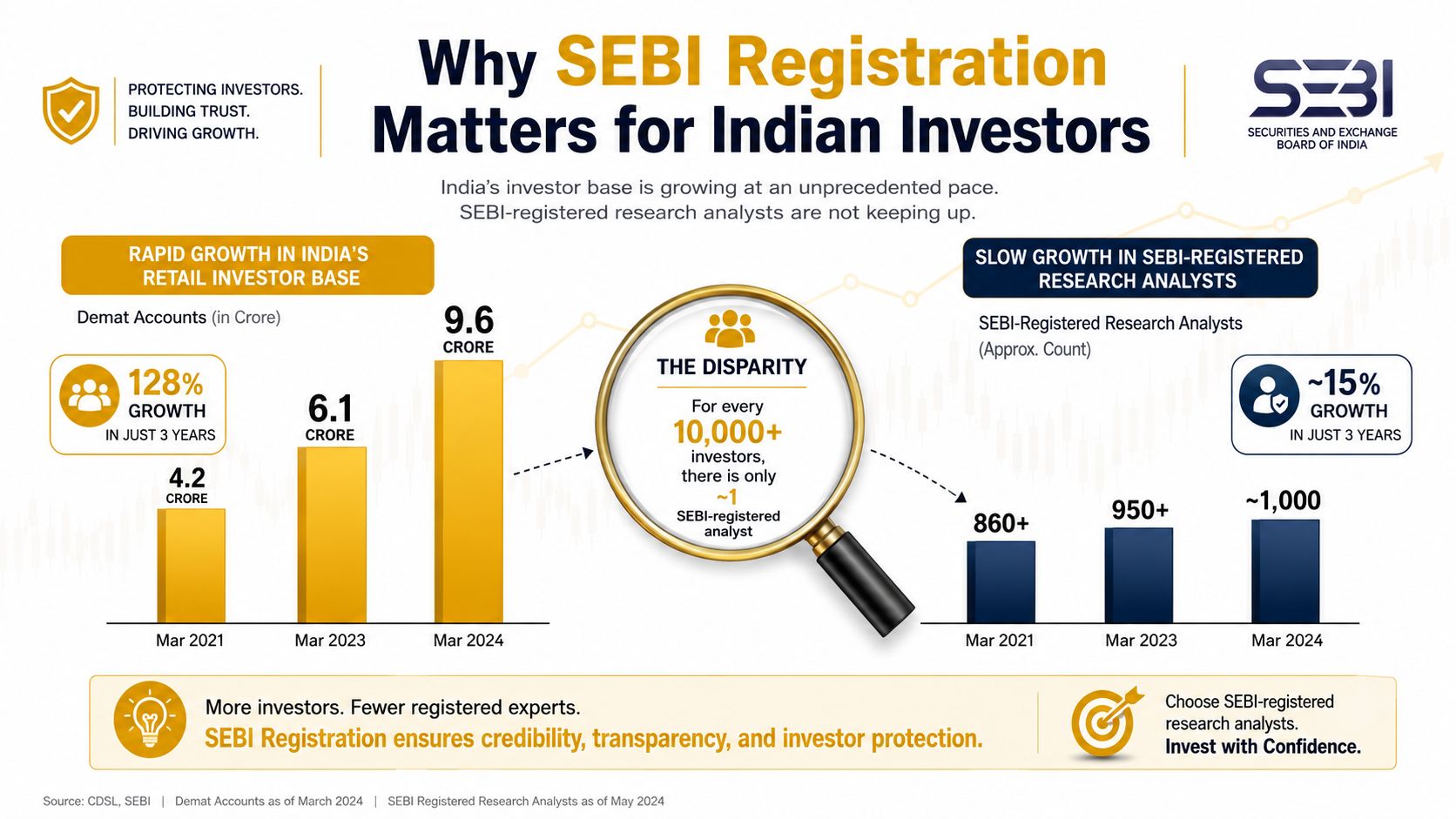
Table of Contents
- Why SEBI Registration Matters for Indian Investors
- What a SEBI Registered Research Analyst Actually Does
- Registration Categories and Net Worth Requirements
- Eligibility and Certification Requirements
- How to Verify an Analyst's SEBI Registration
- Market Commentary Versus Regulated Research Advice
- Operational Challenges for Small Research Analysts
- Compliance Implications for Investors and Analysts
- Quick Reference Checklist for Evaluating Research Calls
- Frequently Asked Questions About SEBI Registration
Why SEBI Registration Matters for Indian Investors
The biggest reason to care about a SEBI registered research analyst is simple, there are far more retail investors than registered analysts now, so credibility matters more than ever. SEBI's own data shows registered research analysts rose from 730 on 31 Mar 2021 to 1,380 on 31 Aug 2024, an increase of about 89% in a little over three years, but the investor universe expanded much faster over the longer run. SEBI's research analyst framework data shows why verification is no longer optional.
When the supply of accountable research doesn't keep pace with investor growth, unregistered advice fills the gap. That's where retail investors get confused, because a confident stock opinion can sound the same whether it comes from a regulated analyst or a random content creator.
Practical rule: if someone is charging for stock research, the first question is not how confident they sound, it's whether they're registered and traceable.
For beginners, this matters because SEBI registration creates a paper trail. It tells you the person has met regulatory requirements, sits under a defined framework, and can be checked against official records. If you're still learning the basics of market structure, the plain-English guide on stock market basics for beginners is a good companion read.
The investor lesson is straightforward. Don't treat “market expert,” “trader,” or “advisor” as protected labels. In India, registration is the proof that matters, not the tone of the post.
What a SEBI Registered Research Analyst Actually Does
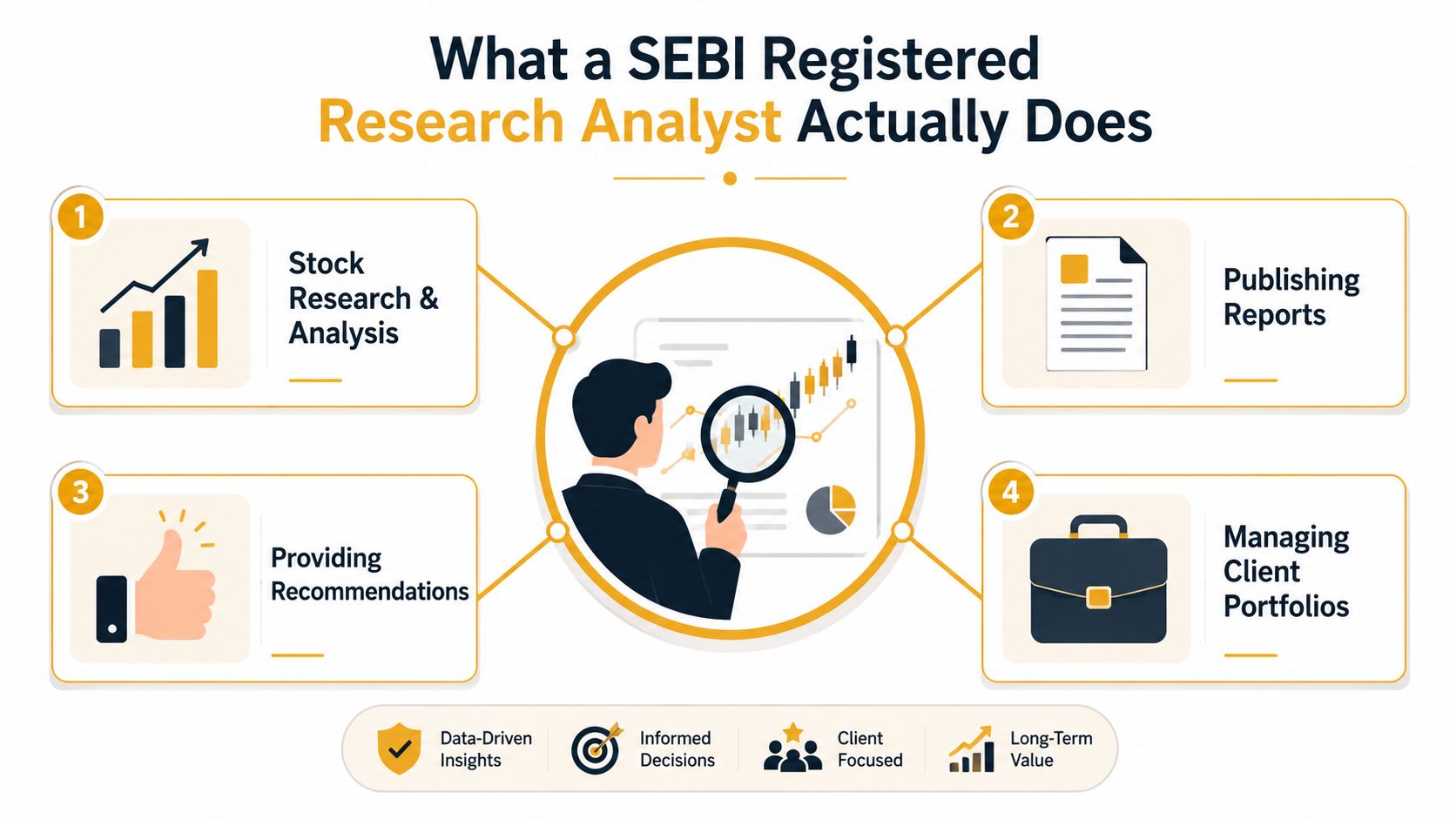
A research analyst under SEBI is a person or entity that provides research reports or investment recommendations for a fee. That includes buy, hold, or sell opinions, and also price targets, which are the analyst's estimate of where a stock may trade if their view plays out. SEBI's definition is about accountability as much as content, because the person giving the view must be identifiable and regulated. SEBI's framework note
The work that falls inside the rule
A registered analyst typically prepares or publishes research after studying company data, market trends, and financial statements. The key point is that the output is meant to be a formal recommendation, not casual commentary.
A few examples make the boundary easier to see:
- Stock report with a target: regulated research.
- Buy or sell call on a listed share: regulated research.
- Sector note with a specific actionable view: can still fall under the regulated umbrella if it becomes an investment recommendation.
- General discussion of index movement or market mood: usually commentary, not research advice.
The confusion starts when social media compresses all of this into one feed. A quick post saying “bullish on banks” may look harmless, but if it is presented as an actionable investment view, the regulatory lens changes.
A useful way to think about it is this, a registered research analyst gives documented recommendations. A casual creator gives opinions, sometimes useful, sometimes not, but not always under the same compliance standard.
Registration Categories and Net Worth Requirements
SEBI divides research analysts into two practical buckets, individuals or partnerships and body corporates or LLPs. That split matters because the financial cushion expected from a solo analyst is different from what SEBI expects from a larger entity with more operational risk.
| Category | Minimum Net Worth | Typical Structure |
|---|---|---|
| Individuals / Partnerships | ₹1 lakh | Solo analyst or small partnership |
| Body corporates / LLPs | ₹25 lakh | Company or limited liability partnership |
These figures are not a performance score. They are a compliance buffer, a basic financial threshold that must be crossed before a person or firm can operate under SEBI's research analyst framework. SEBI's January 2025 guidelines also added a client-linked deposit requirement, starting at ₹1 lakh for up to 150 clients and rising to ₹10 lakh for 1,001+ clients. SEBI's January 2025 guidelines
For investors, the practical reading is simple. A larger research outfit may carry heavier compliance overhead, while a solo analyst may need less capital, but both still have to meet the same standards for accountability, documentation, and disclosure.
That helps explain why a loud market voice is not the same as a registered research business. Registration is about more than market opinions, it also means meeting the compliance structure that sits behind those opinions.
Eligibility and Certification Requirements
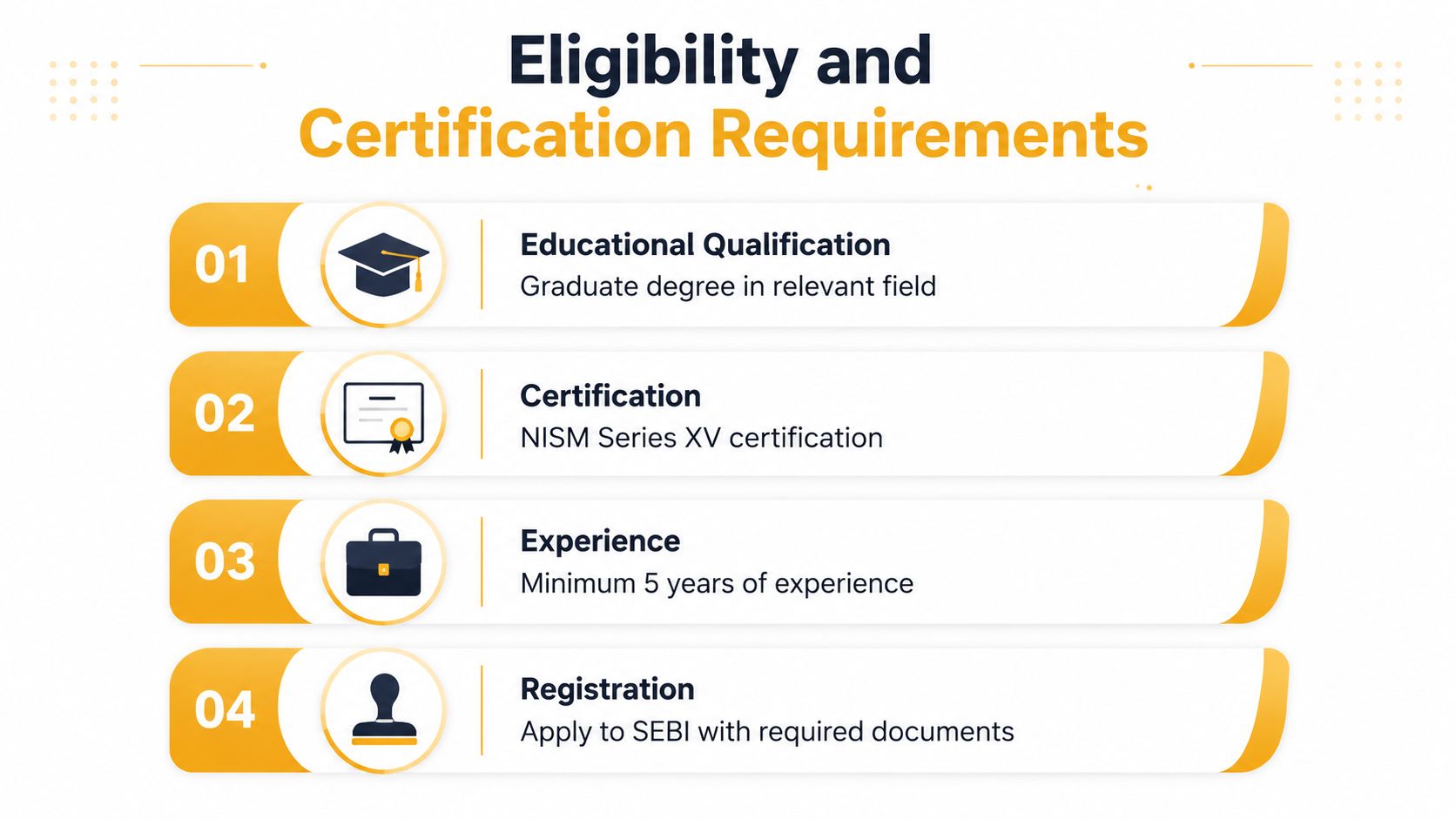
To become a SEBI registered research analyst, a person has to clear both the education-and-experience test and the certification test. SEBI requires a professional qualification or postgraduate degree/diploma in finance-related fields, or a graduate degree with at least five years of relevant experience. SEBI and NISM also require valid NISM research analyst certification for the analyst and associated persons, and the certification has to be renewed before expiry to stay compliant. SEBI regulations PDF
What that means in plain English
SEBI is not asking for a random interest in markets. It wants evidence of either formal education or meaningful work experience, plus a recognised certification that proves the person understands research standards. That's important because a stock call can influence real money, and SEBI wants the person making it to be trained enough to carry the responsibility.
A simple way to read the rule is:
- Education: the analyst needs a qualifying degree or diploma, or a graduate degree with relevant experience.
- Certification: the analyst needs valid NISM research analyst certification.
- Continuity: certification can't be left to expire.
- Accountability: the analyst must stay inside the SEBI framework after registration.
The certification is not a badge of profit-making skill, it's evidence of regulatory readiness.
For investors, this is useful because it separates trained research providers from people who learned market language on social media. If you're comparing who to trust, ask whether the person has both the qualification and the certification, not just a persuasive track record.
How to Verify an Analyst's SEBI Registration
Verification takes only a few minutes, but it should be routine every time you see a new paid stock call. SEBI requires anyone acting as a research analyst, or holding themselves out as one, to be registered unless an exemption applies, so the registration check is the first line of defence. SEBI's FAQ on research analysts
A quick verification routine
- Look for the registration number. A genuine analyst should display it openly in the website footer, profile, or communication.
- Check the official SEBI record. Search the analyst name or registration number in SEBI's intermediary records.
- Match the details carefully. The name, business type, and contact information should line up.
- Watch for inconsistencies. If the number exists but the name or location doesn't match, pause before paying.
A fake or careless profile often hides the basics. If the registration number is missing, buried, or inconsistent across platforms, that's a warning sign. The issue isn't only fraud, it's also sloppy compliance, and sloppy compliance is not something retail investors should reward.
What you want is a repeatable habit. Before you subscribe, pay, or act, check the record first. If the person won't share their registration details clearly, you already have your answer.
Market Commentary Versus Regulated Research Advice
Many retail investors get tripped up here. SEBI says a research report does not include general market trends, broad indices, or economic or political commentary, but it does cover research reports and investment recommendations. That line matters because a bullish view on the market isn't always the same thing as a regulated recommendation. SEBI's FAQ on what counts as a research report
The easiest way to think about it is by example. “The market looks volatile today” is commentary. “I expect this sector to outperform because of these documented factors” starts moving closer to research. “Buy this stock at a target price because of these financials” is squarely in the research zone.
For retail readers, the challenge is that all three can be packaged in the same thumbnail, reel, or Telegram post. That's why the distinction matters. If a creator gives a broad view, you may be reading opinion. If they issue a stock-specific recommendation or price target, you should expect SEBI-level accountability if they are operating properly.
If you want more context on how market stories and calls are often mixed online, the newsroom-style coverage at Indian stock market news shows how reporting differs from advice.
The practical takeaway is not to avoid market opinions. It's to know when an opinion becomes a regulated recommendation, because that changes what disclosures should exist and what recourse you have if something goes wrong.
Operational Challenges for Small Research Analysts
Small and solo analysts face more friction than most investors realise. In early 2026, industry representations to SEBI flagged issues such as delays in application processing, unclear migration from individual to corporate or LLP structures, and questions around whether a principal officer can hold other employment. Those are operational problems, but they shape who can become and stay compliant. Industry representation to SEBI
That matters to investors because the supply of registered analysts is already stretched against the size of the retail market. If registration takes time or the business structure is hard to change later, smaller firms may struggle to scale. Some stay small by choice, others stay small because the compliance path is slow.
Why this affects your stock tips
- Fewer registered providers: the market has less formalised research than retail demand may suggest.
- Longer launch timelines: new analysts may spend more time on paperwork than on publishing.
- Business structure constraints: moving from solo practice to a firm isn't always straightforward.
- Employment clarity issues: if the principal officer's outside work is unclear, compliance becomes harder to manage.
This is also why registered research can feel less abundant than social media tips. A compliant setup carries process, oversight, and documentation. That doesn't make it perfect, but it does make it accountable.
For readers comparing different research services, the broader market context on equity research platforms helps explain why some services look polished while others stay lightweight.
Compliance Implications for Investors and Analysts
SEBI registration adds a clear line of accountability on both sides. For investors, it means the person behind a call should be identifiable, registered, and bound by rules. For analysts, it means every recommendation sits inside a framework that covers certification, disclosures, conduct, and complaint handling.
The practical effect is simple. A registered analyst is not just someone who sounds confident on a market channel, the analyst has to show who they are, how they operate, and where a client can raise a grievance if something goes wrong. That matters because retail investors now see more stock opinions than ever, while the pool of registered professionals remains limited. The gap makes verification more important, not less.
The 2025 client-linked deposit structure adds another layer of accountability, because the required deposit rises as client volumes rise. That creates a financial buffer around larger operations. SEBI also keeps a net worth floor in place, with ₹1 lakh for individuals or partnerships and ₹25 lakh for body corporates or LLPs.
Investors should expect clear registration details, a defined grievance path, and research that can be traced back to a named person or entity. They should also expect disclosure of any conflict that could affect the recommendation. A compliant analyst gives you traceability and a complaint route. A compliant analyst does not give guarantees, certainty, or easy profits.
The safest habit is to treat registration as the starting point. A registered analyst can still be wrong, but a registered analyst is answerable under SEBI's rules, and that difference matters when real money is on the line.
Quick Reference Checklist for Evaluating Research Calls
Use this before acting on any stock tip, paid call, or “research” post. It keeps you focused on evidence instead of urgency.
- Check the registration number: confirm the analyst shows a valid SEBI RA number.
- Match the identity: make sure the name on the post, website, and official record line up.
- Look for disclosures: risk notes, complaint process, and clear contact details should be visible.
- Ask what kind of content it is: general commentary is not the same as a regulated recommendation.
- Ignore pressure tactics: urgency, secrecy, and “limited slots” usually help the seller, not you.
- Separate research from execution: a research analyst gives opinions and reports, not trade execution.
If you're comparing fast-moving call channels with more structured services, the format used in intraday trading calls can help you spot how attribution and timing should look in a more transparent setup.
If the call sounds urgent but the credentials are vague, step back and verify first.
This checklist works because it reduces the decision to a few visible facts. You don't need to guess intent, you only need to check identity, registration, and disclosure.
Frequently Asked Questions About SEBI Registration
Is every free stock tip a SEBI-regulated recommendation? No. Free tips can still be unregistered opinion, commentary, or marketing. The key question is whether the person is presenting themselves as a research analyst and issuing regulated recommendations.
What if an analyst's certification expires? Then the compliance problem is on the analyst's side, because SEBI's framework requires valid certification and renewal before expiry. As a reader, you should pause and verify whether the person is still properly registered and active.
Can a research analyst trade on my behalf? No. A research analyst provides research and recommendations, not portfolio execution. If someone claims they can manage your trades directly through a research analyst role, treat that as a warning sign.
Where should I complain about a fake advisor? Start with the person's official grievance channel, then move to SEBI's complaint system if needed. The important point is to keep records, screenshots, and payment proof before you report.
Does registration mean the analyst will be right? No. Registration means the analyst is accountable and regulated, not that every call will work out. Markets still carry risk, and no compliant analyst can completely remove that risk.
This is for informational and educational purposes only and not investment advice. Consult a SEBI-registered adviser before investing. For more plain-English market explainers, verified trade-call context, and timestamped Indian market journalism, visit Bharatstox and keep building your market understanding with reporting that puts registration, disclosure, and accountability first.
Disclaimer
This article is for informational and educational purposes only and does not constitute investment advice or a recommendation. Investing in securities markets is subject to market risks. Read all related documents carefully before investing.