6 Ethanol Stocks India Investors Should Know
Explore 6 ethanol stocks India investors track, with company snapshots, risks, price metrics to verify, and blending-policy catalysts for 2026.
Could the most important question about ethanol stocks in India be not who benefits from blending, but how much of that benefit reaches shareholders? The list spans three large oil-marketing companies and three sugar-ethanol producers, so ethanol exposure, business concentration, liquidity, and risks differ materially. Current price and performance figures must be checked against dated exchange or company data.
Fuel-grade ethanol is alcohol processed to meet fuel specifications, then mixed with petrol in a controlled proportion. India's blending programme has moved from about 8.1% in ESY 2020-21 to 20% in ESY 2025-26, according to government blending data released by PIB. That creates a policy-backed demand base, but it doesn't make every company in the theme an equivalent ethanol play.
Oil companies gain through procurement, blending and retail distribution inside diversified energy businesses. Sugar companies usually have more direct exposure to distillery volumes, molasses, grain and cane economics. Readers should verify dated share-price performance, ethanol volumes, realisations, margins, capacity utilisation and regulatory changes before drawing conclusions. For a useful framework on measuring campaign outcomes in a different technical sector, see biotech marketing KPIs and success. This is for informational and educational purposes only and not investment advice. Consult a SEBI-registered adviser before investing.
Table of Contents
- 1. Hindustan Petroleum Corporation Limited
- 2. Indian Oil Corporation Limited
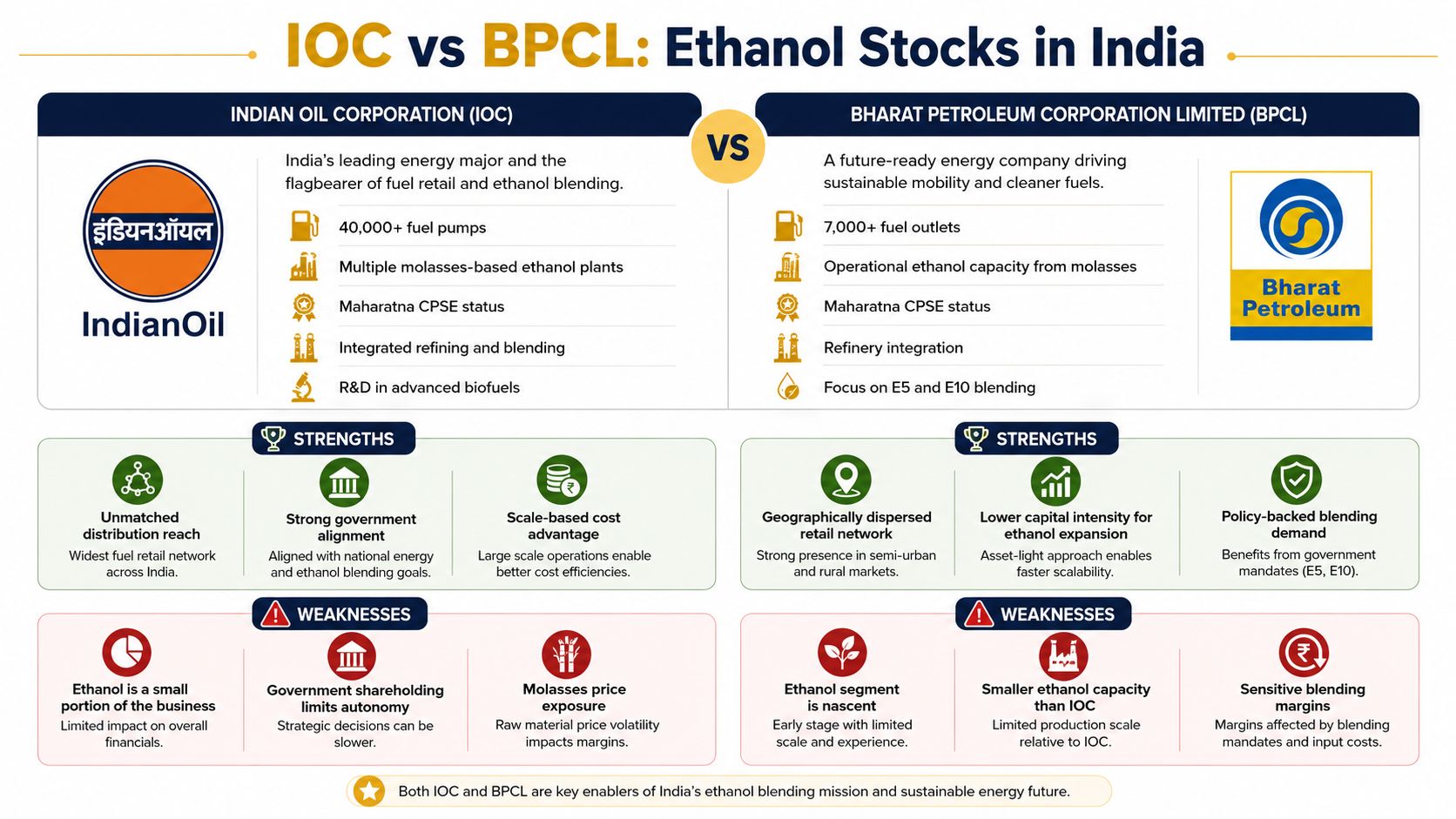
- 3. Bharat Petroleum Corporation Limited
- 4. Triveni Engineering and Industries Limited
- 5. Bajaj Hindusthan Sugar Limited
- 6. Dwarikesh Sugar Industries Limited
- Ethanol Stocks in India, 6-Company Comparison
- How to Compare Ethanol Stocks India Without Chasing Hype
1. Hindustan Petroleum Corporation Limited
HPCL's ethanol exposure is embedded in its wider oil and gas business, linking procurement, fuel blending, refining and retail distribution. That makes it a different type of ethanol stock from sugar producers, whose results can depend more directly on distillery output, feedstock costs and cane economics.
Ethanol-blended petrol combines fuel-grade ethanol with petrol before distribution to retail outlets. For HPCL, the analysis therefore extends beyond distillery production. Supply contracts, blending logistics, refinery operations and changes in fuel composition can affect costs and operating performance.
Reported company examples include ethanol blending connected with refinery operations in Mumbai and Visakhapatnam, along with E5 fuel supplied to retailers across Maharashtra and Gujarat. These activities show operational participation. They do not establish ethanol as HPCL's main earnings driver, since refining, fuel marketing and broader energy conditions remain significant influences.
What to monitor in HPCL disclosures
Readers reviewing HPCL's public filings and investor presentations can assess the ethanol connection by checking:
- Segment contribution: Look for disclosed ethanol-related volumes, realisations, operating costs and capacity information in quarterly presentations.
- Blending policy: Track Ministry of Petroleum and Natural Gas announcements, since changes in permitted or required blending levels may affect procurement demand.
- Margin context: Compare ethanol economics with crude oil and refining conditions rather than interpreting one quarter separately.
India's supply system had about 1,380 crore litres of annual ethanol production capacity as of 30 November 2023, including roughly 875 crore litres from molasses-based distilleries and 505 crore litres from grain-based distilleries, according to PIB's capacity update. For HPCL, this supply mix matters because availability, feedstock type and procurement costs can affect blending reliability.
Recent share prices and performance should be checked against dated exchange or company disclosures. The same checklist applies across the companies in this comparison: verify ethanol volumes, realisations, margins, capacity utilisation and sensitivity to policy changes.
Practical rule: Treat HPCL as a diversified fuel business with ethanol exposure, not as a pure-play distillery. Compare its ethanol contribution with its wider refining, marketing and energy results before forming a view.
2. Indian Oil Corporation Limited
IOC's scale and retail reach create a distinct form of ethanol exposure. Its operations span petroleum refining, fuel marketing and distribution, allowing ethanol to affect the supply and sale of blended petrol across an extensive outlet network.
Reported activities include ethanol-from-molasses plants, blending operations and investment in advanced biofuels. Company coverage has cited molasses-processing plants in Gujarat and Karnataka, along with E10 fuel supplied through IOC pumps in urban centres. These examples confirm participation in the ethanol chain, but they do not show how much ethanol contributes to consolidated earnings.
That distinction helps separate IOC from sugar-to-ethanol companies. A sugar producer may see distillery realisations change directly when feedstock costs move. IOC encounters the same industry conditions through procurement, logistics, retail fuel sales and the wider profitability of its oil business. Ethanol is therefore one part of a larger operating mix, and company results can move for reasons unrelated to blending.
How IOC's operating model changes the analysis
The official roadmap estimated that about 1,016 crore litres of ethanol would be required to achieve 20% blending by ESY 2025-26. An industry estimate cited by the government placed required capacity at roughly 1,700 crore litres, assuming 80% plant efficiency and other sector demand. The figures are set out in the government's published ethanol roadmap material.
Readers assessing IOC can review:
- Biofuel disclosures: Annual reports and investor presentations may identify volumes, project spending and commissioning progress.
- Feedstock conditions: Molasses and grain prices can change procurement economics even when petrol demand is stable.
- Policy execution: A blending mandate supports demand, while supply contracts, logistics and plant utilisation influence delivery.
IOC's crude and refining exposure requires separate analysis. The discussion of crude-oil-related stocks offers adjacent context, but it does not replace checking IOC's full business mix. For a consistent comparison with sugar producers, verify recent prices, operating performance, ethanol disclosures and sensitivity to feedstock and policy changes before drawing conclusions.
3. Bharat Petroleum Corporation Limited
Could BPCL's ethanol exposure be read through both fuel retailing and production, rather than treated as a standalone ethanol business?
Bharat Petroleum Corporation Limited operates between the integrated oil-company model and the sugar-to-ethanol model. It is a major fuel retailer with ethanol production and blending infrastructure, connecting the company to both supply and distribution. Reported examples include an ethanol plant in Tamil Nadu that processes local molasses, alongside E10 fuel supplied through BPCL stations in metropolitan areas.
The two activities carry different operating questions. Local molasses availability can affect production economics, while the retail network must manage blended-fuel procurement, storage, movement and demand. This combination may support operational coordination, but it also makes ethanol's contribution to BPCL's overall performance difficult to isolate.
Refining conditions, fuel-marketing margins, capital expenditure and other energy businesses can influence results at the same time. Higher blending, therefore, does not automatically produce a matching increase in company-wide profit.
What to check in BPCL's filings
India's achieved blending increased from 14.60% in ESY 2023-24 to 19.2% in ESY 2024-25, before reaching the stated target in the following supply year, according to the PIB release on the blending programme. The progression indicates that demand developed across successive supply years, rather than resulting from one policy announcement.
BPCL's disclosures can be read against four questions:
- Renewable-fuels capex: Do project timelines show progress from announced spending to commissioning?
- Blended-petrol volumes: Does operating commentary distinguish volume growth from margin changes?
- Molasses sensitivity: How do procurement conditions compare with reported fuel and marketing margins?
- Execution: Has a planned facility begun production, and are offtake arrangements in place?
Bharatstox has also carried market coverage involving BPCL, including a report on a short-term trading setup. Readers can treat that as dated market reporting and separately verify recent prices, performance, disclosures and policy sensitivity in BPCL's filings.
4. Triveni Engineering and Industries Limited
Triveni Engineering and Industries Limited shows the sugar-to-ethanol economics side of India's ethanol market. Sugar mills, distilleries and cogeneration operations sit within an integrated model, with distilleries producing ethanol from sugarcane molasses near the mills.
The arrangement links cane processing with by-product use and may reduce some transport complexity. It also leaves results more exposed to crushing schedules, feedstock availability, plant utilisation and ethanol realisations than a fuel retailer's results typically are.
A reported example is Triveni's ethanol distillery in Muzaffarnagar, which produces fuel-grade ethanol from molasses and supplies fuel-blending stations and retailers across North India. That relationship shows direct access to the downstream market. It does not, on its own, show the profitability of individual contracts.
Feedstock is the key variable
Recent sector coverage reported that sugarcane supplied 32% of ethanol volumes between November 2025 and July 2026, while grain feedstocks supplied 68%. It also reported projected procurement for 2025-26 above 1,200 crore litres, compared with production capacity of about 2,000 crore litres. The figures appear in the feedstock and capacity discussion published by Econiti.
That shift matters for a producer connected to sugar mills. Molasses, grain and sugar-derived feedstocks can carry different costs, supply constraints and production outcomes. Feedstock flexibility may help a distillery respond to changing availability, while also making the earnings picture harder to read from ethanol volume alone.
A useful review of Triveni's filings can focus on four checks:
- Volume and realisation: Are higher distillery sales accompanied by stable per-unit realisations, or are margins weakening?
- Seasonality: Do crushing schedules explain changes in sugar and molasses availability?
- Input substitution: Which feedstock is being used, and how does its cost compare with the prior period?
- Debt and diversification: Do sugar, engineering and water-related operations cushion volatility, or make consolidated results more difficult to assess?
The central test is conversion. Ethanol exposure matters only if feedstock choices, plant execution and pricing produce durable operating cash flow.
Bharatstox's short-term market radar featuring Triveni is dated market coverage, not a substitute for annual reports, results and company disclosures. Readers can compare recent price performance with those filings and then assess sensitivity to feedstock costs, blending policy and execution.
An educational video can help explain how integrated producers connect sugar processing with fuel supply.
5. Bajaj Hindusthan Sugar Limited
Could Bajaj Hindusthan Sugar Limited offer a clearer view of sugar-to-ethanol economics than an integrated oil marketer? Its business links sugar extraction, molasses fermentation and co-product use, making ethanol a more direct part of the operating story than it is for IOC, HPCL or BPCL.
A reported example is an integrated ethanol distillery connected to a Bajaj Hindusthan sugar mill in Uttar Pradesh, with ethanol supplied to state petroleum corporations for E10 blending. That arrangement can make production volumes and feedstock decisions particularly relevant to results. It also leaves the company more exposed to sugarcane availability, molasses supply, regulation, operating costs and execution.
The investment question is whether additional ethanol volume produces durable cash flow after those costs. A blending mandate provides an offtake framework, yet it does not remove commodity risk. Sugarcane prices, government pricing decisions, molasses availability and plant utilisation can all affect margins. Annual reports and quarterly presentations offer a firmer basis for assessing that exposure than the broad description “ethanol beneficiary”.
Rather than treating capacity as output, readers can test the business through a few operating indicators:
- Crushing-season results: Does reported ethanol production match cane availability and operating days?
- Capacity utilisation: Are distilleries running efficiently and securing enough feedstock?
- Segment EBITDA: How does ethanol profitability compare with sugar operations and prevailing industry pricing?
- Policy announcements: Is the development a confirmed rule, or only a proposal, projection or market expectation?
India's National Policy on Biofuels was amended to advance the 20% petrol-blending target from 2030 to ESY 2025-26. The government has also said no decision has been taken to raise the target beyond 20%, according to the relevant PIB release. For Bajaj Hindusthan, policy stability may assist production planning. The absence of a confirmed higher target, however, limits assumptions of indefinitely accelerating demand.
This profile can therefore be more sensitive than that of a fuel-retailing company. Direct ethanol exposure may amplify operating benefits when feedstock and plant conditions are favourable, while adverse costs, supply conditions or balance-sheet developments may affect results more visibly. Recent prices and performance should be checked against filings and disclosures, with readers using this guide to reading an Indian annual report to locate debt, segment data and management commentary.
6. Dwarikesh Sugar Industries Limited
Dwarikesh Sugar Industries Limited is a smaller-cap sugar and ethanol producer with mills in Uttar Pradesh. Its integrated distilleries make fuel-grade ethanol from molasses, linking reported ethanol exposure to sugar output, cane procurement and feedstock economics.
The company's profile differs from fuel-retailing groups. Its results are more closely connected to cane availability, molasses supply and distillery utilisation during the crushing cycle. A favourable ethanol demand environment may support volumes, yet higher cane costs, weak plant utilisation or supply disruption can limit the benefit.
The concentration provides a focused way to examine the business. Quarterly filings can be assessed through distillery volumes, realisations, cane costs, operating margins and plant utilisation. Geographic concentration also matters, because conditions in Uttar Pradesh and the outcome of a crop cycle may influence supply and costs more directly than they would for a diversified oil marketer.
A practical review should cover:
- Crushing-season output: Compare quarterly production with the company's operating cycle and disclosed capacity.
- Regional cane conditions: Assess whether Uttar Pradesh supply expectations could change feedstock availability or cost.
- Realisation trends: Check whether stronger ethanol demand is improving economics, rather than only increasing volumes.
- Expansion announcements: Treat new capacity as a plan until financing, construction, commissioning and feedstock arrangements advance.
- Trading liquidity: Smaller listed companies may see less active trading, making price movement and order execution harder.
The wider procurement trend explains the sector's continued attention. Government data shows procurement rising from about 38 crore litres in 2013-14 to over 1,200 crore litres projected for 2025-26, according to the PIB account of the programme. That expansion indicates growing demand for ethanol, but it does not establish which producer will earn the strongest margins.
For Dwarikesh, readers should verify the latest share price, operating performance, debt, disclosures and policy sensitivity before drawing comparisons. A growing market can still produce uneven shareholder outcomes. Production efficiency, access to raw materials, debt servicing and liquidity determine how much sector growth reaches an individual company.
Ethanol Stocks in India, 6-Company Comparison
| Company | Implementation complexity 🔄 | Resource requirements ⚡ | Expected outcomes 📊 | Ideal use cases 💡 | Key advantages ⭐ |
|---|---|---|---|---|---|
| Hindustan Petrochemicals Corporation Limited (HPCL) | 🔄 Moderate, refinery + ethanol plant integration, PSU approvals | ⚡ High, refinery-linked capex, storage & distribution upgrades | 📊 Steady ethanol volumes; ethanol remains a minority of revenue | 💡 Policy-driven blend supply to state retailers and regional rollout | ⭐ PSU backing, established distribution, low execution risk |
| Indian Oil Corporation Limited (IOC) | 🔄 High, large-scale retail integration, molasses plants, R&D | ⚡ Very high, national retail network, plant capex, supply chain scale | 📊 Largest blended-fuel reach; scale reduces per-litre cost | 💡 Rapid national E10 deployment and advanced-biofuel pilots | ⭐ Unmatched distribution, strong balance sheet, scale advantages |
| Bharat Petroleum Corporation Limited (BPCL) | 🔄 Moderate, refinery integration with regional molasses plants | ⚡ High, retail upgrades and ethanol capacity additions | 📊 Incremental E5/E10 supply growth; ethanol share small vs petroleum | 💡 Regional urban deployment and targeted blend expansion | ⭐ Geographically dispersed retail network; policy-aligned demand |
| Triveni Engineering and Industries Limited | 🔄 Moderate, co‑located sugar–ethanol–power operations; seasonal timing | ⚡ Medium, distilleries plus cogeneration lower operating cost | 📊 Direct ethanol-margin exposure; higher seasonality and volatility | 💡 Pure-play ethanol exposure; investors seeking integrated feedstock margin | ⭐ Integrated feedstock security, cogeneration efficiency, focused operator |
| Bajaj Hindusthan Sugar Limited | 🔄 Moderate, multiple integrated mills and distilleries | ⚡ Medium, large crushing base but cyclical working capital needs | 📊 Significant ethanol volumes tied to sugar seasonality | 💡 Mid‑cap thematic ethanol play with M&A potential | ⭐ Large crushing capacity, recurring feedstock, visible ethanol contribution |
| Dwarikesh Sugar Industries Limited | 🔄 Low–Moderate, smaller integrated mills concentrated regionally | ⚡ Low–Medium, limited capex but low liquidity and bargaining power | 📊 High leverage to ethanol margins; volatile and liquidity‑sensitive | 💡 High-risk/high-reward small‑cap ethanol exposure; regional supplier | ⭐ High ethanol margin exposure, simple structure, underfollowed stock |
How to Compare Ethanol Stocks India Without Chasing Hype
The six companies fall into two broad groups. HPCL, IOC and BPCL are diversified oil and fuel distributors with ethanol embedded in larger businesses. Triveni, Bajaj Hindusthan and Dwarikesh are more concentrated sugar-ethanol producers, where distillery performance can have a more direct relationship with cane, molasses, grain and crushing cycles.
Neither group is automatically superior. Oil marketers may offer broader operating diversification, but ethanol can be difficult to isolate in consolidated results. Sugar-ethanol producers may offer clearer direct exposure, but they can face stronger feedstock, seasonality, commodity and regional risks. The right comparison depends on what the reader is trying to understand, not on which label sounds most attractive.
A consistent verification checklist
Use the same process for every company before interpreting a price move:
- Dated market data: Check the latest NSE or BSE price, trading date and performance period. Don't compare a current quote with an undated article or an old chart.
- Ethanol volumes: Look for production, sales, procurement and offtake disclosures in annual reports and investor presentations.
- Realisations and margins: A volume increase matters differently when realisations or segment margins are falling.
- Capacity utilisation: Compare installed capacity with actual output and plant operating efficiency.
- Feedstock costs: Track sugarcane, molasses and maize conditions, while recognising that the mix can change.
- Balance sheet quality: Review debt, interest costs, cash flow and funding needs for distillery expansion.
- Policy sensitivity: Follow blending rules, procurement arrangements, permitted feedstocks and official target statements.
- Liquidity and execution: Check trading activity, project timelines, commissioning updates and management commentary.
The policy case is substantial. India advanced the 20% target to ESY 2025-26, and official releases report that the country reached the level five years ahead of the original schedule. But policy support doesn't eliminate commercial risk. Government price decisions, procurement rules, crude-market conditions, feedstock swings, plant utilisation, weather and seasonality can offset the benefit of higher blending.
Brief FAQ
What makes a company an ethanol stock?
A company can enter the theme as a direct ethanol producer, an integrated sugar business with distilleries, an oil marketer that procures and blends ethanol, or a technology and equipment supplier. The label alone isn't enough. Readers should identify ethanol's actual contribution to volumes, revenue, operating profit and capital expenditure.
Why do sugar companies have higher direct exposure?
Sugar companies often convert molasses, syrup or other feedstocks generated during cane processing into ethanol. That can make distillery volumes and margins more visible, while also linking results to cane availability, sugar policy and feedstock costs.
Which metrics should readers check first?
Start with ethanol volumes, realisations, capacity utilisation and feedstock costs. Then review debt, cash flow, project execution and the latest blending-policy disclosures. This sequence helps separate demand growth from profitability.
Bharatstox publishes bylined market journalism, corporate filing updates with visible timestamps and plain-language explainers for NSE and BSE readers. Its reporting can help readers locate the relevant disclosure, understand what changed and distinguish dated information from current data. It isn't investment advice, and readers should use a separate guide to locating dividends on any stock only as part of wider company research.
Visit Bharatstox for dated ethanol-sector journalism, plain-language filing explainers and market updates across NSE and BSE. Use those resources to cross-check company disclosures, policy developments and current market data before forming your own view.
Disclaimer
This article is for informational and educational purposes only and does not constitute investment advice or a recommendation. Investing in securities markets is subject to market risks. Read all related documents carefully before investing.