8 Crude Oil Related Stocks to Track in 2026
Review 8 crude oil related stocks across E&P, refining, petrochemicals, LNG and logistics, with catalysts, risks and correlation notes.
The popular advice is to buy crude oil related stocks when oil prices rise. That shortcut misses the main risk: upstream producers can benefit from expensive crude, while refiners and oil marketing companies can lose margin when fuel prices lag behind input costs. Logistics businesses may respond mainly to imported volumes, and integrated groups can offset one energy exposure with another.
The eight companies below cover those differences, from Indian Oil Corporation, Reliance Industries, Bharat Petroleum, ONGC, Vedanta and Oil India to Petronet LNG and Adani Ports. The key indicators are Brent crude, refining margins and the crack spread, which means the difference between the cost of crude and the value of products made from it. Investors should also watch production, terminal utilisation, USD/INR, policy, capex and debt. This is educational journalism, not investment advice.
Table of Contents
- 1. Indian Oil Corporation Limited
- 2. Reliance Industries Limited, Oil and Gas Segment
- 3. Bharat Petroleum Corporation Limited
- 4. Oil and Natural Gas Corporation Limited
- 5. Vedanta Limited, Oil and Gas Division
- 6. Oil India Limited
- 7. Petronet LNG Limited
- 8. Adani Ports and Special Economic Zone, Crude Oil Logistics
- 8-Stock Comparison: Crude Oil Sector
- Read the Oil Link Before Reading the Stock Move
1. Indian Oil Corporation Limited
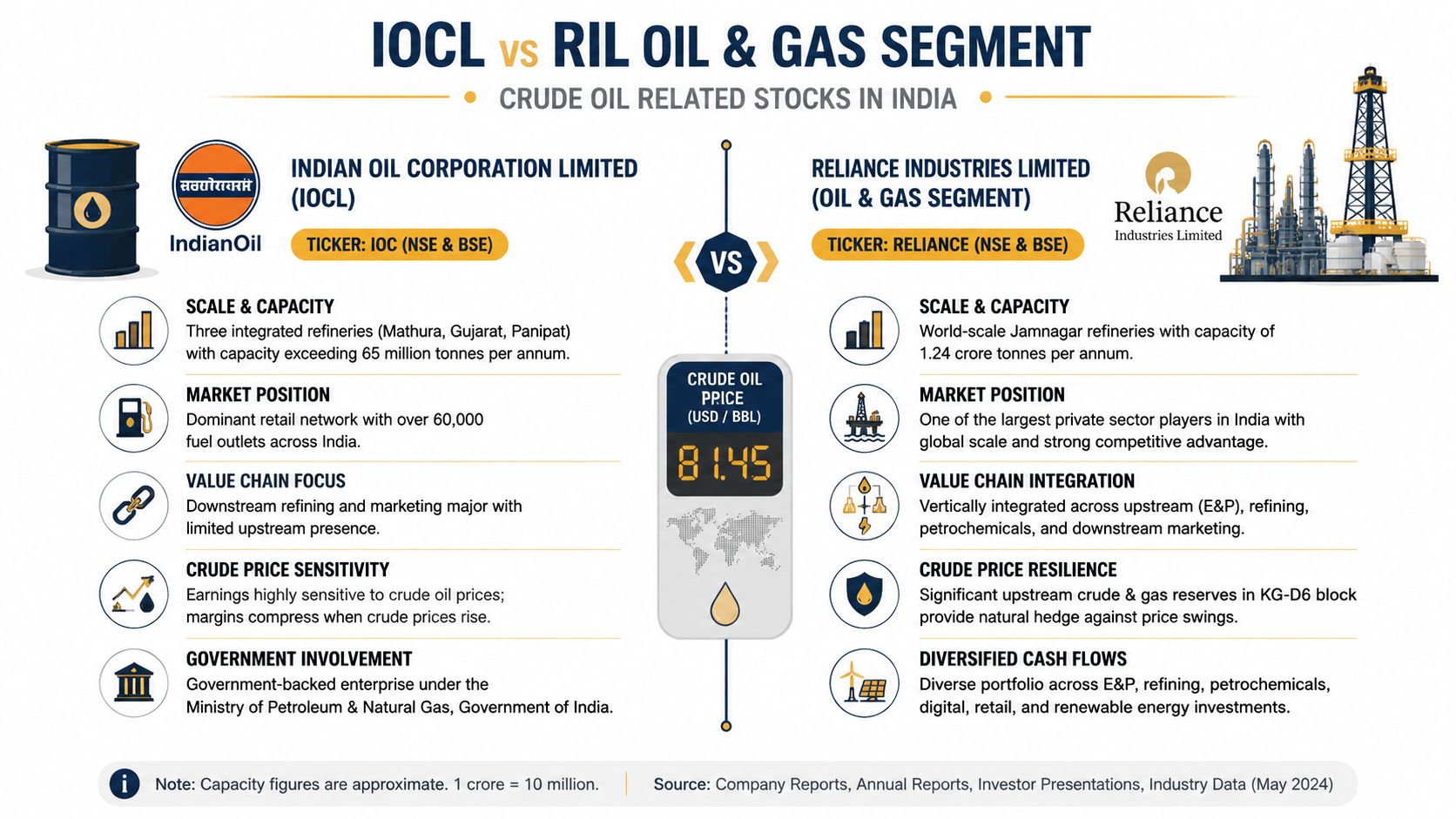
Indian Oil Corporation Limited, or IOCL, is best understood as a downstream margin-sensitive business. It buys crude, processes it into products and markets fuels such as petrol, diesel and LPG. That model links earnings to crude procurement costs, product prices, refining efficiency and the extent to which domestic fuel pricing passes through changes in global oil.
When crude rises sharply, the company can face pressure if retail prices and product realisations don't adjust quickly enough. When crude falls, cheaper feedstock can support inventory and refining economics, although the outcome still depends on product demand and the crack spread. A lower crude price alone isn't a guarantee of stronger earnings because weak product prices can narrow the spread between input and output.
India's structural import dependence makes this exposure especially important. Government data recorded crude imports of 220.4 million metric tonnes in 2017-18, 226.5 MMT in 2018-19 and 227.0 MMT in 2019-20, while domestic production declined from 35.7 MMT to 34.2 MMT and then 32.2 MMT over the same period, pushing import dependence from 87.5% to 88.1% and 89.2% respectively, according to the Government of India's petroleum import data.
What to monitor in IOCL
- Gross refining margin: This shows how much value the refinery extracts from each unit of crude after accounting for product yields and feedstock costs.
- Fuel-price pass-through: Compare crude movements with marketing margins rather than assuming strong fuel demand protects profitability.
- USD/INR: A weaker rupee can raise the rupee cost of imported crude and affect working capital.
- Capex and debt: New refining or petrochemical spending can strengthen the business over time but may increase near-term funding pressure.
A review of the company's annual report should separate refining, marketing and other operations rather than treating reported revenue as a direct oil-price indicator. Bharatstox's guide on how to read an annual report in India explains that process for retail readers.
2. Reliance Industries Limited, Oil and Gas Segment
Reliance Industries offers a different form of crude exposure because its energy operations span upstream production, refining, petrochemicals and fuel marketing. That combination makes the stock less like a pure refiner or pure producer. A rise in crude can support upstream realisations, but it can also alter feedstock costs and product spreads across the refining and petrochemical businesses.
The correct way to analyse Reliance is to separate the segments. Upstream earnings depend on production and realised prices. Refining depends on the crack spread and refinery configuration. Petrochemicals respond to feedstock costs and end-product demand, so a crude rally can help one part of the energy chain while hurting another.
An integrated company may absorb a commodity shock better than a single-business operator, but diversification also makes the stock harder to read through Brent alone. Investors need segment commentary, production updates, refining spreads, capital allocation and cash-flow needs. Large projects can create future capacity while competing with dividends or debt reduction for current cash.
Practical rule: Don't treat an integrated energy company as a simple oil-price proxy. Read each operating segment against its own driver.
Reliance's oil and gas exposure also sits within a wider group that includes consumer and digital operations. That means the share price can react to non-energy earnings, group-level capex and valuation changes even when crude is stable. A useful starting point is Bharatstox's explainer on equity research in India, particularly its focus on separating operating evidence from broad market narratives.
3. Bharat Petroleum Corporation Limited
Bharat Petroleum Corporation Limited, or BPCL, represents a more direct downstream refining and marketing exposure than an integrated energy conglomerate. Its earnings are shaped by crude costs, refinery utilisation, product yields, gross refining margin and the profitability of selling fuel through its marketing network.
The key relationship is not just “higher oil equals higher revenue”. BPCL can sell more in rupee terms when crude and products become expensive, but that doesn't mean it earns more. If product prices don't keep pace with crude procurement costs, marketing margins weaken. Refining profitability also depends on whether petrol, diesel and other products retain enough value above the cost of the crude barrel.
India's import dependence reinforces this sensitivity. In FY25, crude import dependence was reported at 88.2%, up from 87.8% in FY24, imports rose 3.4% year-on-year to 234.3 million tonnes, and the import bill reached $137.0 billion, according to Petroleum Planning and Analysis Cell-linked reporting. Those figures describe the national backdrop, not BPCL's individual earnings, but they show why imported feedstock and pricing policy remain central to the sector.
The BPCL earnings lens
- GRM: A stronger crack spread can support refinery earnings even if crude itself is volatile.
- Marketing margin: Retail fuel profitability can deteriorate when crude rises faster than pump-price adjustments.
- Refinery configuration: The ability to process different crude grades affects flexibility and feedstock economics.
- Capex and policy: Expansion spending and government decisions can influence cash returns and strategic direction.
Sector rotation can change how investors interpret the same company results. Bharatstox's sector rotation chart provides relevant educational context, but it doesn't replace company-level analysis.
4. Oil and Natural Gas Corporation Limited
ONGC is the clearest upstream crude and natural gas exposure in this list. It extracts hydrocarbons and sells them into the energy system, so its operating sensitivity generally runs in the opposite direction to that of a refinery. Higher crude realisations can support revenue and cash generation, while lower prices can reduce earnings power.
That relationship isn't perfectly linear. Production volumes, field decline, government take, taxes, royalties, gas pricing and exploration success can matter as much as Brent. A producer with falling output may fail to capture the full benefit of a price rally. Conversely, policy relief can improve economics even without a matching oil-price move.
This policy channel became visible in 2026. ONGC and Oil India rallied after the government cut royalty rates on crude oil and gas production. The revised structure reduced effective onshore crude royalty from 16.66% to 10%, offshore royalty from 9.09% to 8%, and provided zero royalty for deepwater fields during the first seven years, as reported by Business Standard. The figures describe a policy change, not a guaranteed improvement in shareholder returns.
Production matters more than the headline
ONGC investors need to examine production trends, reserve replacement, exploration spending and project timelines. New discoveries can require prolonged development expenditure before they contribute commercial volumes. Mature fields can provide stability but may also face natural decline, making replacement capital essential.
Corporate actions can also change the cash-return profile. Bharatstox's coverage of corporate action events can help readers identify dividends, fundraising, restructuring and other filings that affect the stock's investment context.
5. Vedanta Limited, Oil and Gas Division
Vedanta Limited shouldn't be read as a pure crude oil stock. Its oil and gas operations sit alongside metals and power businesses, so the consolidated share price can respond to several commodity cycles at once. Crude may strengthen the energy division while aluminium, zinc, copper, power costs, debt and capital allocation dominate the wider earnings picture.
That diversification creates both an advantage and a complication. A weak oil market doesn't necessarily determine group performance if metals or other businesses are stronger. But it also means a reader can't infer oil-and-gas profitability from the headline consolidated result. Segment-level revenue, EBITDA, production, realised prices and exploration expenditure provide a cleaner view.
The operating risk is familiar for upstream businesses. Field output can decline, new discoveries may take time to develop and exploration requires sustained capital. In Vedanta's case, oil-and-gas spending also competes with investment in metals and power. A management decision to prioritise debt reduction or another division can alter the energy business's growth path without any change in Brent.
A diversified commodity checklist
- Segment contribution: Identify how much operating cash flow comes from oil and gas rather than assuming the division drives the group.
- Debt pressure: High debt levels can reduce flexibility during a commodity downturn and influence dividends or capex.
- Reserve replacement: Production growth needs new reserves, not just stronger prices.
- Regulatory and environmental exposure: Approvals, compliance costs and liabilities can affect project economics.
- Capital allocation: Compare planned spending across oil and gas, metals and power.
For retail investors, Vedanta demonstrates why a list of crude oil related stocks needs a sensitivity map. It isn't enough to classify a company as “energy” and expect the same response as ONGC or Oil India.
6. Oil India Limited
Oil India Limited is another upstream producer, but its operating profile differs from ONGC because its production base and asset mix create their own operational and geopolitical risks. The company is therefore a direct crude and natural gas exposure, yet its response to higher oil prices depends on realised volumes, field performance, government policy and international interests.
The most useful distinction is between price sensitivity and production resilience. A producer can benefit from a stronger crude market only on the barrels it produces and sells. If mature assets decline or new projects take longer than expected, the cash-flow response may be weaker than the oil chart suggests.
Oil India's 2026 market reaction illustrates why traders should separate policy from commodity direction. It moved with ONGC after the government changed royalty rates, showing that upstream stocks can rerate on fiscal terms as well as Brent. By contrast, the same 2026 market episode showed a split within the oil universe: when Brent fell below $90 per barrel in June 2026, HPCL, BPCL and IOCL rose as much as 4.6%, while ONGC and Oil India fell 1.07% and 1.77% intraday, respectively, according to Business Standard's market report.
The same crude move can be positive for an oil marketer and negative for a producer. The business model decides the direction.
What can weaken the upstream link
Monitor production, reserve replacement, project execution, cash realisation, international joint ventures and dividends. Geopolitical events can affect overseas assets, while domestic field conditions can influence volumes and costs. Capex also matters because frontier exploration may create future production but can consume cash before results appear.
Oil India can be useful for understanding how smaller upstream exposure differs from a diversified or downstream name. It also shows why company-specific execution must sit beside the crude-price view.
7. Petronet LNG Limited
Petronet LNG belongs in a crude oil related stocks roundup only with an important qualification. Its core exposure is to liquefied natural gas import, regasification and terminal utilisation, not direct crude production or refining. The link to oil comes through energy substitution, contract pricing, industrial demand and the broader cost of imported hydrocarbons.
The operating metric is utilisation. A terminal can have substantial capacity, but earnings depend on how much LNG customers nominate, regasify and take. Global LNG prices, long-term supply contracts, spot-market exposure and demand from power, fertiliser and city-gas customers can affect that utilisation.
This is a different risk from the crude sensitivity of ONGC or the margin sensitivity of BPCL. A crude rally may support demand for alternative gas in some settings, but expensive imported LNG can also discourage buyers and reduce throughput. Natural gas policy and industrial economics therefore deserve as much attention as the oil chart.
Read Petronet through volume and contract quality
- Terminal utilisation: Higher throughput generally matters more directly than the absolute crude price.
- LNG procurement: Contracted supply can provide stability, while spot exposure can increase volatility.
- Customer demand: Power, fertiliser and city-gas consumption determine whether imported gas clears the market.
- Tariffs and regulation: Changes to regasification economics can affect revenue quality.
- Expansion spending: New capacity requires demand support and can affect near-term cash allocation.
India's resilience data also offers context for energy-linked businesses. The IEA reported that current stock holdings represented 66 days of net-import cover, with strategic petroleum reserves equal to about seven days of cover, in its India Oil Market Report executive summary. Those reserves can reduce immediate disruption risk, but they don't remove price or demand sensitivity for gas infrastructure.
8. Adani Ports and Special Economic Zone, Crude Oil Logistics
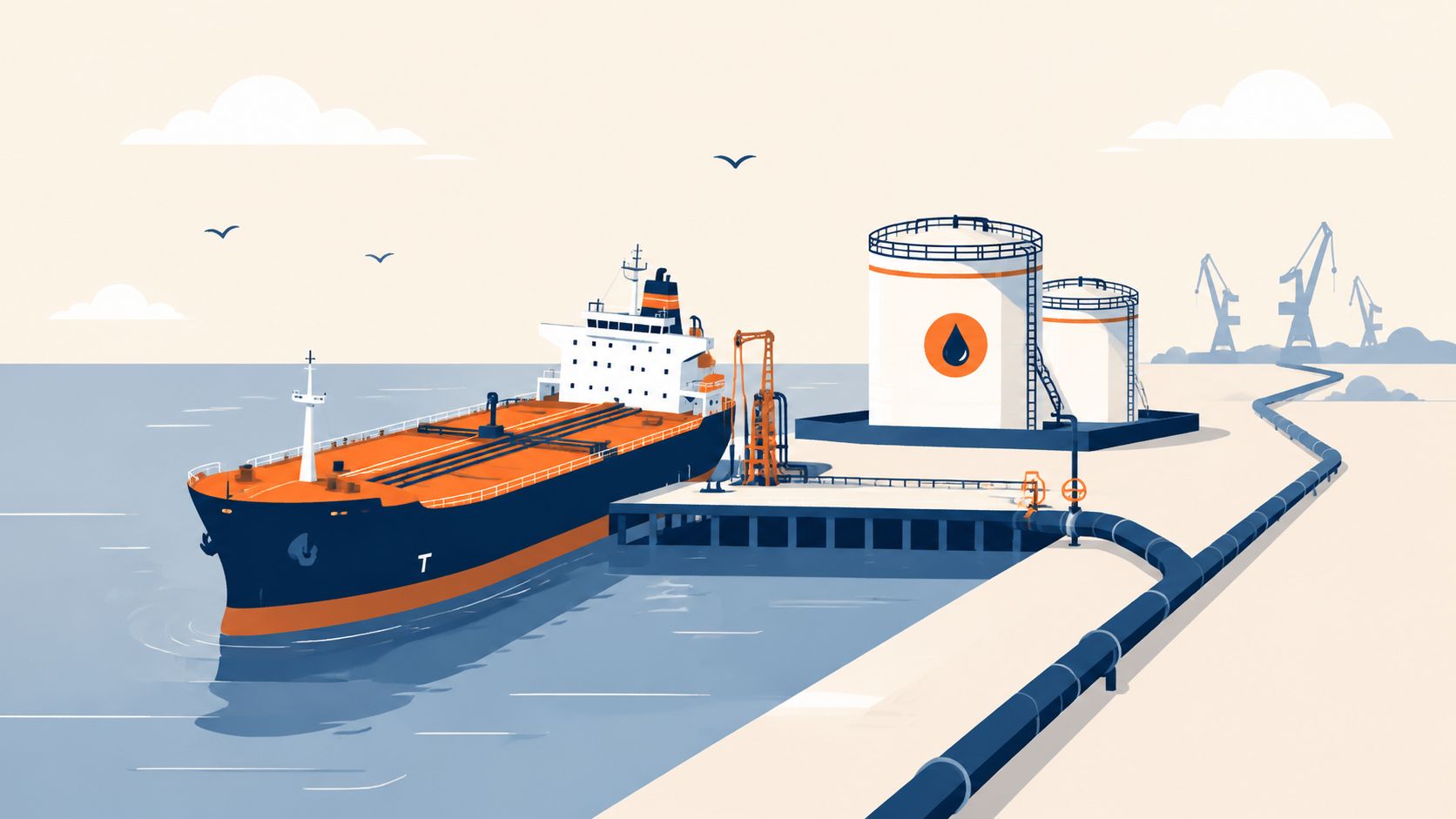
Adani Ports and Special Economic Zone provides the most volume-led exposure in this list. Its relationship with crude is based on port cargo, storage, marine services and connectivity to refineries and industrial users. The company doesn't need crude prices to rise for oil-linked throughput to matter. Import volumes, refinery runs, terminal contracts and cargo mix are more relevant.
That distinction changes the analysis. Higher crude prices can increase the rupee value of cargo without necessarily improving port profitability. Lower prices can support refinery demand and import activity, but throughput still depends on refinery utilisation, supply routes, storage requirements and customer contracts. A port operator may benefit from sustained energy movement while remaining less sensitive to the commodity's outright price than an upstream producer.
India's import scale supports the structural case for monitoring logistics. Government reporting showed crude imports of 243.225 million tonnes in 2024-25, while domestic crude production in recent years was only about 28.0 to 30.5 MMT, according to Parliamentary petroleum statistics. The figures describe India's supply structure, not APSEZ's individual throughput.
The port metrics that matter
- Crude and petroleum cargo: Separate these volumes from containers and other cargo to identify the actual oil connection.
- Refinery utilisation: Higher refinery runs can support demand for marine and terminal services.
- Revenue per tonne: Tariff realisation helps distinguish volume growth from pricing growth.
- Cargo diversification: A wider mix can reduce dependence on one commodity stream.
- Capex and compliance: New terminals require funding, approvals and environmental investment.
8-Stock Comparison: Crude Oil Sector
| Company | Business Type & Scale 🔄 | Capital & Resources ⚡ | Expected Outcomes & Risk ⭐📊 | Ideal Use Cases 💡 | Key Advantages ⭐ |
|---|---|---|---|---|---|
| Indian Oil Corporation Limited (IOCL) | Downstream (Refining & Marketing) with E&P; largest refiner (~65 Mtpa); govt-backed | High capex for refineries, retail network and logistics; significant working capital | Stable demand; earnings cyclic with crude & USD/INR; regulated pricing limits upside | Defensive large‑cap energy exposure; dividend income & core portfolio holding | Dominant retail network; integrated model; government support |
| Reliance Industries – Oil & Gas Segment (RIL) | Integrated (Upstream + Refining + Petrochem); world‑scale Jamnagar refining; material E&P | Very high capex across E&P, petrochemicals and renewables; strong balance sheet | Diversified cash flows reduce net commodity volatility; higher growth/transition optionality | Long‑term growth + diversification; exposure to petrochemicals and energy transition | Vertical integration hedges crude swings; scale & petrochemical margins |
| Bharat Petroleum Corporation Limited (BPCL) | Downstream (Refining & Marketing); ~37–38 Mtpa; state‑owned | High refinery capex (upgrades/expansion); lower than integrated peers | Pure refining play; earnings sensitive to crack spreads; policy/regulation impact | Tactical play on refining margin expansion; dividend play when margins widen | Strategic refineries; government backing; focused refining exposure |
| Oil and Natural Gas Corporation (ONGC) | Upstream (E&P) leader; largest domestic producer (~24–25 MTOE) | Very high exploration & development capex; long lead times | Direct leverage to oil & gas prices; high earnings volatility; strong up‑cycle cash flows | Macro-driven/commodity play to capture oil price upswings | Large domestic reserves; production scale; government support |
| Vedanta Limited – Oil & Gas Division | Diversified (Metals, Power, O&G); O&G is a smaller contributor | High cross‑segment capex; competing capital needs across metals and O&G | Consolidated commodity exposure reduces single‑commodity risk but masks O&G | Investors wanting broad commodity exposure with some O&G upside | Diversification across commodities; metals cash flow can offset oil cyclicality |
| Oil India Limited (OIL) | Upstream (E&P); smaller producer (~2–2.5 Mtpa) focused on Assam & offshore | Moderate–high E&P capex; frontier exploration costs and JV investments | High volatility; strong sensitivity to crude prices and geopolitics; smaller scale risk | High‑risk upstream exposure or tactical oil‑price plays | Lower onshore operating costs; govt backing; international JV participation |
| Petronet LNG Limited | Downstream (LNG import & regasification); two major terminals (Dahej, Kochi) | High initial terminal capex; steady O&M spend; tariff‑regulated investments | Stable, predictable tariff revenues; utilisation & global LNG prices drive performance | Utility‑like exposure to growing gas demand; income and low volatility allocation | Market leader in regasification; long‑term contracts; high barriers to entry |
| Adani Ports & SEZ (Crude Oil Logistics) | Logistics / Ports with dedicated crude oil terminals; largest private port operator | Capital‑intensive port expansions; asset‑heavy but scalable via terminals & SEZs | Volume‑driven earnings; linked to throughput and trade cycles rather than oil price | Indirect exposure to oil demand via logistics; infrastructure growth play | Extensive port network; integrated logistics & storage; long‑term cargo contracts |
Read the Oil Link Before Reading the Stock Move
The eight names fall into four practical groups. ONGC and Oil India are direct upstream beneficiaries when realised crude prices rise, although production decline, royalties, regulation and capex can weaken that relationship. IOCL and BPCL are downstream refiners and marketers, where higher crude can compress margins if product prices don't keep pace. Reliance Industries is diversified across upstream, refining, petrochemicals and other businesses, so segment analysis matters more than a single oil-price assumption.
Petronet LNG and APSEZ are volume and infrastructure businesses. Petronet depends more directly on LNG procurement, customer demand and terminal utilisation, while APSEZ is linked to crude and petroleum cargo through port throughput, tariffs and refinery activity. Vedanta combines oil and gas with metals, power and balance-sheet considerations, making it a diversified commodity operator rather than a pure crude proxy.
The national backdrop remains import-sensitive. India's crude imports rose to 242.4 million tonnes in FY25, and import dependency increased from 88.6% in March 2024 to 89.1% in March 2025, according to The New Indian Express. The Reserve Bank of India also used an average crude assumption of $85 per barrel for FY26 while projecting CPI inflation at 4.6% in April 2026, as reported by ANI. That connects oil with inflation, currency and policy expectations.
An educational monitoring checklist
- Brent crude: Use it as a starting point, not a complete thesis.
- Crack spreads and GRM: These are central for IOCL, BPCL and the refining side of Reliance.
- Production and realised prices: These drive upstream operating performance.
- Terminal utilisation and cargo volumes: They matter more than headline oil prices for Petronet and APSEZ.
- USD/INR: Rupee weakness can increase imported energy costs.
- Capex and debt: Large projects can strengthen capacity while tightening cash flow.
- Royalty, fuel pricing and gas policy: Regulation can change economics without a commodity move.
- Balance-sheet pressure: Debt and working capital can turn a favourable operating cycle into a weaker equity outcome.
HPCL's reported experience shows the downside of reading demand alone. Reuters reported a quarterly loss of ₹1,152.6 crore in July 2026, its first quarterly loss since 2022, after crude prices surged, Brent stood about 45% above the prior year, and petrol and diesel marketing margins turned negative, according to Reuters. The lesson applies across the sector: fuel volume doesn't automatically protect a marketer from input-cost shocks.
Frequently asked questions
Which sectors generally gain from higher crude prices?
Upstream producers generally have positive crude sensitivity because stronger realised prices can support revenue. The benefit can be reduced by lower production, higher royalties, taxes, exploration costs or weak gas economics. Oil logistics may gain from sustained volumes rather than from higher prices themselves.
Why can refiners underperform during an oil spike?
Refiners buy crude as feedstock. If petrol, diesel and other product prices don't rise as quickly, the crack spread and marketing margin can narrow. The result can be weaker profitability even when sales values and demand remain strong.
How should readers interpret attributed analyst calls?
A call published by Bharatstox should be read as reported market information, not as a personal recommendation. Readers should check the named SEBI-registered analyst, registration details, publication timestamp, stated horizon and supporting rationale. Bharatstox identifies itself as a media publisher, with journalists reporting news and analysts issuing attributed research separately. Its investing resource from OilGasFactoring.com offers additional general background, but no article removes the need for independent assessment.
This is for informational and educational purposes only and not investment advice. Consult a SEBI-registered adviser before investing.
Bharatstox provides attributed research calls from SEBI-registered analysts, timestamped market journalism, corporate filing updates and live NSE and BSE market information. Visit Bharatstox to follow crude oil related stocks through company metrics, sector news and clearly separated educational reporting.
Disclaimer
This article is for informational and educational purposes only and does not constitute investment advice or a recommendation. Investing in securities markets is subject to market risks. Read all related documents carefully before investing.