Stock Market Basics Hindi: A Simple Guide
Stock Market Basics Hindi. Learn stock market basics in Hindi and English. This beginner-friendly guide covers NSE, BSE, indices, order types, and practical

You may be smart with money, yet still feel lost when a WhatsApp message sends a stock tip, a chart screenshot, or a claim about quick profits. Stock market basics in Hindi-style simple language begin with one idea: understand the system before responding to a tip.
The stock market is a regulated place where investors buy and sell ownership in companies. The useful beginner skill isn't guessing the next price. It's learning how ownership, exchanges, accounts, orders, settlement, and risk fit together.
Table of Contents
- What Is the Stock Market and Why Does It Matter for You
- How Indian Exchanges Work and What Nifty and Sensex Show
- Demat Accounts, Trading Accounts and the First Steps to Participate
- Order Types for New Traders
- Risk, Return and Realistic Expectations for Beginners
- Next Steps to Learn and Track the Indian Markets Confidently
What Is the Stock Market and Why Does It Matter for You
Suppose a friend forwards a chart and says a company is “about to rise”. You don't know whether the message is based on research, a rumour, or a past price movement. Before asking whether to buy, ask a more basic question: what are you buying?
A share represents a small ownership interest in a company. A business can offer shares to public investors to raise money, while investors buy and sell those shares through an organised market. Your single share doesn't give you control over the business, but it connects your investment to a real company whose operations, finances, and prospects can affect how the market values it.
India's modern exchange-based market took shape during 1992 to 1994. NSE was incorporated in 1992, recognised by SEBI in April 1993, and began operations in 1994, initially with the wholesale debt market before cash-market trading followed. That transition from fragmented trading to an electronic national exchange improved access, transparency, and price discovery for retail participants. NSE's historical market information records the development of this infrastructure.
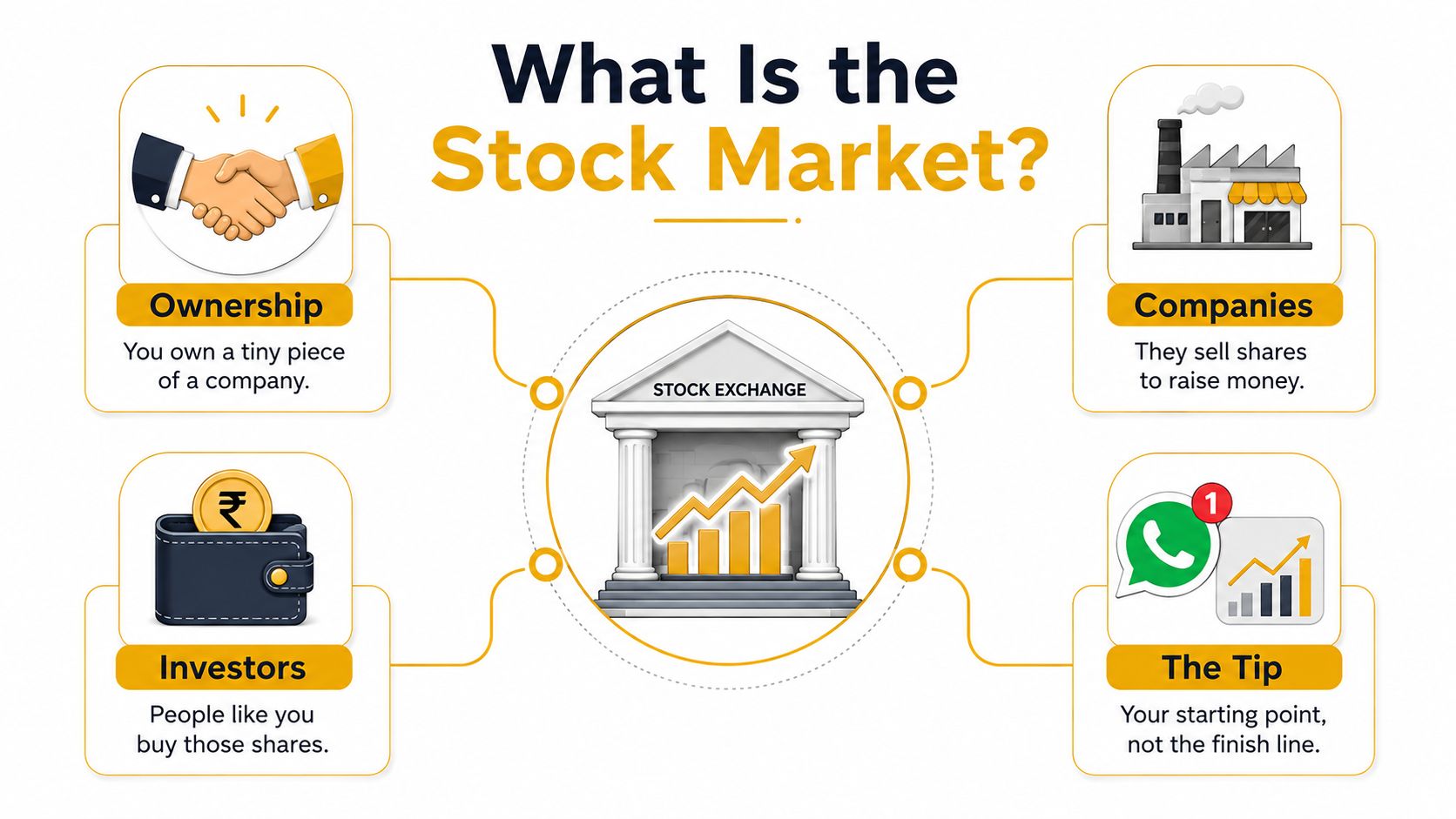
A share is ownership, not a lottery ticket
The stock market isn't a casino, although prices can move quickly and losses are possible. The price reflects what buyers and sellers are willing to pay, influenced by company information, economic conditions, investor expectations, and market sentiment.
A tip can be a starting point for a question, but it isn't proof. Look for the company's official disclosures, understand the business, identify the risks, and separate investing, which usually involves studying ownership over a longer horizon, from trading, which focuses on shorter-term price movements.
Practical rule: If you can't explain what the company does and why the information matters, you're not ready to act on the message.
Bharatstox's coverage of Indian stock market news can help readers see how company events, filings, and broader market developments are reported in context. You don't need to become a finance expert before learning. You need a clear vocabulary and the discipline to pause before placing an order.
How Indian Exchanges Work and What Nifty and Sensex Show
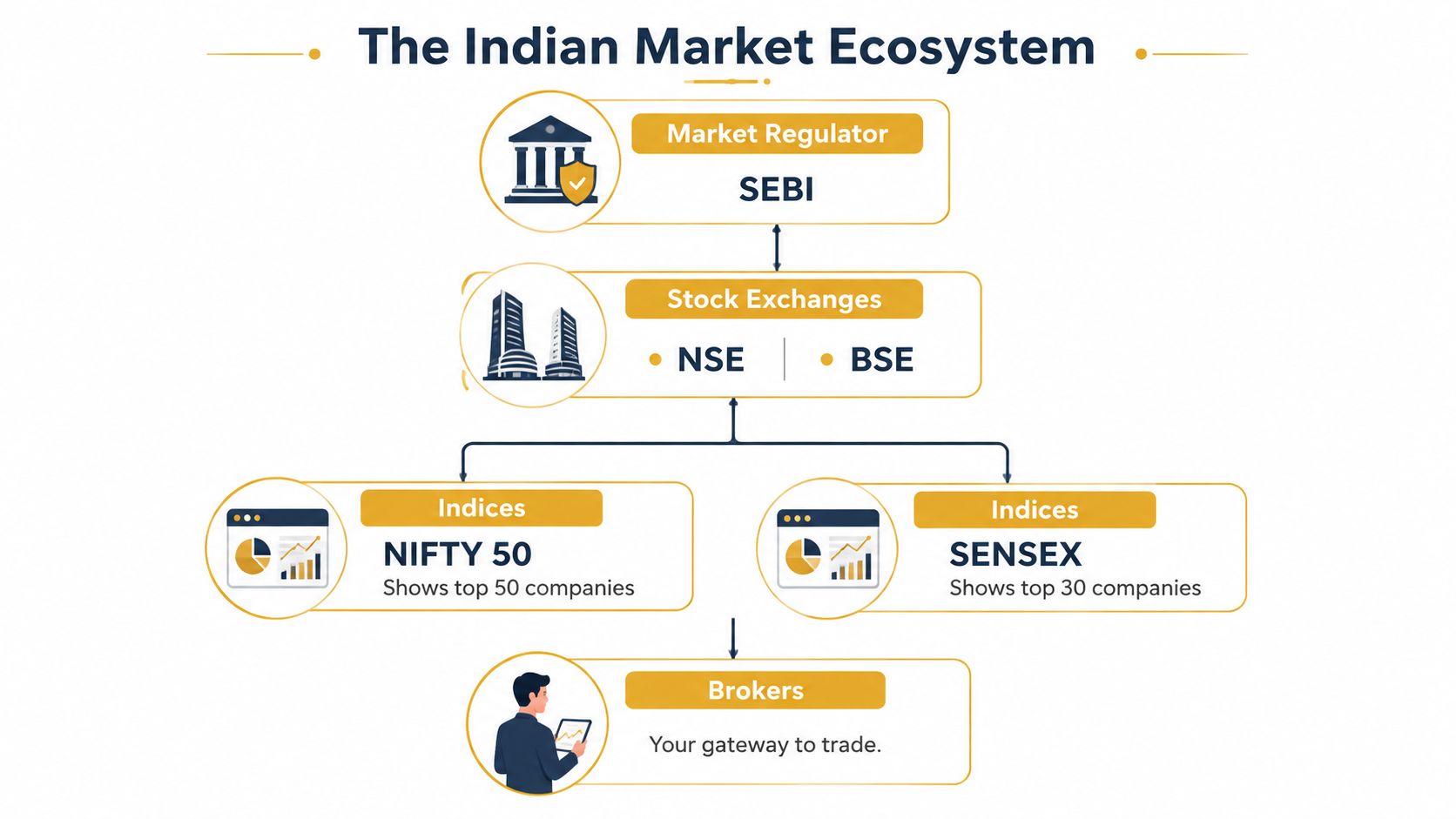
A stock exchange is the organised marketplace where buyers and sellers are matched. In India, the National Stock Exchange, or NSE, and the Bombay Stock Exchange, or BSE, provide major exchange infrastructure for listed securities. Your broker sends trading instructions to the exchange, while SEBI, the Securities and Exchange Board of India, regulates the securities market.
The exchange provides the marketplace, the broker provides access, and the demat system records your electronic holdings. Separating these roles helps explain what happens after you place an order and prevents the common mistake of treating an account-opening app as the market itself.
Indices turn many price movements into a useful signal
An index groups selected stocks into one measure. The NIFTY 50 and SENSEX are widely followed indicators of movement in parts of the Indian equity market. They represent a selected group, so an index change cannot describe every listed company or every investor's portfolio.
An index works like a class average. The average may rise even when some students score lower, and it may fall while some score higher. In the same way, a rising index does not guarantee that each constituent stock gained, while a falling index does not mean every company weakened.
Use NIFTY 50 live analysis for index-related market context. Readers seeking an introduction to index trading for beginners can also examine how indices function in trading.
Before reacting to a green or red number, ask three questions: what happened, which sectors or companies contributed, and whether the move changes the long-term business information you are studying. This habit creates decision hygiene. It keeps a market headline from turning a trading signal into an investment decision, or an account into action without understanding.
Demat Accounts, Trading Accounts and the First Steps to Participate
A demat account holds securities electronically; a trading account places buy and sell orders. They work together but serve different purposes. A bank account generally supplies or receives funds, so all three accounts have separate roles.
After you buy shares, your broker sends the order to the exchange, where it is matched. Following settlement, the securities are credited to your demat account. When you sell, the securities leave that account and the related funds follow the applicable settlement process.
Access has expanded rapidly. Demat accounts rose from 3.6 crore in 2019 to 19.4 crore in 2025, and nearly 21 crore by late 2025, while reporting also described a sharp cooling in new openings during 2025. Economic Times coverage of demat-account growth shows why opening an account is only the beginning. Participation also requires understanding what you are buying, how orders work, and how much risk you can carry.
Check the account before adding money
SEBI's Investor Survey 2025 states that investor households represent 9.5% of Indian households, about 3.21 crore households out of 33.72 crore nationwide. BSE's market-data page provides current market information. These figures do not confirm that a particular investment decision is sound.
Before opening an account, verify:
- Regulatory identity: Check the intermediary's registration and official details instead of relying on an advertisement.
- Charges: Read brokerage, account-maintenance, transaction, and other applicable costs in the schedule.
- Security controls: Understand login protection, authorisation steps, and the process for reporting unauthorised activity.
- Documents: Keep identity, address, bank, and tax details accurate, then read the account-opening terms.
- Product access: Confirm whether the account covers cash equities, IPO applications, derivatives, or other products. Learn the separate risks before using them.
Choosing a best trading platform India option requires checking the services, costs, controls, and products you can understand and use. A forwarded promotion cannot make that decision for you. Start with investing or trading deliberately, rather than treating account access as a reason to act.
Order Types for New Traders
Suppose you want to buy a share after seeing its displayed price. You enter the quantity, press submit, and later discover that the execution price or status differs from what you expected. The order type determines how the broker handles your instruction, so checking it matters as much as checking the stock name.
A market order asks the broker to execute promptly at the best available market price. If the displayed price is ₹100 but only a few sellers offer shares there, some or all of the order may execute at another price. Market orders prioritise speed over price certainty.
A limit order sets the highest price you will pay when buying, or the lowest price you will accept when selling. A buy limit order at ₹98 cannot execute above ₹98. It may remain unfilled if sellers do not offer shares at ₹98 or below.
A stop-loss order sends an order after a specified trigger condition is reached. It can support a risk-control process, while rapid price movements or limited liquidity can still prevent execution at the trigger price.
Common Order Types Compared
| Order Type | What It Means | Best Used When |
|---|---|---|
| Market order | Prioritises execution at available market prices | You understand that the final price can differ from the displayed price |
| Limit order | Sets a price condition for execution | You are willing to wait for your chosen price |
| Stop-loss order | Activates an order after a trigger condition | You have defined a risk process and understand execution limits |
An order type helps carry out a decision, but it does not decide whether the trade suits your plan. Before submitting, confirm the transaction side, quantity, order type, price condition, validity, and product category. Check whether the order concerns cash equity or derivatives, because the same screen can create different obligations across products.
Use a quick verbal check before clicking. Say, “I am buying this quantity, with this price condition, in this product.” If that sentence is unclear, pause and review the order. Opening a trading account gives you access to the market, not an automatic reason to trade. Good decision hygiene begins with understanding what the instruction will do.
Risk, Return and Realistic Expectations for Beginners
Risk means the outcome can differ from what you expect, including the possibility of losing capital. Return is the gain or loss that follows from an investment or trade. The two ideas are connected, but higher risk doesn't automatically produce a higher return.
A volatile share can move sharply in both directions. That movement may look exciting during a rising market, but volatility itself isn't evidence of skill, quality, or future performance. A beginner can also mistake a favourable market phase for personal ability, especially when several decisions appear to work without a tested process.
Compare the decision, not just the possible gain
Consider two approaches. A diversified portfolio spreads exposure across different companies or areas, so one disappointing business doesn't determine the entire outcome. A concentrated position may produce a larger gain if the selected company performs well, but the investor also carries greater company-specific risk.
Patience matters because a short-term price change doesn't explain the full business picture. Risk management starts with knowing how much loss you can financially and emotionally absorb, avoiding borrowed money you don't understand, and refusing to make decisions from anonymous tips or social-media urgency.
SEBI's framework says a person cannot act as a research analyst or present itself as one without a Certificate of Registration from SEBI. The framework was formally notified in 2014 and later amended. SEBI's Research Analysts regulations provide the relevant regulatory reference.

Let process replace prediction
Write down why you are considering a decision, what information could prove your view wrong, and whether the decision is investing or trading. Review the reasoning later, not just the profit or loss. This builds decision hygiene and reduces hindsight bias.
Important: This is for informational and educational purposes only and not investment advice. Consult a SEBI-registered adviser before investing.
Next Steps to Learn and Track the Indian Markets Confidently
Learning becomes useful when it leads to a repeatable routine. Follow index movement for context, read company announcements from traceable sources, and separate a market update from a personal instruction. A simple daily check can include the company's latest filing, the reason for the price movement, the order status, and any risk that could change the original plan.
Settlement also belongs in a beginner's checklist. India's cash equity market generally uses a T+1 rolling settlement cycle, meaning funds and securities are transferred on the next trading day after execution. NSE explains the settlement process, including how weekends and holidays are excluded when calculating the settlement day. NSE's equity settlement-cycle explanation
SEBI also introduced an optional T+0 beta framework on 28 Mar 2024 for selected securities alongside T+1. It offers a same-day settlement route, while eligibility, cut-off timing, execution discipline, and back-office readiness still apply. NSE's T+0 settlement information describes it as an optional beta, not a universal replacement.
Build a calm information routine
Use named, traceable research instead of anonymous calls. Check whether a person presenting research is registered with SEBI, note when the material was published, and read its reasoning and risks rather than copying a target. Bharatstox publishes attributed market journalism, corporate filing explanations, and research calls with visible analyst and timing information, helping readers distinguish reporting from research.
Create a weekly review table with four columns: the original reason for the decision, the expected business or price development, what happened, and what changed afterward. For example, if the decision depended on a company announcement, check whether the announcement produced the expected business effect instead of judging the decision only by the share price. This comparison shows whether the reasoning worked, even when the result was affected by broader market movement.
Remember the market-wide circuit breaker mechanism. It is triggered by movement in either the BSE Sensex or NSE Nifty 50, whichever is breached first, at 10%, 15%, and 20%. At the 10% level, the timing of the move determines whether the halt lasts one hour, 30 minutes, or does not apply. SEBI's trading framework sets out these rules.
For accessible daily context, share market Hindi news can support a routine of reading, checking sources, and reviewing outcomes. Keep account opening separate from market understanding. Before placing an order, confirm whether you are investing or trading, understand the order and settlement process, and identify the risk you are accepting.
Bharatstox brings together Indian market journalism, corporate filing explanations, live market context, and attributed research from SEBI-registered analysts. Visit Bharatstox for market updates with visible timestamps and beginner-friendly explanations before you act.
Disclaimer
This article is for informational and educational purposes only and does not constitute investment advice or a recommendation. Investing in securities markets is subject to market risks. Read all related documents carefully before investing.