7 Top Battery Companies in India: 2026 Guide
Explore 7 top battery companies in India across automotive, backup, industrial, EV and supply-chain segments, with business models and growth catalysts.
India's battery market is led by different names in different segments. Exide Industries and Amara Raja span automotive and industrial batteries, while HBL serves engineered applications; Luminous, Okaya and Livguard focus more heavily on backup and solar use cases, with Tata Green Batteries occupying an automotive and inverter niche.
The popular advice is to treat the biggest battery companies in India as one category, then judge them mainly by their exposure to electric vehicles. That misses how the industry creates value. Lead-acid batteries still support vehicle replacement, inverters, UPS systems and industrial backup, while lithium-ion cells and packs are expanding into electric mobility and storage. A battery pack combines cells with electronics and thermal or safety controls. A BESS, or battery energy storage system, stores electricity for later use and usually includes batteries, power-conversion equipment, controls and monitoring.
This comparison looks at business model, customer segment, operating scale, product breadth, lithium-ion progress and policy catalysts. It covers seven companies across automotive replacement, industrial reliability, home backup, solar, lithium-ion capability and engineered storage. The list is an educational comparison, not a ranking or investment recommendation.
Key takeaways
- Legacy demand still matters: Rechargeable secondary batteries represented 65.5% of India's battery market in 2025, according to Mordor Intelligence's India battery market estimate.
- The market is concentrated: The same estimate places Exide Industries, Amara Raja Energy & Mobility, Luminous Power Technologies, Ola Electric and Reliance New Energy at about 58% of 2025 revenue.
- Domestic capacity remains a constraint: Reported Wood Mackenzie data indicates Indian output met under 1% of roughly 260 GWh of 2026 demand from competitive tenders, as covered in this India battery market overview.
- Circularity is an execution test: Collection, recycling and compliant end-of-life handling may become as important as selling new batteries.
- Chemistry changes the use case: Lead-acid suits established replacement and backup cycles, while lithium-ion can offer a different combination of weight, energy density, control and charging characteristics. Readers comparing lithium chemistries can also review what is LFP in EVs.
Company claims should be checked against official disclosures, dated filings, warranty terms and current product information. This is for informational and educational purposes only and not investment advice. Consult a SEBI-registered adviser before investing.
Table of Contents
- 1. Exide Industries Ltd.
- 2. Amara Raja Energy & Mobility
- 3. HBL Engineering Ltd.
- 4. Tata Green Batteries
- 5. Luminous Power Technologies
- 6. Okaya Power
- 7. Livguard Energy Technologies
- Top 7 Battery Companies in India, Comparative Overview
- How to Read This Battery-Company List
1. Exide Industries Ltd.
Exide Industries is the broadest conventional battery business in this group. Its value comes from serving several installed bases at once, including passenger vehicles, two-wheelers, commercial vehicles, industrial systems, UPS equipment and home backup. That breadth matters because replacement demand arrives through many channels, not only through new vehicle production.
A market comparison places Exide at about 50% of India's domestic battery market, ahead of Amara Raja at roughly 35%, according to MarkNtel Advisors' India battery market report. The figures refer to the conventional domestic comparison cited by the source, so they shouldn't be read as a complete measure of every lithium-ion or storage business in the country.
Where Exide creates value
Exide's strongest operating advantage is reach. Vehicle owners and inverter users typically need correct fitment, quick replacement, warranty handling and service access. A large dealer and service network can reduce the practical friction between a battery failing and a customer getting a replacement.
Its portfolio includes automotive and two-wheeler batteries, commercial applications, industrial and UPS products, inverter batteries and home UPS systems. Manufacturing, recycling and in-house research support the company's established lead-acid business, while Exide Care emergency services add a service layer around the product.
The trade-off is that official online pricing isn't centralised. Final prices can differ by city, dealer, exchange arrangement and fitment. That's common in replacement-led categories, but it makes online comparison less straightforward than a simple catalogue price.
Lithium-ion execution
Exide Energy Solutions is building the company's lithium-ion cells and modules capability. This gives Exide exposure to a chemistry and supply chain that differ materially from its lead-acid base, but the scale-up remains an execution task rather than a completed replacement for the existing portfolio.
Practical reading: Exide is best understood as a distribution, replacement and industrial reliability business that is adding lithium-ion capability, not as a pure-play EV-cell manufacturer.
For readers following market commentary separately from product analysis, Bharatstox has published a report on swing-trade setups involving Exide Industries and Hindalco. That material should be assessed as attributed market journalism, not as part of this product comparison.
Official information is available through the Exide Industries website.
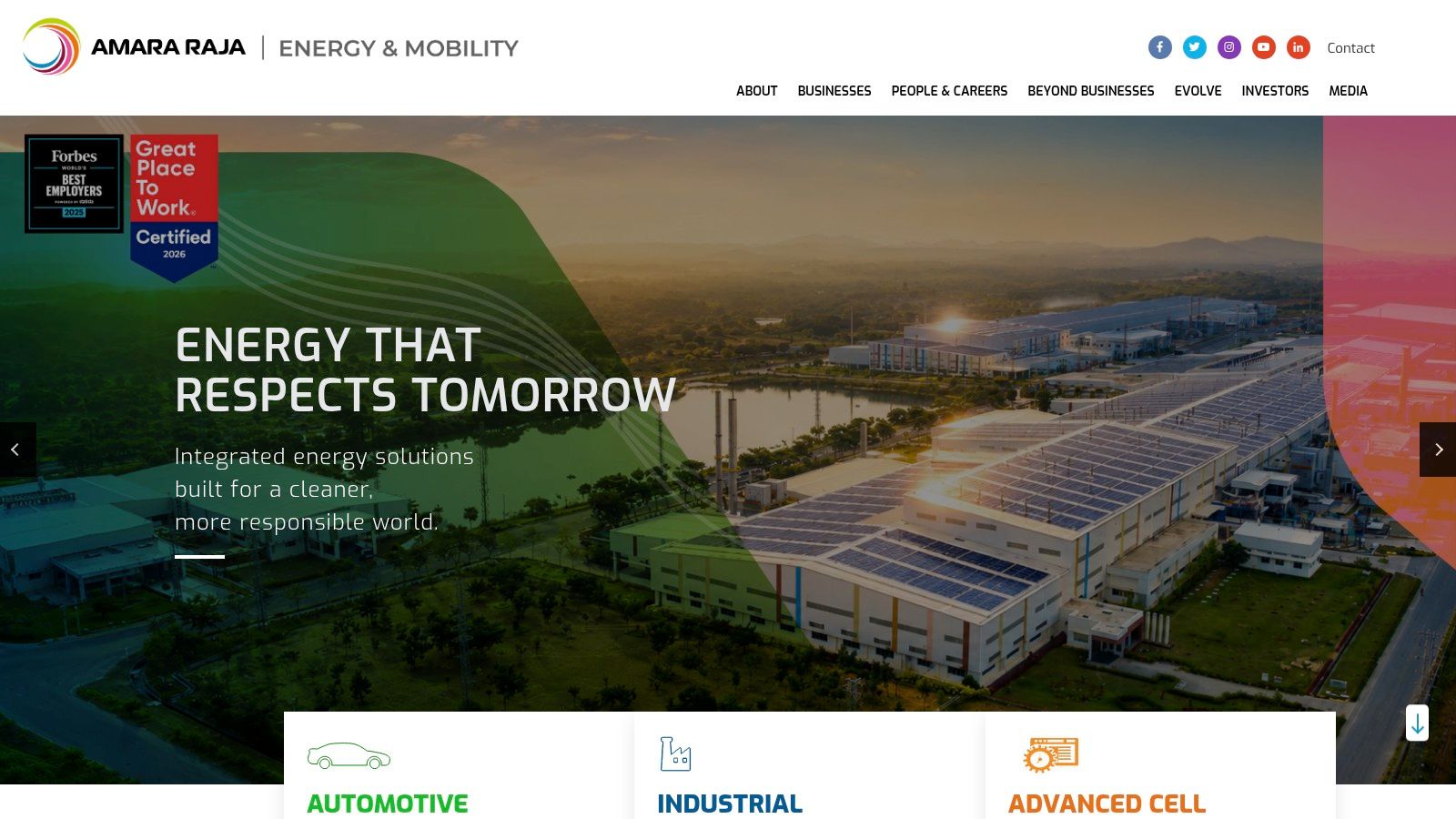
2. Amara Raja Energy & Mobility
Amara Raja Energy & Mobility shows how an established lead-acid company can extend from automotive replacement into industrial backup, advanced cells, charging and battery-management systems. Its consumer-facing Amaron brand is associated with automotive aftermarket demand, while Amaron Quanta addresses UPS and industrial applications where reliability, maintenance requirements and system compatibility matter.
The company's legacy position remains substantial. In Q3 FY25, lead-acid batteries contributed about 96% of Amara Raja's total revenue, according to the MarkNtel Advisors comparison. That figure reveals the central strategic tension clearly. New-energy projects can expand the addressable market, but the existing business still depends heavily on conventional batteries and their replacement cycle.
Automotive and industrial depth
Amaron's automotive range serves the aftermarket and benefits from the practical importance of cranking performance, warranty support and local availability. Amaron Quanta extends the company into UPS, data-centre and mission-critical backup applications through VRLA and AGM products.
Those categories demand more than a recognisable label. Buyers also assess installation, service response, battery-room requirements, replacement planning and system uptime. A supplier with automotive distribution and industrial application knowledge can serve both high-volume replacement and more specification-led accounts.
The company provides national distribution and application tools, including product-finder resources. Centralised e-commerce can help customers research products, although many buyers still prefer local dealers for fitment, exchange and installation.
Building the next platform
Amara Raja's Advanced Cell Technologies, or ARACT, covers lithium-ion cells, packs and chargers. The group is also developing capability around a larger cell-manufacturing platform and EV-related systems. Those initiatives could broaden the company's role from battery supplier to energy-technology provider, but availability and manufacturing scale are still developing.
A useful distinction is between selling a battery today and building a cell platform for future demand. The first depends on distribution and replacement economics. The second depends on chemistry, process control, capital deployment, customer qualification and ramp-up execution.
Lithium-ion products should therefore be evaluated separately from Amaron's mature lead-acid franchise. Readers who want market-context reporting can also review Bharatstox's equity research explainer, while company-specific claims should be checked against the Amara Raja Energy & Mobility website.
3. HBL Engineering Ltd.
HBL Engineering, formerly HBL Power Systems, occupies a different part of the battery ecosystem. It isn't primarily a consumer replacement brand. Its value lies in designing and supplying batteries, electronics and storage systems for applications where failure can affect safety, continuity or mission performance.
The company serves defence, railways, aviation, telecom, oil and gas, power infrastructure and other specialised markets. These customers generally buy against technical specifications, qualification requirements and project or tender processes. That creates a business model distinct from the dealer-led purchase of a car battery or home inverter battery.
Engineered reliability
HBL's portfolio spans several chemistries and formats. It offers nickel-cadmium batteries, including pocket, sintered and fibre-plate types, along with pure-lead batteries, VRLA, tubular-gel products and lithium batteries. This multi-chemistry approach lets the company match battery design to operating conditions rather than forcing every customer into one technology.
The product may also be part of a larger engineered system. HBL supplies chargers, electronics and containerised BESS solutions for grid and rail applications. In such projects, the customer evaluates integration, monitoring, safety, maintenance and performance under operating conditions, not only the battery's nameplate capacity.
Why this isn't a retail comparison
HBL's strength in customised engineering also explains its limitations for ordinary consumers. It has limited presence in automotive and home-inverter categories, and pricing is generally project or procurement based rather than displayed as a standard online retail price.
Public-sector and strategic customers can provide technically demanding opportunities, but procurement timing, qualification cycles and project concentration can influence the business differently from a broad aftermarket network. Readers should examine order disclosures, segment information and execution records rather than compare HBL solely with consumer brands.
Procurement lens: For engineered batteries, the important question is often not “Which brand is cheapest?” but “Can the supplier meet the specification, qualification, integration and service obligations over the system's operating life?”
HBL's official information is available at the HBL Engineering website. Separate market coverage is available in Bharatstox reporting on HBL Engineering and GMR Airports.
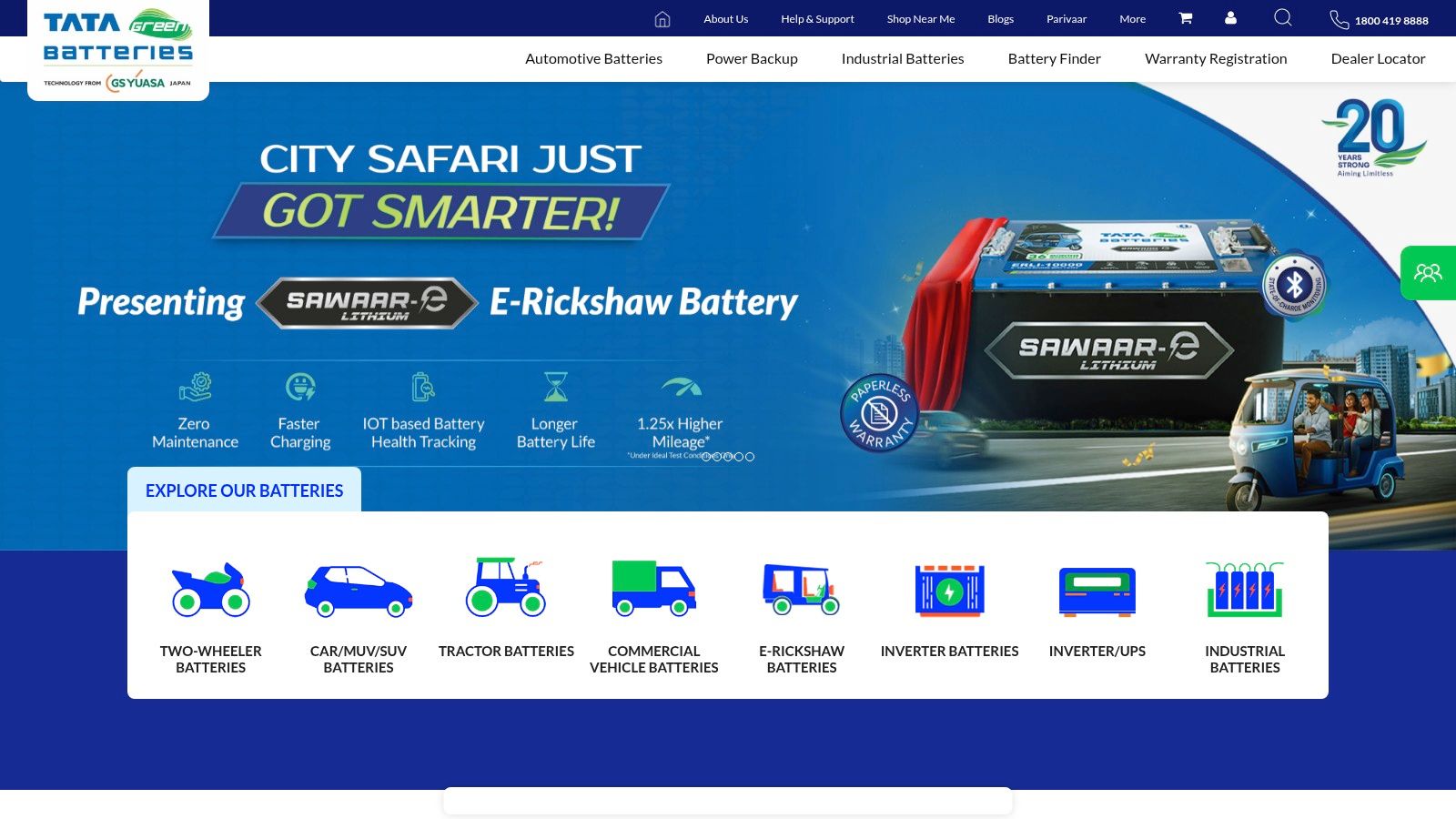
4. Tata Green Batteries
Tata Green Batteries, operated through Tata AutoComp GY Batteries, represents a technology and distribution partnership model. The business combines Tata AutoComp's automotive ecosystem with GS Yuasa technology lineage, supplying batteries for automotive and inverter applications.
Its positioning is strongest where product fitment, cranking performance and perceived manufacturing quality matter. The brand has a presence across two-wheeler and passenger-vehicle use cases, with OE linkages and a developing retail and dealer network. That gives it a bridge between original-equipment supply and aftermarket replacement.
Technology translated for Indian use
The product range draws on VRLA, ISS and calcium-calcium, or Ca-Ca, lead-acid technologies. VRLA means valve-regulated lead-acid, a sealed design commonly used where controlled maintenance and installation matter. ISS refers to idle-stop-start applications, where the battery must tolerate more frequent cycling than a basic conventional starting battery.
Technology transfer alone doesn't determine customer value. Battery performance also depends on vehicle compatibility, climate, driving patterns, installation quality, charging-system condition and warranty handling. Tata Green's product finders and support resources help address the fitment side of that equation.
The company also highlights products tuned for Indian operating conditions, recyclability and OE or aftermarket support. Buyers should still verify the current model, warranty terms, exchange process and service coverage in their location because dealer-led sales can produce different final prices.
A lead-acid specialist, not a lithium-first story
Tata Green's portfolio is centred on lead-acid products. Lithium-ion availability is more limited than its conventional range, so the company should be assessed mainly through automotive replacement, OE relationships, dealer access and technology-backed lead-acid performance.
That distinction matters when comparing the top battery companies in India. A company can be well positioned in vehicle batteries without having the same lithium-ion manufacturing profile as a cell-platform developer. Readers learning how to assess disclosures can use Bharatstox's guide to reading an Indian annual report.
The Tata Green Batteries website provides product and support information.
5. Luminous Power Technologies
Luminous Power Technologies is primarily a backup and energy-management brand for homes and small businesses. Its strongest association is with inverter batteries and power continuity rather than automotive starting batteries. That makes it important in a market where households and small enterprises buy batteries to keep essential loads operating during outages.
Its portfolio spans tubular, gel and lithium-ion inverter batteries, along with home backup systems and solar products. Tubular lead-acid batteries are widely used in inverter applications because the design supports repeated backup cycling and can be matched to different load and usage requirements. Gel batteries use a gelled electrolyte, while lithium-ion systems introduce a different operating profile, control architecture and installation discussion.
The customer decision is a system decision
A home-backup purchase isn't only about battery chemistry. The user must consider the inverter, connected load, backup duration, installation space, ventilation, maintenance and warranty support. Luminous's product tools, app and service channels help customers work through that system, while its partner and service network supports local installation and after-sales needs.
Most sales move through dealers, so street prices can vary by city, exchange offer and configuration. The same product name may also appear in different system bundles, making a like-for-like comparison important.
From household backup to larger storage
Luminous also operates in commercial and industrial BESS solutions. That expands the company's addressable use cases, but commercial storage has different buying criteria from a household inverter. Customers assess energy-management software, power-conversion equipment, safety controls, service-level commitments, integration and lifecycle economics.
Its broader ecosystem through Schneider Electric in India can support a wider power-management context, but product-level claims and current availability should be verified through official materials. Luminous has an extensive India footprint across plants, offices, channel partners and service coverage, which supports its retail-led model.
System rule: A battery's advertised capacity doesn't tell you the practical backup experience by itself. Load, inverter efficiency, battery condition, installation and usage pattern all affect the result.
Luminous's official product information is available on the Luminous Power Technologies website.
6. Okaya Power
Okaya Power is built around power backup and solar solutions rather than a broad automotive OE franchise. Its portfolio includes short and tall tubular inverter batteries, home and high-capacity UPS systems, e-rickshaw batteries, solar batteries, panels and power-conditioning units.
That combination gives the company a practical role in residential and small-business energy systems. A customer can evaluate the battery alongside the inverter, solar panel, PCU and installation requirements instead of buying a standalone battery without considering the rest of the setup.
Transparent retail is part of the proposition
Okaya operates an official online store with visible MRPs, delivery options and product catalogues. That's a meaningful contrast with dealer-heavy categories where the buyer often has to request a quotation and negotiate exchange terms before seeing the final price.
Online transparency doesn't remove the need to verify fitment. Battery capacity, inverter compatibility, load profile, warranty conditions and installation support still determine whether a listed product suits the intended use.
The company also publishes product information and certifications. Selected tall-tubular models carry long warranty options, including periods of up to 60 months, as stated in the product plan and official product context. Warranty length should not be treated as a guarantee of service experience. The terms, exclusions, registration process and service network matter just as much.
Where Okaya fits in the market
Okaya's retail portfolio remains primarily lead-acid. Lithium-ion products are more concentrated in its solar line, so the brand is better mapped to home backup, SME backup, solar integration and e-rickshaw applications than to domestic automotive leadership or large-scale cell manufacturing.
That positioning also creates a clear risk boundary. The company can benefit from a wider energy-solution basket, but solar and backup demand involve installation quality, channel execution and customer support, not just battery production.
Explore the current catalogue through the Okaya Power website.
7. Livguard Energy Technologies
Livguard Energy Technologies is a retail-focused energy brand with products across automotive batteries, inverter batteries, lithium-ion home backup and residential or commercial solar solutions. Its business model puts the customer interface closer to the purchase decision through online tools, dealer discovery and a direct-to-consumer store.
The inverter range includes INVERTUFF tall and short tubular batteries, with extended warranty options on selected products. Automotive battery finders cover two-wheelers, passenger vehicles, commercial vehicles and farm vehicles, allowing the customer to narrow the choice by vehicle type rather than relying only on a generic battery category.
Digital tools reduce purchase friction
Livguard's online load calculator helps a household estimate a suitable backup configuration. Its price checker, dealer locator and D2C store provide additional purchase information, while visible MRPs, EMI and payment options make the transaction easier to compare online.
That transparency is useful, but it doesn't replace local fulfilment. Battery availability can differ by city, and installation, exchange collection, delivery conditions and warranty registration may still depend on the dealer or service partner.
The company's lithium-ion home-backup lineup gives it exposure to a newer chemistry in a retail setting. Yet automotive OEM penetration is thinner than that of legacy leaders, and the heavy industrial portfolio is limited. Livguard therefore fits more naturally into the home backup, solar and retail energy lens than the mission-critical infrastructure lens.
The execution question
Livguard's opportunity is to connect product discovery, pricing, finance, installation and service in one customer journey. The risk is that a digital storefront can show availability more clearly than the physical network can consistently deliver it. A careful comparison should check local stock, service response, warranty conditions and the exact chemistry used in the selected model.
For company information, visit the Livguard Energy Technologies website. Bharatstox also publishes plain-language equity research explainers, which should be read alongside official filings and company disclosures.
Top 7 Battery Companies in India, Comparative Overview
| Company | Implementation complexity 🔄 | Resource requirements ⚡ | Expected outcomes ⭐📊 | Ideal use cases | Key advantages 💡 |
|---|---|---|---|---|---|
| Exide Industries Ltd. | Low, dealer/service network simplifies procurement | Large lead‑acid manufacturing & recycling footprint; Li‑ion scale‑up underway | High ⭐, reliable availability and broad SKU coverage; strong market reach 📊 | Automotive aftermarket, home inverters, commercial/UPS | Nationwide support, OEM ties, extensive service & recycling |
| Amara Raja Energy & Mobility | Moderate, mix of dealer fulfilment and e‑commerce (dealer preferred by many) | Strong automotive/industrial capacity; Li‑ion gigafactory/ARACT in development | High ⭐, proven cranking and UPS performance; transparent operations 📊 | Automotive cranking, UPS/data‑centre, industrial backup | Aftermarket recognition, Quanta mission‑critical range, Li‑ion R&D |
| HBL (HBL Engineering Ltd.) | High 🔄, project/tender procurement and custom engineering | Specialist multi‑chemistry production (Ni‑Cd, pure‑lead, lithium) and engineered BESS | Very high ⭐, tailored, high‑reliability outcomes for critical sectors 📊 | Rail, defence, aviation, telecom, utility‑scale BESS | Custom engineering, multi‑chemistry expertise, public‑sector credibility |
| Tata Green Batteries | Low, OE-backed dealer channels and fitment tools | Moderate manufacturing with GS Yuasa tech transfer; lead‑acid focused, limited Li‑ion | Good ⭐, durable cranking performance and OE fitment 📊 | Two‑wheelers, passenger vehicles, home inverters | Japanese technology lineage, OE presence, durability for Indian conditions |
| Luminous Power Technologies | Low, broad consumer channels, app/website support | Extensive inverter‑focused plants; tubular/gel and Li‑ion options | Good ⭐, strong home backup performance and serviceability 📊 | Home & small business backup, commercial BESS | Strong brand, wide service network, multiple chemistries and warranties |
| Okaya Power | Low, transparent e‑store and direct purchase flow | Moderate manufacturing; strong solar + backup product mix (mostly lead‑acid) | Good ⭐, value and warranty focus; clear pricing impact 📊 | Home/SME backup, solar systems, e‑rickshaw batteries | Transparent online pricing, nationwide delivery, long warranties on tall tubulars |
| Livguard Energy Technologies | Low, D2C store, online tools and dealer network | Moderate; growing Li‑ion lineup alongside inverter batteries | Good ⭐, retail‑friendly outcomes, clear pricing & financing 📊 | Home backup, two‑wheelers, residential solar | Visible MRPs, EMI/options, online tools and expanding Li‑ion range |
How to Read This Battery-Company List
The seven names aren't interchangeable. Exide Industries and Amara Raja Energy & Mobility are anchored in automotive and industrial batteries, where replacement cycles, OE relationships, dealer coverage and reliability support the business. Tata Green Batteries also sits close to automotive and inverter demand, with GS Yuasa technology lineage and a lead-acid-led portfolio.
HBL Engineering belongs to the industrial and mission-critical group. Its batteries and engineered systems serve defence, railways, aviation, telecom, oil and gas, power infrastructure and grid or rail storage applications. Buyers in these markets typically care about qualification, custom engineering, integration, safety and procurement execution more than retail visibility.
Luminous, Okaya and Livguard are more closely associated with home, SME and solar backup. Their differences appear in channel model and product presentation. Luminous brings broad backup recognition and service coverage. Okaya emphasises a visible online catalogue and store. Livguard combines retail products with calculators, pricing tools, dealer discovery and a D2C route.
The chemistry question
Lead-acid remains central to India's battery industry. Amara Raja's Q3 FY25 revenue mix illustrates how the established chemistry still anchors a major energy-storage company. Lead-acid products benefit from existing manufacturing, distribution, service and recycling arrangements, but they also carry weight, maintenance and lifecycle considerations that differ from lithium-ion systems.
Lithium-ion is not one uniform technology. Cells, modules, packs and complete BESS projects represent different layers of value. A cell maker controls a fundamental component. A pack integrator combines cells with battery-management systems, wiring, enclosures and safety controls. A BESS provider may also need power-conversion equipment, software, thermal management, installation and long-term maintenance.
Scale, policy and supply risk
India's battery market estimate puts the market at USD 9.29 billion in 2025 and projects it to reach USD 78.81 billion by 2035, according to Mordor Intelligence's forecast. Another part of the same source projects secondary batteries to grow at a 15.9% CAGR through 2031, showing why rechargeable applications are attracting capacity and technology investment.
Domestic manufacturing, however, remains small relative to projected demand. Reported Wood Mackenzie data says domestic output met under 1% of India's roughly 260 GWh 2026 demand pipeline from competitive tenders, according to Energy Economics Times coverage. That gap makes OEM contracts, import substitution, local assembly, cell access and currency exposure important execution factors.
Government policy is designed to improve the supply base. The ACC PLI scheme targets 50 GWh of domestic advanced-chemistry-cell manufacturing capacity and carries a budgetary outlay of ₹18,100 crore, according to the Press Information Bureau release. A later government release says facilities must be set up within two years, with incentives disbursed over five years on sales of batteries made in India, as explained by the Press Information Bureau. In 2025 customs changes, the government also exempted 35 additional capital goods for EV battery manufacturing from Basic Customs Duty, according to the Budget-related PIB release.
Recycling is part of the moat
A battery company's responsibilities don't end at sale. India has about 83 kTPA of recycling capacity, while roughly 95% of used batteries are still handled by the informal sector or sent to landfills, according to Next Move Strategy Consulting's India battery market report. The same source says EVs are expected to account for about 60% of battery demand in 2025 and nearly 75% by 2047, making collection, recycling, traceability and second-life systems increasingly relevant.
For readers comparing companies, the practical checklist is straightforward:
- Chemistry: Identify whether the business earns mainly from lead-acid, lithium-ion cells, packs, BESS or a mix.
- Customer concentration: Separate dealer-led replacement demand from OEM, industrial, defence and tender-based revenue.
- Sales model: Check whether price discovery happens through a dealer, official store, integrator or project quotation.
- Manufacturing: Look for evidence of operating capacity, local value addition, cell access and ramp-up progress.
- Circularity: Review collection, recycling partnerships, compliance systems and end-of-life traceability.
- Disclosure quality: Compare dated filings, annual reports, investor presentations, product pages and clearly attributed public reporting.
Frequently asked questions
Is lead-acid or lithium-ion better?
Neither chemistry is universally better. Lead-acid remains relevant for automotive replacement, inverter backup and industrial applications where established supply and service networks matter. Lithium-ion can suit applications that value different combinations of weight, energy density, cycling and digital control, but the decision depends on system design, cost, safety, installation and lifecycle requirements.
What's the difference between a cell maker and a pack integrator?
A cell maker produces the electrochemical unit. A pack integrator assembles cells into a usable system with a battery-management system, enclosure, protection and connections. A company can participate in more than one layer, but the capital, technology and execution risks aren't identical.
What does BESS mean?
BESS stands for battery energy storage system. It stores electricity and releases it when needed, usually as part of a larger setup that includes controls, power conversion, monitoring and safety equipment. Utility, commercial and residential systems can have very different specifications.
How can investors verify company disclosures?
Use official annual reports, exchange filings, dated investor presentations, product documentation and named, attributed public reporting. Bharatstox provides bylined market journalism and corporate-filings coverage, with timestamps and plain-language explainers that can add context, but its material shouldn't replace primary company disclosures or professional advice.
This is for informational and educational purposes only and not investment advice. Consult a SEBI-registered adviser before investing.
Bharatstox offers attributed market journalism, corporate-filings coverage, timestamps and plain-language explainers for readers tracking Indian companies and sectors such as batteries. Visit Bharatstox to follow company disclosures and understand market developments without treating journalism as a personalised investment recommendation.
Disclaimer
This article is for informational and educational purposes only and does not constitute investment advice or a recommendation. Investing in securities markets is subject to market risks. Read all related documents carefully before investing.