Solar Stock List: 8 Indian Companies to Track
Explore an 8-stock solar stock list covering developers, manufacturers, EPC, wind, storage and listed proxies, with risks and research checks.

India's solar capacity reached 150.26 GW as of 31 March 2026, up from 2.82 GW in 2014, but that growth doesn't make every solar-linked company the same kind of investment. This solar stock list covers eight names and one unlisted reference across developers, power utilities, modules, wind, services, finance-adjacent exposure and storage, with different business models and risks rather than recommendations.
The popular advice is to search for the “best solar stock” and compare recent price moves. That approach misses how companies earn revenue. A developer may depend on long-term power purchase agreements, or PPAs, while a module manufacturer responds to equipment demand, imported inputs and selling prices. An engineering, procurement and construction, or EPC, company depends on project execution and order-book conversion. A service provider may only earn a small, indirect share of revenue from renewable-energy customers.
The sector has already moved beyond a niche. MNRE's physical-progress data places India's cumulative solar capacity at 150.26 GW, divided into 110.43 GW of utility-scale solar, 25.73 GW of rooftop solar and 14.10 GW under KUSUM and off-grid projects. That mix matters because utility developers, rooftop installers, manufacturers, financiers and storage businesses face different demand and policy conditions.
This article uses public disclosures and supplied company descriptions, distinguishes listed companies from an unlisted industry reference, and explains what to check in capacity, PPAs, order books, policy incentives, financial statements and risk disclosures. Readers should verify the latest annual reports, exchange filings and dated results before drawing conclusions. For additional context on market-loss recovery, see this guide to recover Evergreen Solar ESLRQ losses.
Key takeaways
- Capacity: India's solar base is large, but capacity alone doesn't show profitability.
- PPAs: Contracted tariffs and off-taker quality can influence revenue visibility.
- Order books: Equipment and EPC businesses must convert announced work into completed projects and cash collection.
- Policy incentives: Domestic manufacturing and rooftop programmes can support demand, while trade changes can alter margins.
- Financials: Revenue, EBITDA, profit, cash flow, debt and receivables need to be read together.
- Risk checks: Import dependence, overcapacity, refinancing, technology changes and execution deserve equal attention.
This is for informational and educational purposes only and not investment advice. Consult a SEBI-registered adviser before investing.
Table of Contents
- 1. Adani Green Energy Limited ADANIGREEN
- 2. Tata Power Company Limited TATAPOWER
- 3. ReNew Power Private Limited RENEWPOWER
- 4. Suzlon Energy Limited SUZLON
- 5. Shriram Properties Limited and Shriram Mahindra Finance Limited
- 6. Waaree Energies Limited WAAREE
- 7. Hinduja Global Solutions Limited HGS
- 8. Luminous Power Technologies Private Limited
- 8-Company Solar Stock Comparison
- How to Research This Solar Stock List
1. Adani Green Energy Limited ADANIGREEN
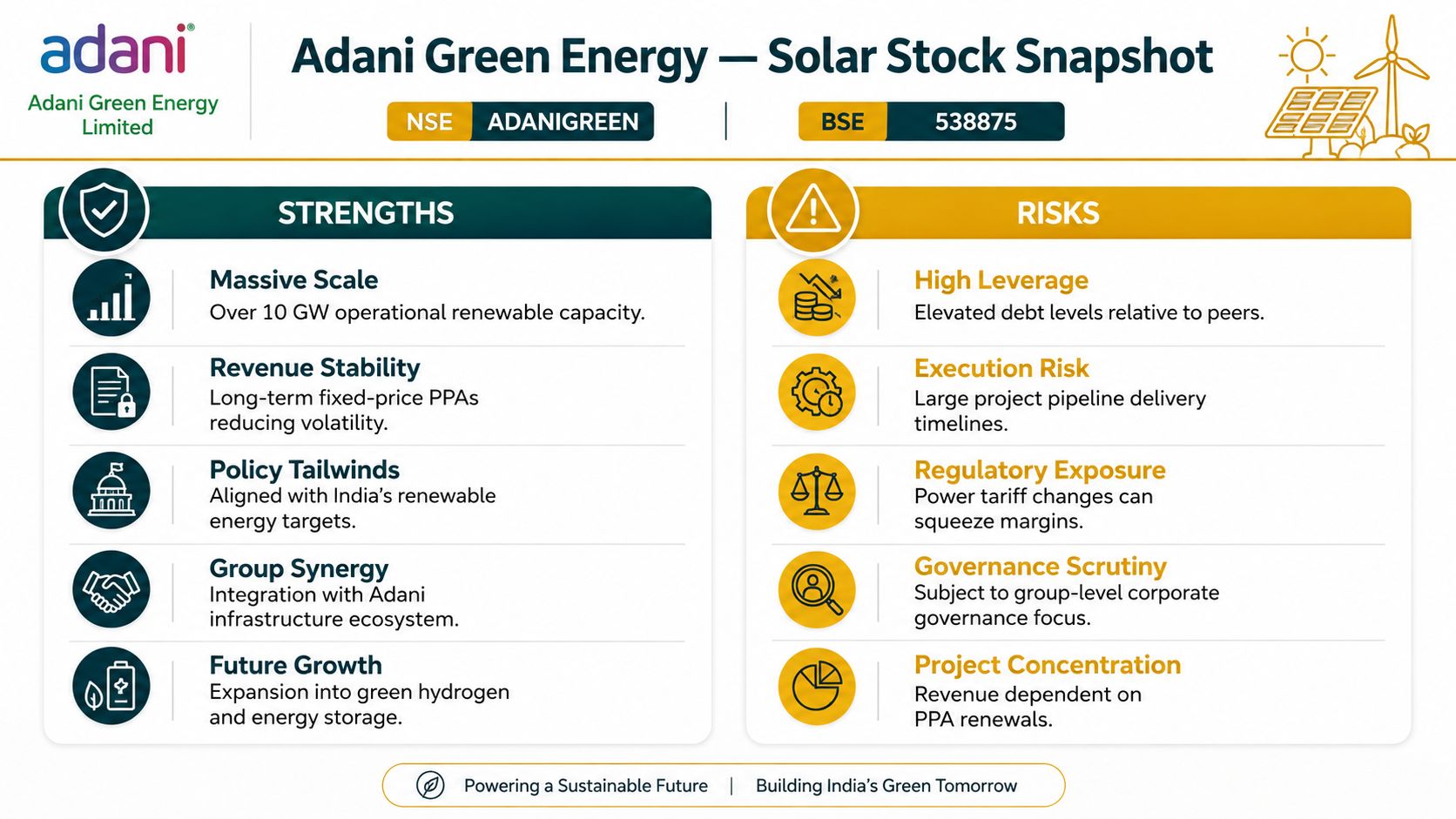
Adani Green Energy earns revenue from electricity sold under long-term power purchase agreements, rather than from selling panels or building projects for other owners. Its business sits in the utility-development segment of a solar stock list and includes solar, wind and hybrid renewable assets. The operating evidence to examine is commissioned capacity, electricity generation and the reliability of collections from off-takers.
Its portfolio includes utility-scale renewable parks in Tamil Nadu, Karnataka and Rajasthan, supplying state utilities and large corporate customers. Captive procurement partnerships may also bring demand from multinational companies seeking renewable electricity. The commercial value of each arrangement depends on its disclosed tariff, contract terms, commissioning status and buyer.
What drives revenue and what to monitor
Capacity under construction and generation from operating projects provide a clearer starting point than an announced pipeline. Plant availability, tariff realisation and receivables show whether assets are producing and billing as expected. PPAs can make revenue more predictable by setting a framework for electricity sales, but they leave construction, financing, curtailment and counterparty risks in place.
Readers assessing ADANIGREEN should separate operating assets from projects still being developed. Debt, interest costs and refinancing needs can affect cash flow, especially if commissioning takes longer than planned. The financial strength of buyers and the terms governing PPA renewals also warrant review.
Practical rule: A large renewable pipeline is not the same as operating cash flow. Check how much capacity is commissioned, how much is being built, and how quickly completed projects begin billing.
The company is listed on the NSE and BSE. Readers tracking announcements can consult Bharatstox's Indian stock-market news, then check the original exchange filing and dated financial result. This information is educational, not a recommendation to buy or sell.
2. Tata Power Company Limited TATAPOWER
Tata Power's distribution networks and generation assets give it exposure to several parts of India's electricity system. Revenue can come from thermal, hydro, solar and wind generation, electricity distribution, and renewable-energy projects developed through Tata Power Renewable Energy. This operating mix makes the company a broader power-infrastructure business than a pure-play solar developer.
The diversification can reduce dependence on one equipment cycle, while making consolidated results harder to interpret. Coal costs, transmission arrangements, distribution performance, regulatory decisions and PPA rates may affect profitability alongside renewable capacity. Solar-policy changes therefore do not influence Tata Power in the same way they would a standalone module manufacturer.
The operating lens for an integrated utility
Analysis should follow each segment's main operating driver. Generation requires attention to plant availability, output, fuel costs and tariff structures. Distribution depends on customer quality, network investment, collection efficiency and regulatory treatment. Renewable projects call for review of commissioned capacity, construction progress, PPAs and cash generation.
Tata Power's solar projects have supplied corporate customers in Maharashtra, Gujarat and Karnataka. Its distribution operations also cover urban electricity demand, including customers in Mumbai and other cities. These activities can spread exposure across generation, networks and contracted projects, but they also mean that reported growth in one division may conceal pressure elsewhere.
For readers reviewing project awards, regulatory decisions and financial information, the NSE and BSE corporate announcements explained by Bharatstox provide a way to locate disclosures. The original exchange filing remains the reference point. Investors should also compare segment results with cash generation and examine whether renewable expansion is supported by operating performance, rather than relying on consolidated growth alone.

A diversified power company may reduce single-segment exposure, but it also requires segment-by-segment reading. Consolidated growth alone can conceal pressure in one operating division.
3. ReNew Power Private Limited RENEWPOWER
ReNew Power's solar farms in Rajasthan and Gujarat feed electricity into state-grid PPAs, making commissioned capacity and tariff realisation primary operating metrics. The company also owns wind projects in Tamil Nadu and Karnataka, giving it exposure to utility-scale renewable generation across more than one technology.
Revenue mainly comes from producing electricity from operating assets and selling that output under PPAs to government entities and corporate off-takers. Contracted sales can make cash flows more predictable than merchant power, where prices change with market conditions. The arrangement still leaves the company exposed to construction delays, financing terms, interest costs, grid connectivity and receivables.
Why pure-play exposure has two sides
Solar and wind assets may complement each other operationally, but each project needs separate examination. Resource quality, transmission access, equipment performance, contracted tariffs and the financial standing of the off-taker can affect results.
A useful review starts with the operating portfolio. Readers should examine commissioned capacity, generation against expectations, project completion, PPA tenor and the identity of each off-taker. They should compare accounting profit with operating cash flow, since depreciation and financing costs can make reported earnings differ from cash available for expansion or debt service.
Project-level disclosures also help distinguish new construction from assets already producing revenue. A growing development pipeline may support future capacity, while execution delays can postpone cash generation and increase funding needs.
Refinancing deserves close attention for a capital-intensive developer. If project debt must be renewed, changes in financing cost or availability can alter returns even while the underlying PPA remains in place. Receivable delays can create similar pressure by separating reported sales from cash collection.
For retail readers, RENEWPOWER is a company-specific case for studying contracted renewable generation, not a proxy for every solar business. Its economics differ from those of an equipment manufacturer or EPC contractor, so the relevant evidence is asset performance, contract quality and cash generation. This discussion is educational, not a recommendation to buy or sell the company.
4. Suzlon Energy Limited SUZLON
Suzlon's revenue cycle begins with turbine orders and ends with commissioning. The gap between booked orders and installed capacity is where execution risk lives. The company brings wind manufacturing into a solar stock list, with revenue exposure spanning onshore wind turbines, project development, EPC contracting and renewable-generation assets.
That mix creates different tests for each business line. Equipment revenue depends on manufacturing, delivery, installation and customer acceptance. Project development depends more on commissioned capacity, generation and cash collection after construction. Operating assets may produce recurring power revenue, while manufacturing remains tied to new orders and execution margins.
The metric is order-book conversion
Readers tracking SUZLON should examine order-book composition, delivery schedules, manufacturing utilisation, working capital and after-sales service revenue. A large order book supports future revenue only when the company can deliver contracts at commercially viable margins and collect receivables without tying up excessive cash.
Its projects in high-wind-resource zones and supply relationships with Indian renewable developers place Suzlon within the wider clean-energy supply chain. International manufacturing and export activity may broaden its customer base. It also introduces currency, trade and overseas execution risks.
Wind equipment requires different engineering, site assessment, logistics and maintenance capabilities from solar equipment. Policy support for renewable capacity can benefit both sectors, but a slowdown in project awards may reach equipment suppliers before it affects operating generators.
Read the order book as a conversion pipeline, not as booked profit. Delivery, execution margin and customer payment determine whether announced demand becomes financial performance.
The main risks include cyclical demand, competition, project delays, input costs and technology changes. Investors should also consider whether manufacturing utilisation and order-book conversion are improving alongside reported revenue, rather than treating announced demand as completed business.
Suzlon offers a distinct wind-equipment exposure within a broader renewable-stock review. It should be assessed through orders, deliveries, commissioning, margins and cash collection, rather than analysed as a conventional solar module company. This discussion is educational, not a recommendation to buy or sell the company.
5. Shriram Properties Limited and Shriram Mahindra Finance Limited
Solar exposure can also appear through property development and finance, although that exposure is less direct than ownership of a solar plant or manufacture of a module. Shriram Properties develops residential and mixed-use projects, where embedded renewable solutions may form part of site infrastructure. Shriram Mahindra Finance, described in the supplied company profile as formerly Mahindra & Mahindra Financial Services, represents the financing-adjacent side of solar adoption.
For a property company, the key revenue drivers remain project launches, construction progress, sales, collections and completion. Solar integration may support a project's operating design, but it doesn't automatically turn the developer into a renewable-energy company. The financial analysis must still focus on land, approvals, inventory, customer collections, debt and cash flow.
Finance changes the risk equation
A lender financing solar installations for manufacturers, warehouses or small businesses earns through credit deployment and repayment rather than electricity generation. The relevant checks include borrower quality, asset security, loan growth, collection performance, provisions, capital adequacy and funding costs.
Examples such as solar loans to mid-sized manufacturers and warehouses, or Tier-II property developments with on-site renewable systems, illustrate potential channels for adoption. They don't establish the financial contribution of solar to either entity. Readers need segment disclosures and management commentary before assigning a separate renewable valuation.
These businesses may benefit when more customers seek solar installations or energy-efficient infrastructure. They can also face risks that pure-play developers don't, including real-estate cycles, borrower defaults, liquidity pressure and regulatory changes affecting lending.
Neither name should be treated as a direct substitute for a listed solar manufacturer or renewable generator. The correct question is how material the solar-linked activity is, how it is disclosed, and whether it changes group-level earnings or merely supports the core business.
6. Waaree Energies Limited WAAREE
Waaree Energies manufactures photovoltaic modules and cells, while also undertaking EPC contracts for utility-scale and distributed solar projects. Its revenue exposure therefore spans module shipments, manufacturing costs, project execution and, where applicable, solar assets. For investors, the operating metrics differ from those used for a power developer. Capacity utilisation, shipment volumes, order-book conversion, inventory and receivables deserve close attention.
India's domestic manufacturing policy supports this business model, but installed capacity alone does not establish profitable growth. Module prices can weaken when supply expands faster than orders, or when imported products compete aggressively. The company's reported capacity additions should therefore be assessed alongside utilisation, customer demand and cash generation.

Manufacturing needs a supply-chain review
India imported 352.57 lakh solar PV modules from China worth USD 1.70 billion in FY25, according to industry reporting on India's solar-module imports. This dependence leaves manufacturers exposed to imported inputs, cell availability, duties, freight costs and currency movements. Those factors can affect margins even when sales volumes rise.
An equipment maker's order book requires a different reading from a developer's PPA portfolio. Investors should check customer concentration, shipment schedules, warranty provisions, inventory days, receivables and the gap between announced and operational capacity. Bifacial modules supplied for high-irradiance zones in Rajasthan and Gujarat illustrate a product opportunity, although technology cycles can shorten the life of any current advantage.
The company's stated or reported relationships with projects associated with developers such as Adani Green Energy and ReNew Power should be verified through formal disclosures. A supply relationship may support future sales, but it does not by itself prove revenue, margins or repeat orders.
Storage is an adjacent demand area. Readers can compare the sector context through this guide to top battery companies in India.
Overcapacity remains a material risk. Reuters reported caution around new solar-module capacity as concerns about excess supply emerged. Policy changes can also affect exports and encourage manufacturers to redirect output to India. Utilisation, backward integration and cost control may consequently matter more than a “Make in India” label. This section is educational, not a recommendation.
7. Hinduja Global Solutions Limited HGS
HGS has handled customer-service, billing and operations support connected with distributed solar customers and utility activity. Its energy and utilities work may include contracts involving solar developers, utilities and renewable financiers, although the company's disclosures do not establish how much revenue comes from renewable-energy clients.
HGS earns from service delivery, including contact-centre work, billing platforms and back-office operations. The operating metrics to examine are client concentration, contract renewals, employee costs, technology spending, utilisation and margins in the relevant segments. Solar adoption can increase demand for customer onboarding, complaint handling and billing support, while HGS remains diversified across broader BPO and IT services.
Why indirect exposure behaves differently
A rooftop provider may outsource customer support across installation, billing and maintenance. A utility adding renewable generation may also contract out contact-centre or back-office work. HGS therefore depends on service volumes, pricing and contract retention, rather than on project output or equipment sales.
The company cites customer service for distributed rooftop-solar users and billing-platform operations in solar-heavy utility zones. Investors should seek energy-sector revenue disclosure, contract duration, renewal terms and profitability before treating those examples as material exposure. A named client relationship or industry vertical can indicate activity, but it does not establish revenue, margins or repeat orders.
Indirect participation can limit exposure to module prices, PPA tariffs and project financing. It can also reduce the benefit from renewable growth if energy-related work remains a small share of total revenue.
HGS is listed on the NSE and BSE. Its risks include competition across IT and BPO services, wage inflation, client churn and lower outsourcing budgets. The stock fits a broad solar list as a service-adjacency reference, rather than as a pure renewable-energy holding. This discussion is educational, not a recommendation.
8. Luminous Power Technologies Private Limited
Luminous Power Technologies is an unlisted industry reference for the inverter, charge-controller, battery and energy-storage side of distributed solar. It isn't a listed stock that retail investors can buy through the NSE or BSE, but its products help illustrate the equipment required when rooftop systems combine solar generation with battery backup or grid connectivity.
The company's business model is linked to sales of inverters, batteries and related systems for residential and commercial installations. Demand depends on rooftop adoption, replacement cycles, installer networks, product reliability, battery costs and technology upgrades. Those factors differ from the economics of a utility-scale solar farm, where the focus is on generation, tariffs and long-term PPAs.
How to follow an unlisted reference
Readers can use listed proxy businesses in adjacent segments, including Exicom Tele Systems and Genus Power Infrastructures, while recognising that proxy exposure isn't identical to ownership of Luminous. They can also track MNRE updates, industry disclosures and company filings from comparable listed manufacturers.
The rooftop segment has shown strong momentum. Down To Earth reported rooftop capacity of 23.5 to 25.7 GW by March 2026, depending on the source, with 2.7 GW added in Q1 2026 and residential systems contributing about 82% of new installations. The same report said the PM Surya Ghar rollout took fewer than eight days to add 100,000 beneficiary households. These figures describe market adoption, not Luminous-specific revenue.
An investor researching this category should review battery cost trends, inverter efficiency, warranty obligations, product upgrades and distribution strength. To understand how private-company information can be assessed, Bharatstox's guide explains how to read an annual report in India. Because Luminous is unlisted, readers must rely on industry tracking and available corporate information rather than an exchange ticker and regular public-market price discovery.
8-Company Solar Stock Comparison
| Company (Ticker) | Implementation complexity 🔄 | Resource requirements ⚡ | Expected outcomes 📊 | Ideal use cases 💡 | Key advantages ⭐ |
|---|---|---|---|---|---|
| Adani Green Energy (ADANIGREEN) | High, utility-scale project execution, permitting, grid integration | Very high capital & project financing; significant O&M and land needs | Predictable long-term PPA cash flows; growth via large pipeline | Large-cap renewable exposure; long-term PPA-driven income | Scale, diversified renewables, group integration |
| Tata Power (TATAPOWER) | Medium-high, multi-segment operations (thermal, hydro, renewables, distribution) | High capex for generation & distribution; fuel and grid costs | Stable distribution cash flows; transition upside but coal margin risk | Diversified energy exposure; income + transition plays | Diversification, established distribution footprint |
| ReNew Power (RENEWPOWER) | High, utility-scale project development focused on renewables | Capital-intensive; dependent on refinancing and green funding | Predictable PPA-backed revenue; growth tied to project build-out | Pure-play renewable exposure without thermal legacy | Pure-play focus, strong PPA book, access to green finance |
| Suzlon Energy (SUZLON) | Medium, manufacturing, EPC and project delivery complexity | Working-capital intensive; manufacturing and supply-chain capex | Cyclical revenues tied to turbine orders; margin gains with utilization | Exposure to wind manufacturing and EPC cycle | Domestic turbine manufacturing, export capability |
| Shriram Properties & Shriram Mahindra Finance (Solar-adjacent) | Medium, property development plus NBFC credit processes | Moderate capital via NBFC lending; credit risk management | Higher-margin finance income; property value-add; indirect solar exposure | Solar financing & embedded renewables in real estate | Loan origination scale, diversification into property and finance |
| Waaree Energies (WAAREE) | Medium, manufacturing lines plus EPC project delivery | High manufacturing capex; sensitive to commodity input costs | Revenue from module sales and EPC; sensitive to price cycles | Bet on domestic solar manufacturing and Make-in-India policies | Integrated manufacturing-to-EPC model, export capability |
| Hinduja Global Solutions (HGS) | Low-medium, service delivery, billing, O&M platforms | Low capital intensity; skilled labor, tech platforms | Recurring service revenue; scalable with solar sector growth | Low-capex indirect solar exposure via services | Recurring contracts, scalable offshore delivery model |
| Luminous Power Technologies (Unlisted) | Low-medium, component manufacturing and aftermarket service | Moderate capex for inverters & batteries; channel financing | Steady demand for inverters/storage; aftermarket and service revenue | Monitor via listed proxies for inverter/storage exposure | Critical component supplier, strong aftermarket potential |
How to Research This Solar Stock List
The eight names and one unlisted reference fall into three practical research buckets. Contracted renewable generators include Adani Green Energy, Tata Power's renewable operations and ReNew Power. Their key questions concern commissioned and under-construction capacity, generation, PPAs, tariffs, off-taker quality, receivables, debt and refinancing.
Equipment and EPC businesses include Suzlon Energy and Waaree Energies. Here, an order book matters only when the company converts it into deliveries, completed projects, revenue, margin and cash collection. Manufacturing investors should add input sourcing, imports, duties, inventory, warranty provisions, technology cycles and capacity utilisation to the review.
Indirect or unlisted exposure includes Shriram's property and finance-related platforms, HGS and Luminous Power Technologies. These businesses may benefit from solar adoption without earning most of their revenue from electricity generation or modules. Their core risks remain property execution, borrower credit, service-client retention, product distribution and technology adoption.
A disciplined review should cover:
- Capacity: Verify the latest operational and under-construction capacity, then distinguish owned assets from projects under development.
- Execution: Examine order-book conversion, project completion, commissioning schedules and receivables.
- PPAs: Read the tenor, tariff, escalation terms, off-taker and payment record instead of treating every contract as equally valuable.
- Balance sheet: Assess debt, refinancing needs, interest costs, liquidity and the cash required for expansion.
- Financial performance: Compare revenue, EBITDA, profit and operating cash flow across recent reported periods.
- Policy exposure: Check dependence on domestic-content rules, rooftop incentives, import duties, auctions and export markets.
- Technology and inputs: Review module and turbine cycles, battery upgrades, imported components, commodity costs and currency sensitivity.
- Governance: Read related-party disclosures, auditor comments, pledges, contingent liabilities and changes in accounting presentation.
Capacity alone is insufficient because a plant can be under construction, an order book can remain unfulfilled, and revenue can be delayed by grid connection or customer payment. The same installed-capacity figure also says little about tariff quality, debt service or cash conversion.
Frequently asked questions
What makes a solar stock different from a renewable developer
A solar stock can be a developer, utility, manufacturer, EPC contractor, financier, service provider or storage business. A renewable developer generally earns from owning or operating generation assets, while the other categories earn from equipment, construction, financing or support services.
Why include an unlisted company
An unlisted company can be important for understanding an industry segment even when it isn't directly investable through an exchange. Luminous provides context for inverters and storage, while listed proxy companies offer only partial and potentially different exposure.
How do PPAs affect revenue visibility
A PPA sets contractual terms for selling electricity to an off-taker, which can make revenue planning clearer than relying entirely on spot-market prices. Investors still need to examine tariff, tenor, curtailment terms, payment history, refinancing and project performance.
Why isn't capacity enough
Capacity measures the size of an asset base, not the quality of earnings. Profitability also depends on construction cost, generation, tariff, utilisation, input prices, debt, receivables and the company's ability to turn projects into cash flow.
SEBI's Research Analyst Regulations, 2014 define a research report as written or electronic communication containing analysis, recommendations or opinions about securities or public offers. The regulations also require registered research analysts to disclose material conflicts and prohibit misleading or false statements in research reports. That's why readers should distinguish attributed commentary from anonymous tips and check whether any specific call comes from a named, SEBI-registered analyst.
This is for informational and educational purposes only and not investment advice. Consult a SEBI-registered adviser before investing. Bharatstox helps readers follow bylined market journalism, NSE and BSE corporate filings, visible timestamps and plain-language explainers at Bharatstox. Its coverage is intended to explain public information, not present any company as a buy, sell or hold recommendation. Readers new to markets can also use this beginner stock investment guide for foundational concepts.
Bharatstox brings together attributed market journalism, NSE and BSE corporate announcements, visible timestamps and plain-language explainers for Indian retail investors. Follow solar-sector filings, company results and renewable-energy developments at Bharatstox, and use the reporting as a starting point for your own documented research.
Disclaimer
This article is for informational and educational purposes only and does not constitute investment advice or a recommendation. Investing in securities markets is subject to market risks. Read all related documents carefully before investing.